


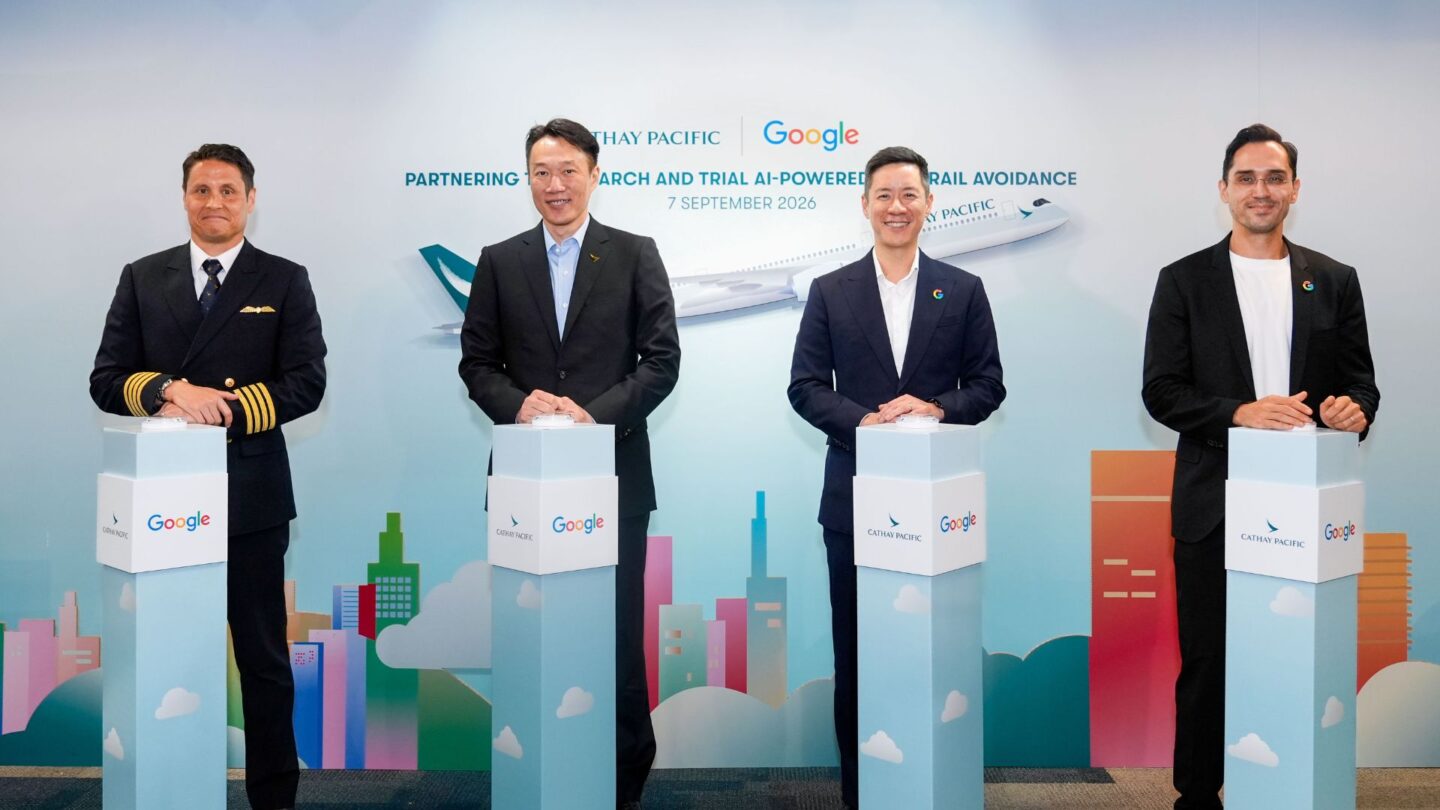
The aviation industry is exploring ways to reduce its climate impact beyond cutting fuel consumption and carbon dioxide emissions. Google and Cathay Pacific are testing an artificial intelligence-based approach to reduce the warming effect of aircraft contrails across the Asia-Pacific region.
The partnership is part of Google’s Operating Blue Skies initiative, which uses technology and data to address environmental challenges in aviation. Cathay Pacific is the first commercial airline in Asia to work with Google on its contrail-avoidance technology, with initial trials focused on ultra-long-haul flights.
AI identifies areas where contrails are likely to persist
Contrails are thin lines of ice crystals that can form behind aircraft when they fly through areas of cold, humid air. Many disappear shortly after an aircraft passes, but certain atmospheric conditions can cause them to spread and last longer. These persistent contrails can contribute to warming by trapping heat that would otherwise escape into space.
Although contrails are less visible than aircraft carbon emissions, their climate effect is considered an important part of aviation’s overall environmental impact. Google has previously tested its contrail prediction and avoidance technology in the United States and over the North Atlantic, where the company has examined how aircraft could alter their routes to avoid conditions that favour persistent contrails.
The system combines satellite imagery, weather information, and artificial intelligence models to identify areas where contrails are more likely to form and persist. The information can then be used to make relatively small changes to an aircraft’s flight path or altitude.
Cathay Pacific is testing the technology on long-distance routes across Asia-Pacific. When a flight is expected to pass through an area with a high likelihood of producing persistent contrails, the airline can adjust the aircraft’s altitude to avoid those conditions. The changes are designed to work alongside the types of routine flight adjustments already made by pilots and flight planners.
This approach does not require airlines to replace existing aircraft or introduce new propulsion systems. Instead, it focuses on using more detailed information about atmospheric conditions to decide where aircraft fly.
Early trials point to lower contrail warming
Google and Cathay Pacific say initial trial results show the technology could make a measurable difference. More than 80 flights have followed routes designed to reduce the likelihood of persistent contrails, with satellite observations used afterwards to assess the results.
Google’s analysis estimated that the flights achieved a 40% reduction in contrail-induced warming compared with what would have been expected without the avoidance measures. The results suggest that relatively small changes to flight operations could reduce part of aviation’s climate impact without requiring major changes to aircraft technology.
The Hong Kong-Singapore corridor produced particularly notable results during the trial. Atmospheric conditions along the route can favour persistent contrails, so avoiding certain areas had a significant effect. According to the results, changes made along the corridor contributed more than half of the total emission reductions recorded during the trial.
The findings do not mean that contrails have been eliminated or that every flight can avoid them. The approach’s effectiveness depends heavily on atmospheric conditions, available flight paths, and the ability to make practical changes to an aircraft’s altitude or route.
The results also represent an early stage of development. More flights and additional data will be needed to determine how consistently the system performs across different routes, seasons and weather conditions.
Google and Cathay expand the next phase of testing
Following the initial trials, Google and Cathay Pacific are moving towards a larger second phase of the project. Contrails.org, a non-profit organisation specialising in contrail research, is joining the effort to help expand the scientific understanding behind the technology and its potential climate benefits.
The wider trial could provide more information about how contrail avoidance works under different conditions in the Asia-Pacific region. The area is becoming increasingly important for international aviation as passenger and cargo traffic continues to grow, making technologies that can reduce the environmental impact of existing flights potentially valuable to airlines.
The partnership also highlights a different approach to aviation sustainability. Much of the industry’s attention has focused on technologies such as sustainable aviation fuel, more efficient engines, electric aircraft, and other ways to reduce carbon dioxide emissions. Contrail avoidance addresses a separate source of climate warming that flight planning and atmospheric data can help tackle.
Google’s technology could therefore complement longer-term efforts to make aircraft and fuels cleaner. Rather than waiting for new aircraft or propulsion technologies to become widely available, airlines could potentially use improved weather forecasting, satellite observations and AI models with aircraft already in service.
The technology still needs to prove it can be deployed reliably and at scale while fitting within existing aviation operations. Airlines must balance environmental considerations with factors such as safety, fuel consumption, air traffic restrictions and flight schedules.
For now, the trials with Cathay Pacific provide an early indication that AI-assisted flight planning could offer another way for airlines to address aviation’s climate impact. If larger trials confirm the initial results, contrail avoidance could become an additional tool for reducing warming from commercial flights across major international routes.