

Google’s latest foldable smartphone appears to be taking a more cautious approach than previous generations, with the Pixel 11 Pro Fold bringing several useful improvements but fewer major changes. While the company has upgraded the processor, displays, main camera and wireless charging, the device remains heavier and thicker than Samsung’s latest foldable phones.
The Pixel Fold range previously stood out for its distinctive design, larger displays and strong durability. However, the Pixel 11 Pro Fold arrives at a time when rivals are becoming slimmer and lighter, making Google’s decision to retain much of the existing hardware more noticeable.
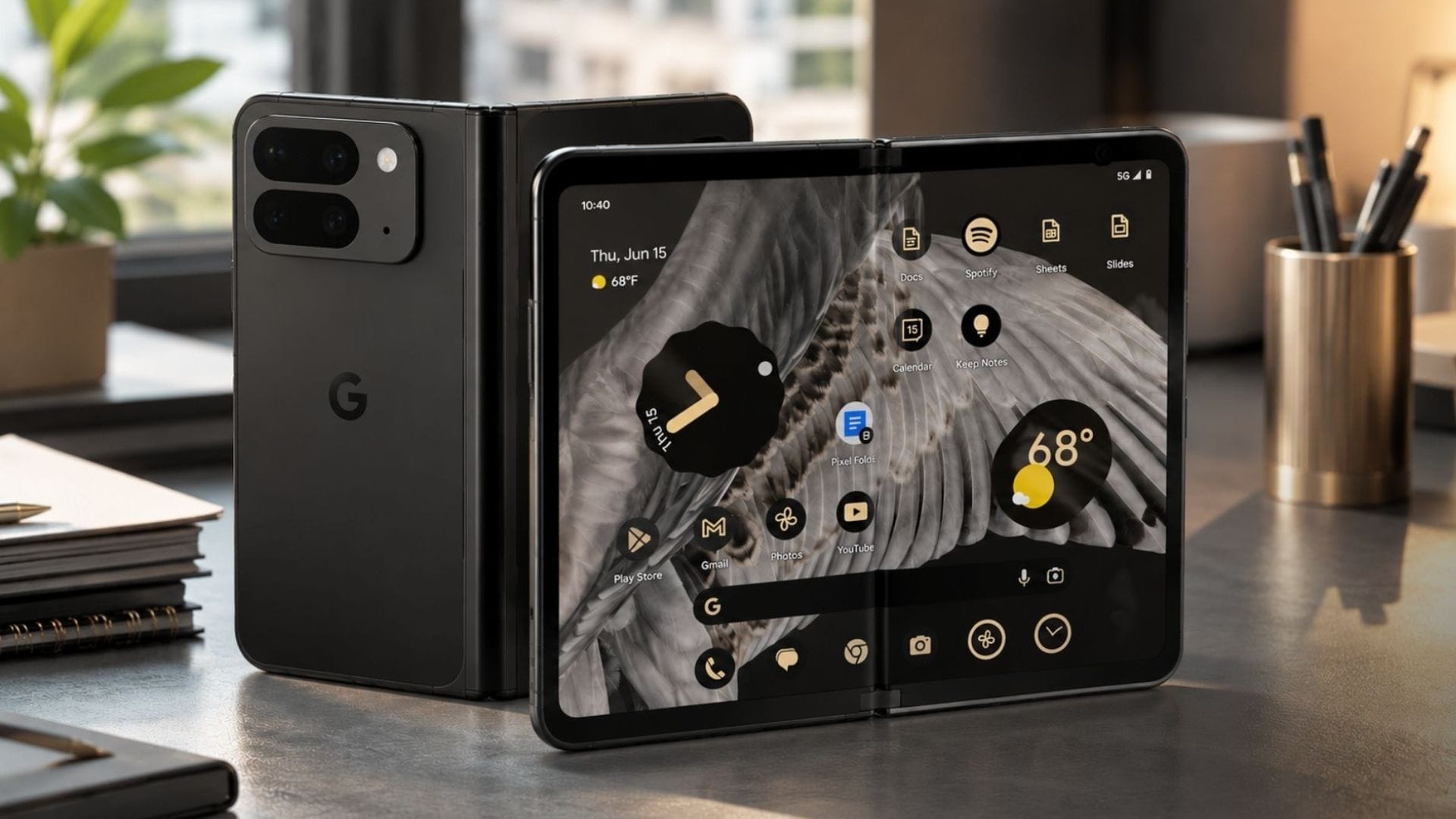
Familiar design with improved displays
The Pixel 11 Pro Fold features a 6.5-inch outer OLED display and an 8-inch flexible OLED screen on the inside. Both panels are broadly the same size as those found on the previous generation, although Google has increased peak brightness by 20 per cent to 3,600 nits. The company has also reduced the bezel size, giving the phone a more modern appearance.
Google has managed to reduce the handset’s weight by around 10 per cent, bringing it down from 258 grams on the Pixel 10 Pro Fold to 239 grams. However, that reduction still leaves the Pixel 11 Pro Fold considerably heavier than Samsung’s latest alternatives. The standard Galaxy Z Fold 8 weighs 201 grams, while the Galaxy Z Fold 8 Ultra weighs 215 grams.
Thickness remains another concern. At 10.1mm when folded, the Pixel 11 Pro Fold is noticeably thicker than Samsung’s competing models. That could make the difference more apparent when the phone is carried in a pocket or used for extended periods.
The Pixel 11 Pro Fold does retain IP68 dust and water resistance, giving it an advantage over Samsung’s Z Fold 8 range, which has an IP48 rating. Google has also introduced a new glass fibre material for the rear panel, which it says is highly resistant to cracking. The material is intended to build on the durability improvements introduced with the previous generation.
However, the focus on toughness has come at the expense of some of the design changes expected from a new flagship. The reduced weight is welcome, but the phone remains substantially heavier and thicker than its closest rivals.
New processor and camera improvements
Inside, the Pixel 11 Pro Fold uses Google’s new Tensor G6 processor, which is also found across the wider Pixel 11 family. Google says the new chip can provide up to 25 per cent faster web browsing, 20 per cent improved power efficiency and 15 per cent faster app loading compared with the previous generation.
The processor also works with a new image signal processor designed to improve camera performance. Google says the updated system can capture Night Sight images up to 4.5 times faster. Security is handled by the Titan M3 chip, which is designed to protect the handset against increasingly sophisticated cyber threats.
Battery capacity, however, has gone in the opposite direction. The Pixel 11 Pro Fold has a 4,806mAh battery, down from 5,015mAh in the previous model. Wired charging remains at 30W, but wireless charging receives a substantial upgrade. With Qi 2.2 support, the phone can charge wirelessly at up to 25W with a compatible charger, up from 15W previously.
The rear camera system also receives an important upgrade. Google has fitted the Pixel 11 Pro Fold with a new 48-megapixel main camera, alongside a 10.5-megapixel ultra-wide camera and a 10.8-megapixel telephoto camera with 5x optical zoom.
The main sensor should help maintain Google’s reputation for strong smartphone photography, but the camera system does not receive all the upgrades found on other Pixel 11 Pro models. The foldable is limited to 30x Super Res Zoom rather than the 120x capability offered elsewhere in the range, while its telephoto camera does not receive a new sensor.
Google has also introduced its HiLight indicator LED system to the Pixel 11 Pro Fold. The feature can provide visual alerts for incoming calls and when Gemini is activated. Support for text notifications is not available at launch, limiting its usefulness compared with what the system could eventually offer.
Software takes centre stage as hardware changes slow
With fewer foldable-specific hardware changes, Google is placing greater emphasis on the software features shared across the Pixel 11 family. Magic Capture uses artificial intelligence to identify strong photographs and video clips, allowing users to focus on a moment while the phone selects suitable content.
The Pixel 11 Pro Fold also benefits from new Camera Looks, which provide customisable options for adjusting the appearance and colours of photographs. Google has also introduced Creator Suite, offering tools for people who produce video content, including a built-in teleprompter, improved project organisation, and a storyboard editor.
Other new intelligence features include Rambler, enhanced assistance for retrieving flight information while messaging and tools designed to automate certain tasks. These features are not exclusive to the Pro Fold, however, as they are also available on other Pixel 11 models.
One of the more useful additions for the foldable itself is Google’s new floating-window system, known as bubbles. It allows many applications to open in free-floating windows, making better use of the large internal display. A small app switcher positioned in the bottom-right corner also makes it easier to move between open applications.
The feature is useful, but Google still does not offer the option to keep the taskbar permanently pinned to the bottom of the display. Samsung’s Galaxy Z Fold devices provide that functionality, making multitasking more straightforward for users who frequently switch between applications.
The Pixel 11 Pro Fold also includes new Made You Look animations for the external display. These animations are intended to attract children’s attention when photographs are being taken, although their appeal is likely to be limited outside family situations.
Overall, the Pixel 11 Pro Fold remains a capable flagship foldable, but its improvements feel less ambitious than those introduced by earlier Pixel Fold generations. The brighter displays, lighter construction, new processor, faster wireless charging and upgraded main camera are all welcome additions. Yet the continued weight and thickness, reduced battery capacity and lack of several Pro-level camera features make the phone harder to justify as a major generational upgrade.
The comparison with Samsung is particularly significant. Samsung has continued to refine its book-style foldables, while Google appears to have concentrated on improving an established design rather than introducing a major new direction. The Pixel 11 Pro Fold is therefore not necessarily a poor device, but its higher price and limited foldable-specific innovation could make it a difficult sell against increasingly capable rivals.