


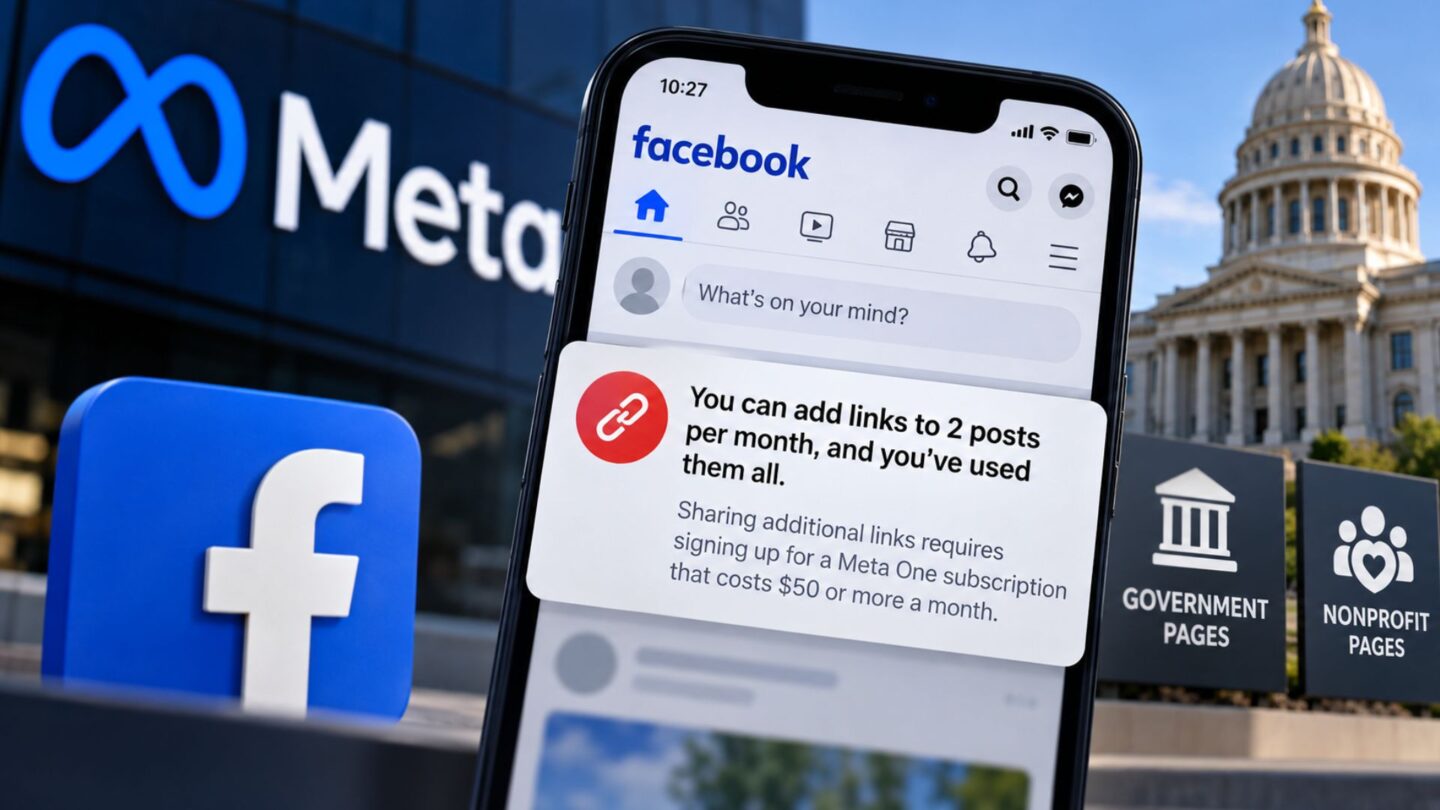
Meta is testing restrictions that limit how many links some Facebook pages can share without paying for a subscription, leaving government organisations and nonprofits concerned about their ability to communicate with the public. Although the company says the experiment is not intended to affect these groups, several organisations have reported being blocked from sharing links after reaching a monthly limit.
The restrictions are prompting affected organisations to reconsider how they use Facebook to distribute important information, promote community events, recruit volunteers and collect donations. Some have stopped including links in their posts, while others are exploring alternative ways to reach their audiences without paying for additional subscription features.
Government pages face unexpected restrictions
Daniel Starks, communications manager for the city of Greenville, Texas, oversees nearly a dozen local government Facebook pages. The city, with a population of about 35,000, recently discovered that its library’s Facebook page could no longer publish more than two links a month.
A notification told the page administrators they had exhausted their monthly allowance. To share additional links, they would need to subscribe to Meta One, a paid service costing at least US$50 a month for a plan offering additional link-sharing privileges.
The restriction immediately created a problem for the city’s communications team. According to Starks, more than half of the city’s communications direct residents to information published on its official website. These links help residents access public services, announcements and other essential information.
“More than half of what we do as a city is linking back to information on our website,” Starks told Engadget. “It’s scary because we don’t know how we’re going to pivot.”
Concerned that other municipal pages could face the same restrictions, Starks instructed his team to stop placing links directly in Facebook posts. Instead, the city began directing followers to the comments section, where staff would provide the relevant website addresses.
The situation was particularly frustrating because Meta had previously verified the library page as a government facility. The company has said the test shouldn’t affect government-operated pages, yet the city’s experience suggests the restrictions are reaching accounts outside the intended group.
“When you have an official governmental entity that is trying to get out in some instances very, very important information, and we’re being paywalled by Facebook all because we’re trying to post a link, that’s a problem,” Starks said.
For local authorities, the concern extends beyond social media engagement. Facebook remains an important channel for reaching residents, and link restrictions could make it harder to direct people to official announcements and practical resources. Moving information elsewhere may also require additional effort from communications teams and residents.
Nonprofits struggle with subscription costs
Nonprofit organisations are reporting similar difficulties, including groups that have already completed Meta’s verification process for charitable activities. These organisations say their pages are recognised as nonprofits and have been approved to use the platform’s fundraising tools, yet they still face link-sharing limits.
Bethany English, co-president of a small nonprofit that organises pet food pantries in Indianapolis, discovered the restriction while preparing a Facebook post about an event involving her organisation, the East Side Pawject. After reaching the monthly limit, she could no longer include a link to the group’s website in the post.
The organisation, which English co-founded last year, relies on Facebook to help people find pet food pantries, identify donation drop-off points, and learn how to support its activities. Its page has just under 1,000 followers, making the platform an important way to reach people in the local community.
Facebook posts also direct potential volunteers and donors to the organisation’s website, where they can find further information and participate in fundraising activities. Without the ability to share links freely, the group risks creating additional barriers for people who want to get involved.
Meta offered English a paid subscription as an alternative. An expert-level plan that allows up to 20 Facebook links per month costs US$150. For a small nonprofit operating with limited resources, that additional expense is difficult to justify.
“We’re a very small nonprofit, and we want to do big things, but that makes it very hard when something just like having social media is going to cost that much,” English told Engadget.
English has considered creating more Facebook events instead of relying on ordinary posts. She has also explored asking board members to share links through comments on their personal profiles, which are exempt from the restrictions. However, these workarounds may not provide the same reach or convenience as publishing links directly.
“I don’t know what the fix is,” she said. “I know that the long-term implications will be big if we’re not able to use it as we have before.”
Other nonprofit representatives have expressed comparable concerns. Jeff Bannister, marketing manager for SparkPoint, a North Carolina-based organisation that promotes public health and stronger social connections in Transylvania County, said the restriction had also affected his organisation.
“Fifty bucks for eight links a month is crazy,” Bannister told Engadget. “That’d be crazy for a corporation or a small business,” he said, adding that the return on investment appeared almost negative.
SparkPoint is exploring ways to exchange information with other local nonprofits to reduce its dependence on Facebook. However, Bannister said moving away from the platform would be difficult because a substantial part of the county’s audience still uses it.
David Diskin, president of California Freethought Day, encountered the restriction shortly before the organisation’s annual civic engagement event in Sacramento. He was offered subscription options priced at US$40 a month for eight links, US$119 for 20 links and US$399 for unlimited sharing.
The timing was particularly frustrating because the restriction appeared just days before the event. Although the limitation was unexpectedly reversed later that week, allowing the organisation to share links again, Diskin said the change came too late to help with the group’s major fundraiser.
“It wasn’t until after our big fundraiser had passed that they fixed the problem.”
Meta expands paid link-sharing through Meta One
Meta has been testing paid link-sharing on Facebook for nearly a year. The feature was initially tied to Meta Verified subscriptions and has since become a key benefit of Meta One, the company’s newer plans focused on AI features and additional professional capabilities.
The subscription structure offers different access levels. The entry-level plan costs US$14.99 a month but doesn’t include additional Facebook link-sharing privileges, though subscribers can add a dedicated link page to their Instagram bios. A US$49.99 monthly plan allows eight Facebook links, while the US$149.99 tier increases the allowance to 20 links. The most expensive option, priced at US$499.99 a month, includes unlimited Facebook links.
These restrictions have raised questions about why Facebook is moving a basic platform feature into paid subscriptions. Sharing website addresses has long been standard on Facebook, letting users and organisations direct audiences to external information without requiring specialised technology or artificial intelligence services.
The rules have also confused page administrators. Some users report they can still share links in comments beneath their posts, while others say the option is unavailable. Meta’s descriptions of its subscription plans and help centre information have also left some users unsure whether the restrictions are a temporary experiment or a permanent policy change.
In a statement to Engadget, a Meta spokesperson did not explain why nonprofit organisations were encountering the limits. Instead, the spokesperson described the company’s broader experiment with paid link-sharing.
“We’ve been testing whether sharing links on Facebook should be part of the Meta One subscription,” the spokesperson said. “We will continue to evolve the experience based on the feedback we receive and what we learn.”
The statement indicates that Meta is still assessing the feature. Still, it does not clarify how it identifies government and nonprofit pages or why some verified organisations have been affected despite the company’s stated intention to exclude them.
For smaller organisations, the financial implications are significant. Paying hundreds of dollars a month for unrestricted link-sharing may be unrealistic, especially when Facebook supports community services rather than generates commercial revenue. Organisations that cannot afford subscriptions may have to change their communications strategies, rely on alternative platforms or accept reduced access to their existing audiences.
The inconsistent application of the restrictions adds another challenge. Diskin’s experience shows that access can be restored without explanation, leaving organisations uncertain whether they can rely on Facebook during important campaigns and events.
As Meta continues to evaluate the experiment, government communications teams and nonprofit leaders are waiting for clearer guidance. Until the company explains how it will apply the restrictions and whether affected organisations will be exempt, many will have to find alternative ways to share information with the communities they serve.
Meta’s decisions could therefore have consequences beyond subscription revenue, particularly for organisations that depend on Facebook to connect residents with public services, charitable resources and opportunities to participate in local activities.