

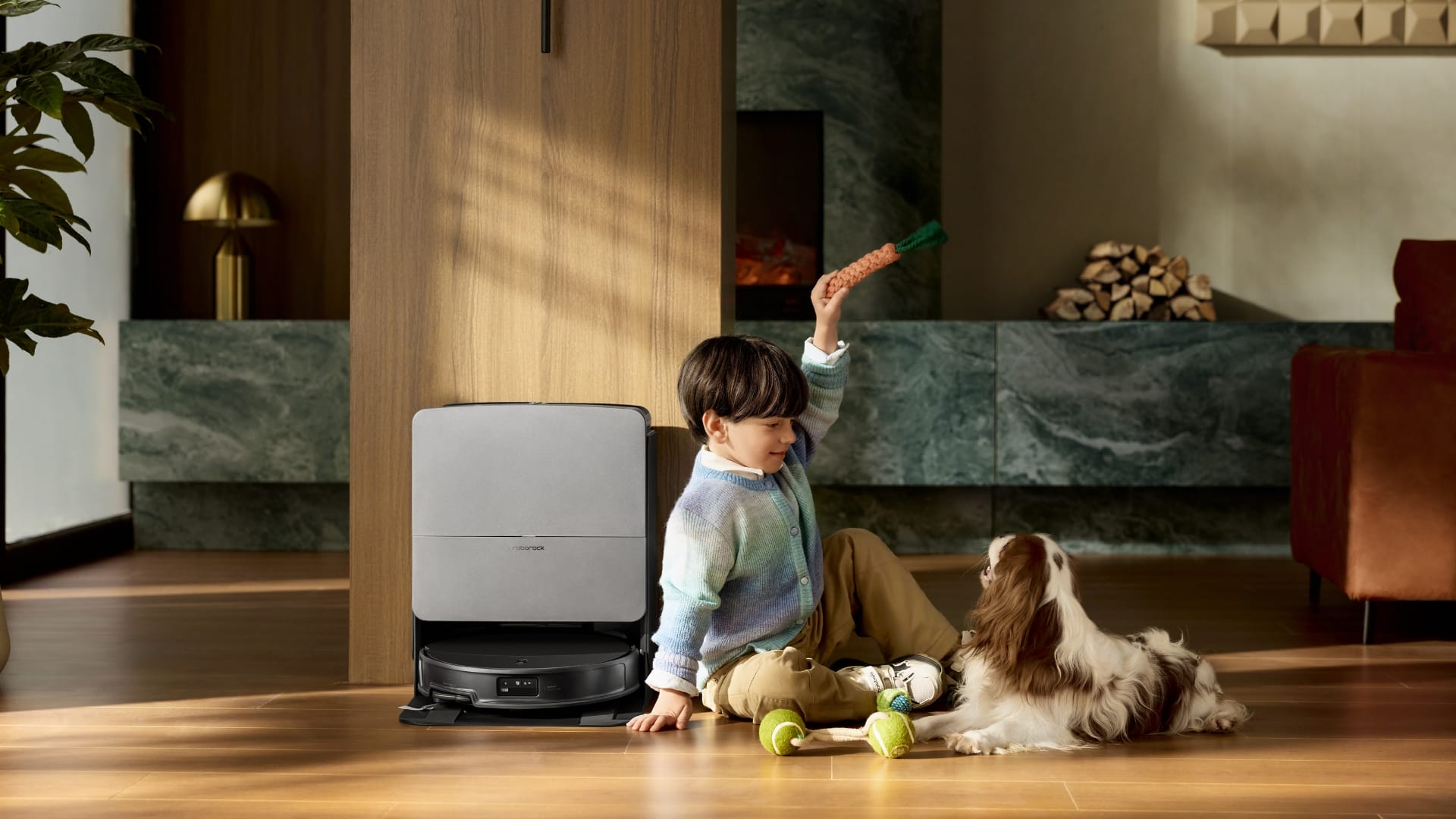
Roborock has unveiled the Saros 20 robot vacuum at CES 2026, introducing a new flagship model designed to handle complex home environments with minimal user intervention. Announced on 7 January 2026, the Saros 20 combines a redesigned adaptive chassis, upgraded vision-based navigation, and an enhanced self-cleaning dock to extend robotic cleaning into more autonomous, real-world use.
The Saros 20 is positioned as a response to common limitations faced by robotic vacuums in homes with uneven flooring, mixed surfaces, and tight spaces. By focusing on mobility, perception, and long-term self-maintenance, Roborock aims to reduce the need for manual assistance during everyday cleaning. The launch reflects the company’s continued emphasis on turning robotic cleaning from a scheduled task into a largely hands-free household function.
Adaptive chassis and navigation designed for real homes
At the centre of the Saros 20 is the AdaptiLift Chassis 3.0, which combines liftable main and auxiliary wheels with a climbing arm. Guided by vision sensors and adaptive algorithms, the system analyses floor transitions, tests different traversal methods, and memorises the most effective approach. This allows the robot to cross double-layer thresholds of up to 4.5 cm plus 4 cm, maintaining uninterrupted cleaning between rooms.
The chassis also introduces dynamic height adjustment for carpets. When enabled through the app, the robot raises its body to maintain optimal suction and brush contact on rugs with pile heights of up to 3 cm. If the robot becomes stuck, it can independently lift its front, rear, left, or right side to free itself, reducing the likelihood of user intervention.
Navigation is handled by the StarSight Autonomous System 2.0, an upgraded 3D vision platform capable of recognising more than 200 common household objects. Compared with traditional laser-based navigation, the system operates with a sampling frequency 21 times higher, allowing faster mapping, more accurate localisation, and improved obstacle avoidance. A slim body height of 7.98 cm enables the Saros 20 to clean under low furniture, while lateral obstacle avoidance helps it track closely along walls, furniture, and irregular edges.
Cleaning performance across carpets, edges, and hard floors
The Saros 20 uses a triple-lift architecture that coordinates the chassis, main brush, and dual spinning mops to adapt to different surfaces in real time. On carpets, the robot raises its chassis and lifts the mops to keep textiles dry while lowering and stabilising the main brush for deeper fibre engagement. For vacuum-only tasks, the mops can detach completely, maximising airflow and debris transfer.
On hard floors, the robot switches to mopping mode, lifting the main brush to prevent dust recontamination during wet cleaning passes. The dual spinning mops rotate at up to 200 RPM, with adaptive downforce ranging from 8N during standard cleaning to 13N when tougher stains are detected. To increase scrubbing pressure, the robot transfers weight onto the mops, improving contact with the floor and reducing the number of passes needed to remove dried spills and residues.
Edge and corner coverage is handled by the FlexiArm system, which extends into toe kicks as low as 2 cm and tracks closely along baseboards and furniture lines. Under test conditions, the system is engineered to achieve full edge coverage, reducing the visible cleaning gap often left by round robot designs. Suction is delivered by an upgraded digital motor providing up to 35,000 Pa, while a dual anti-tangle system is designed to manage long hair and pet fur. An upgraded omnidirectional wheel with an integrated cleaning brush helps prevent debris build-up during operation.
RockDock and app-driven automation complete the system
Supporting the robot is a redesigned RockDock that focuses on hygiene and extended autonomy. The dock performs bidirectional mop washing using water heated to up to 100°C, followed by warm-air drying at 55°C. Roborock states that testing has verified over 99.99 percent bacteria removal from the spinning mops after washing. The dock also includes hot-water self-cleaning to reduce residue build-up.
Automatic dust emptying allows for up to 65 days between dust bag changes, while additional features include automatic detergent dispensing, warm-water refilling, and fast charging in approximately 2.5 hours. A detachable base enables occasional manual cleaning. The Saros 20 is available with either a standard dock or an optional refill and drainage system, which automates clean water refilling and wastewater removal in supported regions, subject to installation requirements.
Control is managed through the Roborock app, which uses SmartPlan 3.0 to learn room types and user habits. The system can adjust suction levels, rewash mops after heavily soiled areas, and reduce power during scheduled quiet periods. Advanced options allow users to customise carpet behaviour, enable stain-targeted cleaning, and integrate the robot into broader smart home environments through Matter support and major voice assistants.
The Roborock Saros 20 is scheduled for international rollout in 2026, with pricing and regional availability to be announced. By combining adaptive hardware, vision-based intelligence, and a self-maintaining dock, the Saros 20 represents Roborock’s most comprehensive approach yet to fully autonomous floor cleaning.