

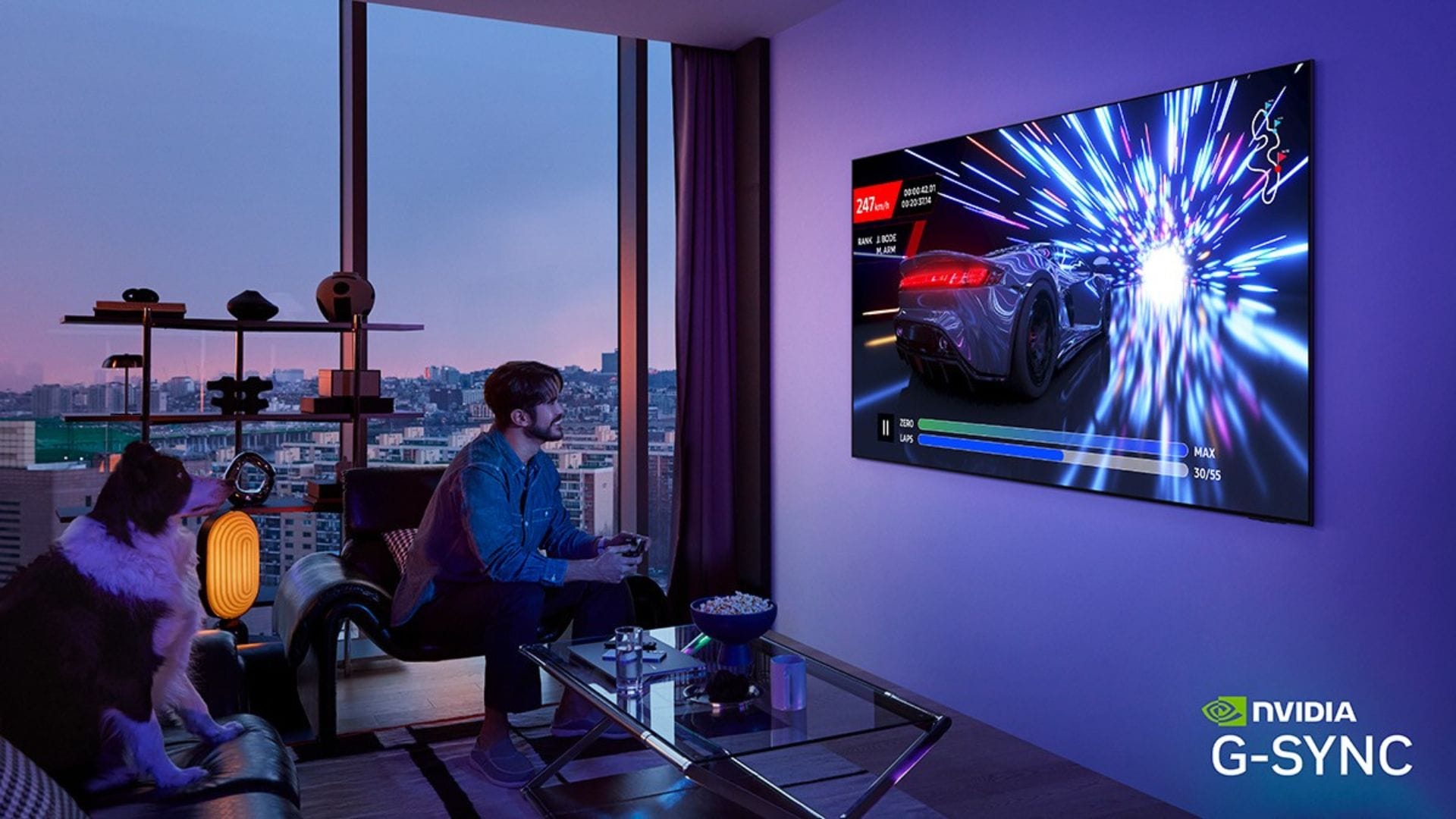
Samsung has announced that its 2026 OLED television lineup will support NVIDIA G-Sync, expanding the use of the gaming-focused technology across its premium home entertainment products. The move comes amid heightened activity in the global TV market, with major manufacturers making strategic shifts in response to shifting demand and rising production costs.
The company said the new compatibility applies to both its 2026 OLED TVs and selected Odyssey-series gaming monitors. While variable refresh rate features are increasingly common on modern displays, official G-Sync support remains relatively limited in the television segment, making Samsung’s announcement a notable development for gamers and high-end TV buyers alike.
Samsung confirms G-Sync support across 2026 OLED range
In an official statement, Samsung confirmed that its full 2026 4K OLED television range will be compatible with NVIDIA G-Sync. The models were first shown publicly at CES 2026 and form the core of Samsung’s OLED TV offering for the year. They include the OLED S95H, OLED S90H and OLED S85H, covering the company’s high-end, mid-range and entry-level 4K OLED models.
Samsung uses the “H” suffix to identify its 2026 televisions, marking a change from the “F” suffix used for its 2025 models. The company has not explained why it skipped the letter “G” in its naming scheme. Despite this, the range’s structure remains consistent, with the S95H as the flagship model and the S85H aimed at more price-conscious buyers seeking OLED picture quality.
Televisions with official G-Sync compatibility are still relatively rare. NVIDIA’s own list of compatible large-format displays is dominated by OLED panels from LG and Philips, with only occasional entries from other brands. Samsung’s inclusion across its entire 2026 OLED line, therefore, represents a broader commitment than seen in previous years and brings its TVs closer in feature parity with dedicated gaming monitors.
What G-Sync adds for TV viewers and gamers
NVIDIA G-Sync is a variable refresh rate technology that synchronises the output of an NVIDIA graphics card with a display’s refresh rate. By matching these rates in real time, the system can reduce screen tearing, stuttering and input lag, which are common issues when frame rates fluctuate during gaming or high-motion content playback.
Unlike open standards, G-Sync requires certification from NVIDIA and relies on a combination of hardware, software and licensing. This means manufacturers must meet specific performance criteria before their products can carry official support. As a result, G-Sync is typically found on higher-end monitors rather than on a limited number of televisions.
Many modern TVs already support adaptive sync technologies such as AMD FreeSync or VESA Adaptive Sync. These systems offer similar benefits and are widely adopted because they do not involve licensing fees. However, they are not always optimised for use with NVIDIA graphics cards. Samsung’s decision to add G-Sync support ensures smoother performance for users with NVIDIA-based gaming PCs, particularly when using large-screen OLED TVs as primary gaming displays.
Availability and broader industry context
Samsung’s announcement comes amid uncertainty in the television industry. Recent weeks have seen competitors adjust their strategies, including collaborations between major brands and pauses in the development of certain high-resolution panels. Against this backdrop, Samsung’s focus on gaming features may be an effort to enhance OLED TV appeal in a competitive, cost-sensitive market.
For consumers, wider G-Sync availability offers more choice when pairing high-performance PCs with large-format displays. OLED panels are already valued for their deep blacks, fast response times and strong contrast, and the addition of certified variable refresh rate support further enhances their suitability for gaming and fast-moving video content.
Samsung has not yet confirmed pricing or regional availability for its 2026 OLED TVs with G-Sync. More details are expected closer to launch. If widely rolled out, the feature could help Samsung differentiate its OLED range while signalling a broader shift towards gaming-led innovation in mainstream television design.