Advanced robot showcases surprising ability on the tennis court
UBTECH’s Walker S2 humanoid robot impresses with a new tennis demonstration, showing agility, balance and growing robotic intelligence.

UBTECH Robotics has shared new footage of its Walker S2 humanoid robot, demonstrating what appears to be an increasingly sophisticated ability to play tennis. In the video, the robot is seen moving confidently around the court, gripping a tennis racket and returning shots with a level of control that suggests rapid progress in humanoid movement and decision-making.
Playing tennis presents significant technical and mechanical challenges for any robot. It requires early ball detection, accurate judgement of speed and trajectory, quick positioning, and the ability to strike with timing and balance. Walker S2 appears to manage these factors effectively in the clip, maintaining a steady posture while reacting to its opponent’s shots. Although the video has been edited, the sequences shown highlight a convincing display of coordination and responsiveness.
UBTECH has not confirmed whether the robot is genuinely being developed as a potential tennis companion or whether the demonstration is simply a showcase of capability. However, the performance suggests that, with further improvement, these robots could one day more closely match human speed and handle faster, more competitive play. The company’s latest display hints at a future where humanoid robots might participate in more dynamic physical activities, even in sporting environments traditionally dominated by humans.
The Walker S2’s smooth swing motion is particularly notable. The robot appears to deliver controlled strokes rather than mechanical movements, suggesting growing refinement in motion control systems. While not yet equivalent to a professional athlete, the robot demonstrates an ability that would have seemed unrealistic only a few years ago.
Technology development and previous milestones
Walker S2 was officially introduced by UBTECH in 2024 as an advanced industrial humanoid robot designed for demanding environments. One of its key features is autonomous battery swapping, allowing prolonged operation without human intervention. This places it among a new generation of humanoids created not simply for research, but for ongoing, practical deployment.
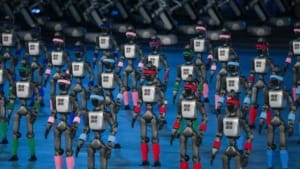
In November, the company drew significant attention when it released footage purportedly showing hundreds of Walker S2 robots being prepared for commercial and industrial roles. The video sparked debate over its authenticity, with some observers questioning whether it depicted real-world deployment or staged material. UBTECH responded by insisting that the footage was genuine, reinforcing its claim that humanoid robots are already entering active service environments.
The tennis demonstration now adds another layer to the discussion around Walker S2’s real-world potential. Rather than focusing only on industrial functions such as logistics, inspection, or assistance work, UBTECH appears eager to highlight agility, precision, and adaptability. These traits are essential not only for sport but also for any environment that requires complex, unpredictable movement.
Whether tennis is a serious long-term application or simply a dramatic test scenario, it clearly demonstrates progress in robotics engineering. Systems must handle perception, reasoning, movement planning, balance, and execution all within fractions of a second. The fact that a robot can maintain rally play against a human at normal video speed is a strong indicator of how far the technology has developed.
Global race toward more capable humanoid robots
The humanoid robotics industry is expected to make major strides this year, as manufacturers work to improve both physical agility and artificial intelligence. Companies such as Boston Dynamics, Figure AI, Unitree, and 1X are among the leading developers advancing the field, each seeking to prove that humanoid machines can eventually operate effectively in human-designed environments.
Competition in this field has been increasing worldwide, and China has positioned itself as a strong player in robotics development. UBTECH’s growing visibility places it firmly in that race, with Walker S2 now attracting attention not only for industrial capability but also for its surprising ability to handle recreational tasks such as tennis.
The possibility of humanoid robots engaging in sports has already sparked wider conversation. Some enthusiasts have even suggested that events like tennis could one day appear in dedicated robotic sporting competitions, similar to how robotics contests already exist in other technical fields. While that idea remains speculative, demonstrations like this make it seem less far-fetched than before.
For now, Walker S2 remains a symbol of rapid change in the robotics world. The robot’s latest appearance underlines how close technology is moving towards machines that can interact with the physical world in more natural, human-like ways. If development continues at this pace, future versions may be faster, stronger, and perform with even greater accuracy, whether in factories, commercial settings, or, perhaps one day, as unusual but capable tennis partners.