


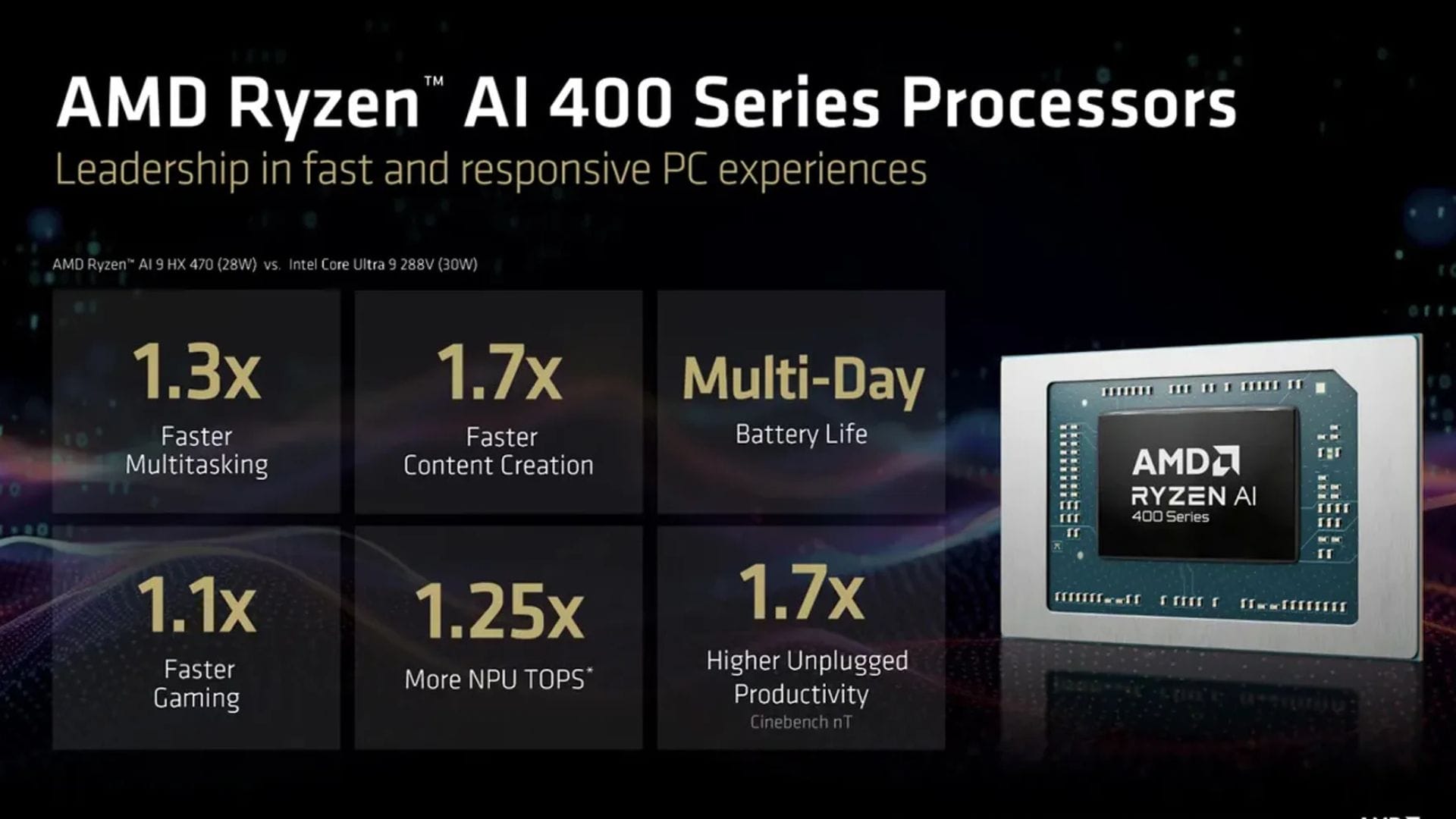
AMD is reportedly developing a refreshed version of its Ryzen AI Max 400 processor family, signalling another push to improve performance in laptops and compact PCs designed for artificial intelligence workloads. The update, said to carry the internal codename “Gorgon Halo”, has surfaced through recent leaks and points to a modest but targeted upgrade rather than a complete architectural overhaul.
The information, first shared by hardware-focused publication VideoCardz, suggests AMD is focusing on higher clock speeds and faster memory support to sharpen the appeal of its AI-focused processors. If accurate, the refresh would build on the existing Ryzen AI Max range, which already combines high core counts with powerful integrated graphics and dedicated AI acceleration.
This move comes as competition in the AI PC market intensifies. Chipmakers are racing to offer processors that can handle on-device AI tasks efficiently, reducing reliance on cloud services while improving speed, privacy and power efficiency for everyday users.
A refresh built on existing foundations
According to the leaked details, the “Gorgon Halo” processors are expected to be an updated version of AMD’s current Strix Halo-based Ryzen AI Max chips. Rather than introducing a new design, AMD appears to be refining what it already has by increasing clock speeds across the CPU and integrated GPU.
The leaks indicate that core and thread counts will remain unchanged compared with current models. This suggests AMD is confident in the balance it has already struck between performance and power efficiency, and sees higher frequencies as the most effective way to deliver noticeable gains without increasing complexity or cost.
Another reported change is support for faster LPDDR5X-8533 memory. This would represent an improvement over the memory speeds used by existing Ryzen AI Max processors and could play a key role in boosting overall responsiveness. Faster memory is particularly important for AI workloads, which often rely on rapid access to large amounts of data.
What the leaked specifications suggest
Leaked specifications shared by VideoCardz point to incremental but meaningful improvements across the lineup. At the top end, the Ryzen AI MAX+ 495 is said to feature 16 cores and 32 threads, with a base clock of around 3.1GHz and a maximum boost clock reaching up to 5.2GHz.
The integrated Radeon 8060S graphics processor is reportedly clocked at 3.0GHz. Compared with current Strix Halo-based chips, these figures suggest an increase of around 100MHz on both the CPU and GPU. While the jump may appear small on paper, such increases can translate into tangible gains in everyday performance and graphics-assisted AI tasks.
Other models in the rumoured lineup, including the Ryzen AI MAX+ 492, Ryzen AI MAX 490, Ryzen AI MAX+ 488 and Ryzen AI MAX 485, are expected to follow a similar pattern. Each would mirror its predecessor’s core configurations, while benefiting from slightly higher clock speeds and faster memory support. Together, these changes could result in smoother multitasking and quicker AI inference on compatible applications.
Architecture, timing and competition
From an architectural standpoint, the Gorgon Halo refresh is expected to retain AMD’s Zen 5 CPU cores alongside RDNA 3.5 integrated graphics. This continuity means developers and system builders would not need to adapt to a new platform, while still benefiting from performance improvements.
The leaks also suggest there may be a small speed increase for the built-in neural processing unit, although specific figures have not been confirmed. Even a modest increase could enhance on-device AI features such as image processing, voice recognition and real-time translation, all of which are becoming standard expectations on modern PCs.
If the reports are accurate, AMD could launch the refreshed Ryzen AI Max processors later in 2026. That timing would place them firmly against Intel’s Core Ultra Series 3 chips, which have already been announced as part of Intel’s own AI PC strategy. A refresh would allow AMD to stay competitive without waiting for an entirely new generation, reinforcing its position in a market that is rapidly shifting towards AI-centric computing.