

Dassault Systèmes and NVIDIA have announced a long-term strategic partnership to develop a shared industrial artificial intelligence architecture designed to support mission-critical applications across multiple industries. The collaboration brings together Dassault Systèmes’ Virtual Twin technologies with NVIDIA’s AI infrastructure, open models and accelerated computing software to establish science-validated Industry World Models.
The partnership aims to position industrial AI as a core system of record rather than a standalone or experimental tool. By grounding AI systems in physics-based simulation and validated industrial data, the two companies intend to support decision-making across complex domains such as biology, materials science, engineering and manufacturing. The initiative also introduces a new way of working through skilled virtual companions deployed on Dassault Systèmes’ agentic 3DEXPERIENCE platform.
According to the companies, the shared architecture is designed to scale across industries while maintaining trust, traceability and validation. This reflects rising demand for AI systems that can operate reliably in high-stakes industrial environments where accuracy, compliance and predictability are essential.
Science-validated world models and a new way of working
At the centre of the collaboration is the concept of Industry World Models, which combine virtual twins with artificial intelligence models informed by real-world physics and industrial knowledge. These models are intended to simulate, predict and optimise the behaviour of complex systems, from biological processes to large-scale manufacturing operations.
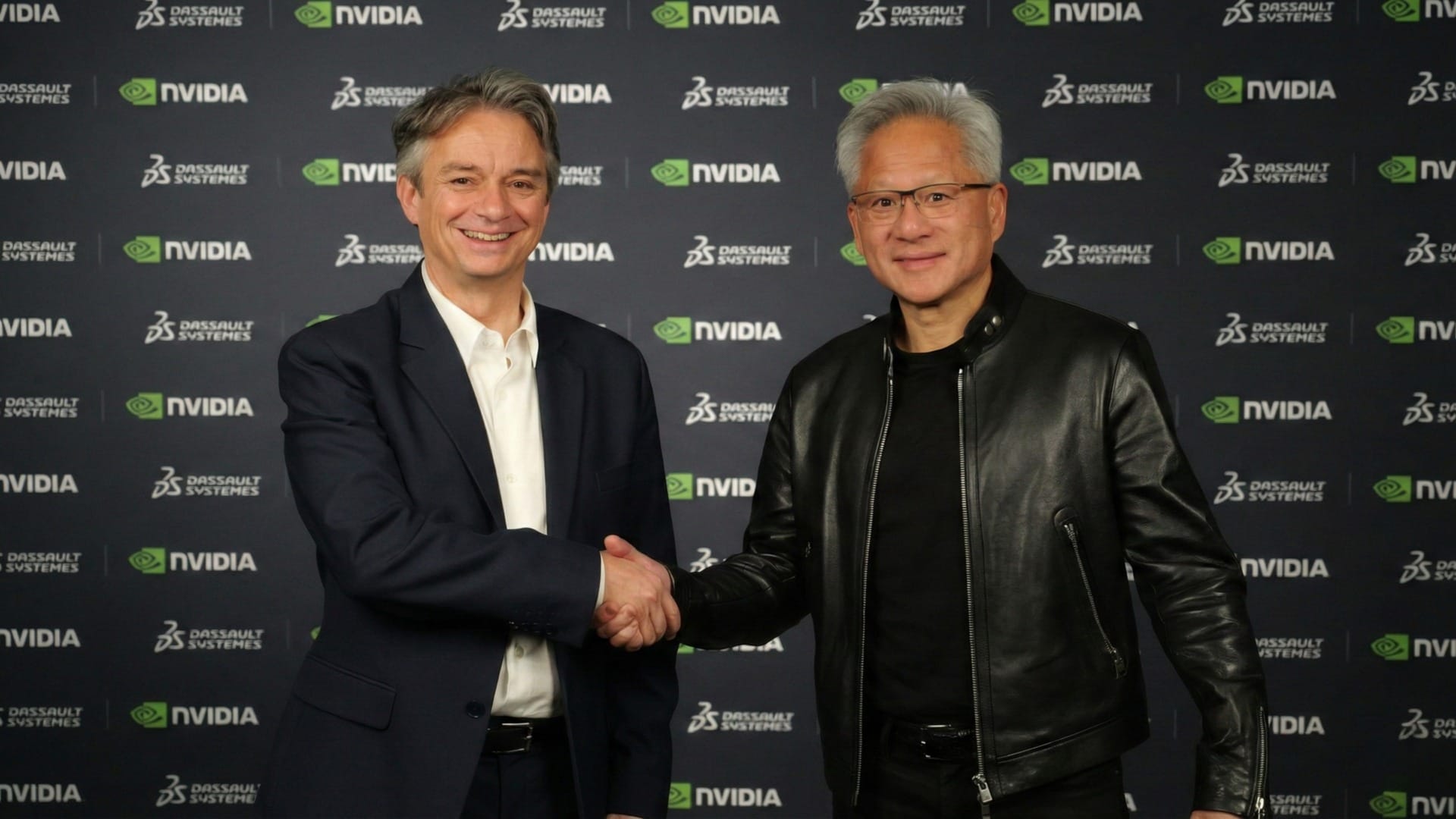
Pascal Daloz, chief executive officer of Dassault Systèmes, said artificial intelligence is moving beyond prediction and content generation towards a deeper understanding of the real world. “When AI is grounded in science, physics and validated industrial knowledge, it becomes a force multiplier for human ingenuity,” he said. He added that the partnership with NVIDIA is focused on building industry world models that help organisations design, simulate and operate complex systems with greater confidence, while supporting innovation across the generative economy.
Jensen Huang, founder and chief executive officer of NVIDIA, described physical AI as the next frontier of artificial intelligence, rooted in the laws of the physical world. He said the collaboration unites decades of industrial expertise with NVIDIA’s AI and Omniverse platforms to transform how researchers, designers and engineers build and operate large-scale industries.
A key outcome of the partnership is the development of skilled virtual companions. These AI-powered agents are designed to operate within the 3DEXPERIENCE platform, drawing on deep industrial context to provide trusted and actionable insights. The companies believe this approach will enhance productivity by augmenting human expertise, particularly in knowledge-intensive engineering and research workflows.
Industrial AI infrastructure deployed at global scale
The partnership also encompasses large-scale infrastructure deployment. Dassault Systèmes, through its OUTSCALE brand, is rolling out AI factories as part of its sustainable and sovereign cloud strategy. These AI factories will use the latest NVIDIA AI infrastructure across three continents, enabling customers to operate AI models within the 3DEXPERIENCE platform while ensuring data privacy, intellectual property protection and data sovereignty.
NVIDIA is adopting Dassault Systèmes’ model-based systems engineering approach to design its own AI factories, starting with the NVIDIA Rubin platform. This work will integrate into the NVIDIA Omniverse DSX Blueprint, which is designed to support large-scale AI factory deployment.
This shared infrastructure underpins a wide range of industrial use cases. In biology and materials science, the NVIDIA BioNeMo platform combined with Dassault Systèmes’ BIOVIA world models is intended to accelerate the discovery of new molecules and next-generation materials. In engineering and design, SIMULIA AI-based virtual twin physics behaviour, powered by NVIDIA CUDA-X libraries and AI physics tools, enables faster and more accurate outcome prediction.
In manufacturing, NVIDIA Omniverse physical AI libraries are being integrated into DELMIA virtual twins of global production systems. This integration is aimed at enabling more autonomous and software-defined factories, supporting the transition from design to deployment with greater efficiency and reliability.
Industry adoption across manufacturing, mobility and research
Several organisations have highlighted how the partnership could influence industrial workflows. Cécile Béliot, chief executive officer of Bel Group, said the collaboration provides the computational power required to model and optimise food products at scale, supporting both innovation and sustainability objectives.
Motohiro Yamanishi, president of industrial automation at OMRON, said growing manufacturing complexity requires a shift towards fully autonomous and digitally validated production systems. He noted that combining NVIDIA’s physical AI frameworks with Dassault Systèmes’ virtual twin factories and OMRON’s automation technologies could help manufacturers move more quickly and confidently from design to deployment.
In the automotive sector, Vivek Attaluri, vice president of vehicle engineering at Lucid, said Dassault Systèmes has been a long-standing partner in maintaining agility and speed of innovation. He highlighted the potential of multi-physics digital twin simulation models powered by NVIDIA’s physics-informed AI to shorten the path from concept to production without compromising predictive accuracy.
Research institutions are also exploring the platform’s capabilities. Shawn Ehrstein, director of emerging technologies and CAD/CAM at the National Institute for Aviation Research at Wichita State University, said virtual twin technology introduces significant efficiency gains across aircraft design, manufacturing and validation. He noted that virtual companions built on the 3DEXPERIENCE agentic platform using NVIDIA Nemotron open models can help reduce certification effort while preserving information sovereignty.