

HP has unveiled a broad portfolio of new products and platform updates at CES 2026, positioning personal fulfilment as a driver of business performance as organisations reassess how work is structured and supported. The company’s announcements span AI-powered PCs, printers, device management software and gaming systems, reflecting a strategy that links productivity, wellbeing and resilience as core elements of the modern workplace.
The company cited research indicating that only one in five knowledge workers currently report a healthy relationship with work, but that access to the right tools can more than double this likelihood. When employees see visible investment from their organisations, that effect increases further. Against a backdrop of economic uncertainty, workforce fatigue and rapid technological change, HP framed its CES presence around closing what it described as a fulfilment deficit, treating it as an opportunity for innovation rather than a constraint.
This framing underpins HP’s approach to the future of work, which combines local AI performance, mobility and systems-level resilience. Rather than focusing solely on raw computing power, the company emphasised adaptability across different work environments, from hybrid offices to distributed teams, alongside stronger support for IT departments tasked with maintaining continuity.
New AI PCs and form factors reshape mobile computing
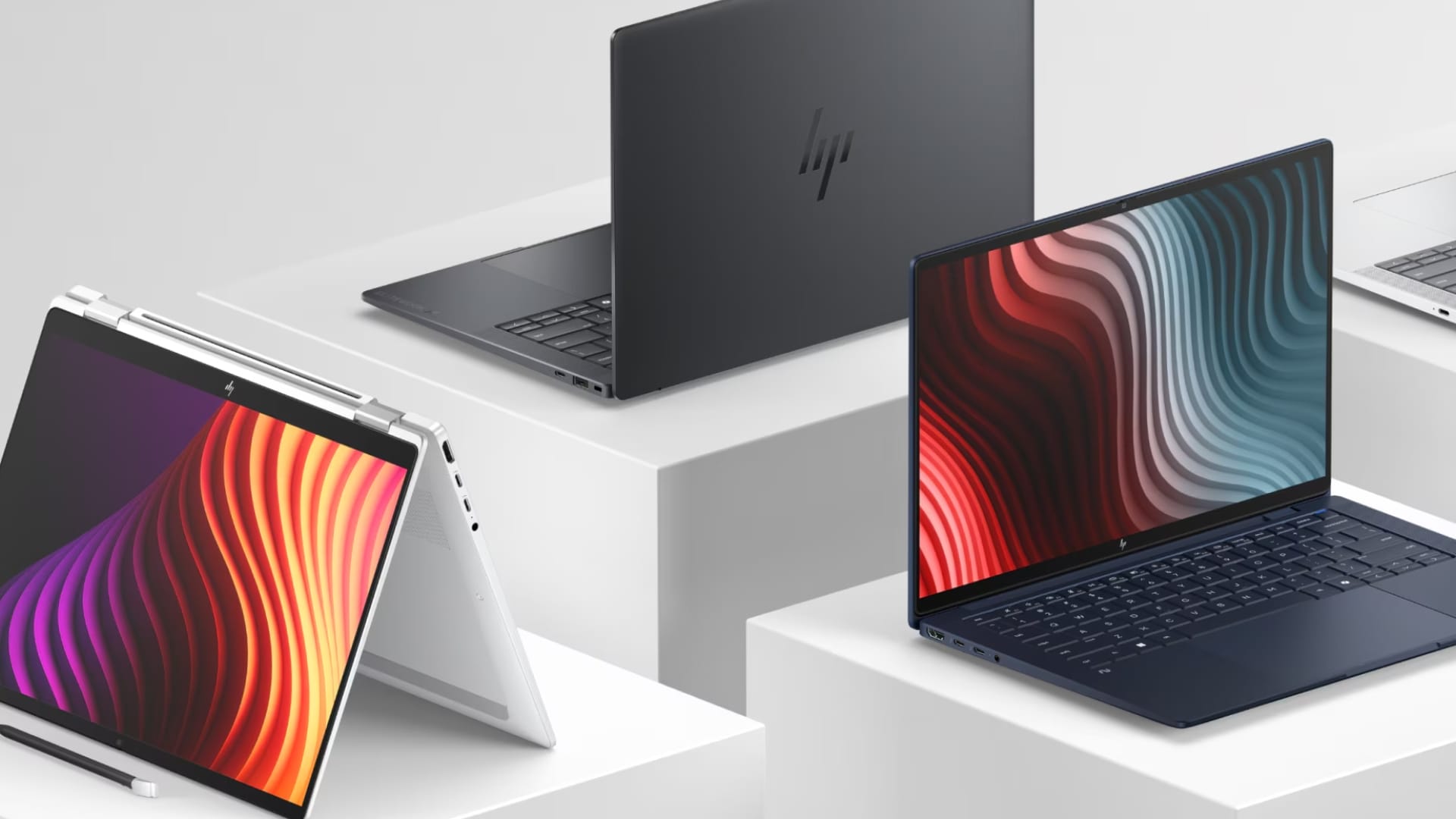
Central to HP’s CES announcements is a refreshed AI PC portfolio designed to deliver higher on-device AI performance while remaining portable. The company introduced the HP EliteBoard G1a, described as the smallest and lightest AI PC in its portfolio. The device integrates full PC components into a keyboard form factor, allowing local AI workloads to move with users across different settings. The EliteBoard G1a was also recognised as a CES 2026 Innovation Award honouree.
HP also expanded its premium business notebook range with the HP EliteBook X G2 Series, targeting leaders and professionals operating in AI-intensive environments. These systems are positioned as part of a wider industry shift towards notebooks capable of supporting concurrent AI applications through dedicated neural processing units delivering up to 85 trillion operations per second. The same level of AI acceleration is also present in select consumer models, including the HP OmniBook Ultra 14.
The broader OmniBook portfolio received updates as well, with new Snapdragon-based configurations and OLED displays. HP highlighted battery life as a differentiator, stating that the new HP OmniBook 3 16 offers the longest battery life in a 16-inch OLED consumer AI PC, under specific test conditions. These updates reflect a push to balance performance, endurance and visual quality as AI workloads become more commonplace in everyday computing.
Productivity, resilience and device management at scale
Beyond personal computing, HP introduced its first integration of Microsoft Copilot into HP Office Print devices. This brings AI-assisted document summarisation, translation and organisation directly to printers, extending productivity tools beyond the PC and into shared office infrastructure. The integration is designed to support faster workflows while maintaining security and control in business environments.
HP also announced enhancements to its Workforce Experience Platform, adding firmware-level recovery capabilities that allow IT teams to address critical device issues even when systems fail to boot. This update reflects growing concern around operational resilience as organisations rely more heavily on distributed endpoints. By enabling faster recovery at a lower level of the system, HP aims to reduce downtime and limit disruption across hybrid workforces.
The company positioned these platform updates as essential complements to AI adoption. As devices become more autonomous and interconnected, HP argued that manageability and recovery are becoming just as important as performance, particularly for enterprises operating across multiple regions and regulatory environments.
Gaming, sustainability and skills development initiatives
At CES 2026, HP also announced a significant brand consolidation within its gaming portfolio, uniting OMEN and HyperX under the HyperX name. As part of this move, the company introduced the HyperX OMEN MAX 16, described as its most powerful gaming laptop to date. The system features fully internal cooling designed to support high performance without external accessories, alongside AI-driven optimisation through OMEN AI and a high-polling-rate keyboard.
Complementing its hardware announcements, HP highlighted the HP Digital Passport, a platform that provides customers with a centralised view of their device information. This includes onboarding support, feature discovery and details about a device’s sustainability credentials, reflecting a broader emphasis on transparency and lifecycle awareness.
HP also confirmed the return of its Future of Work Accelerator in 2026. Since its launch in 2022, the programme has supported 35 non-profit organisations across 13 countries, reaching more than 11 million people. The Accelerator offers US$100,000 in funding, US$100,000 worth of HP hardware and solutions, and a six-month training and mentorship programme. In 2026, it will return to the US and expand eligibility to include for-profit organisations for the first time, with a focus on AI and future work skills. Applications open on 12 January, with a deadline of 6 February.