

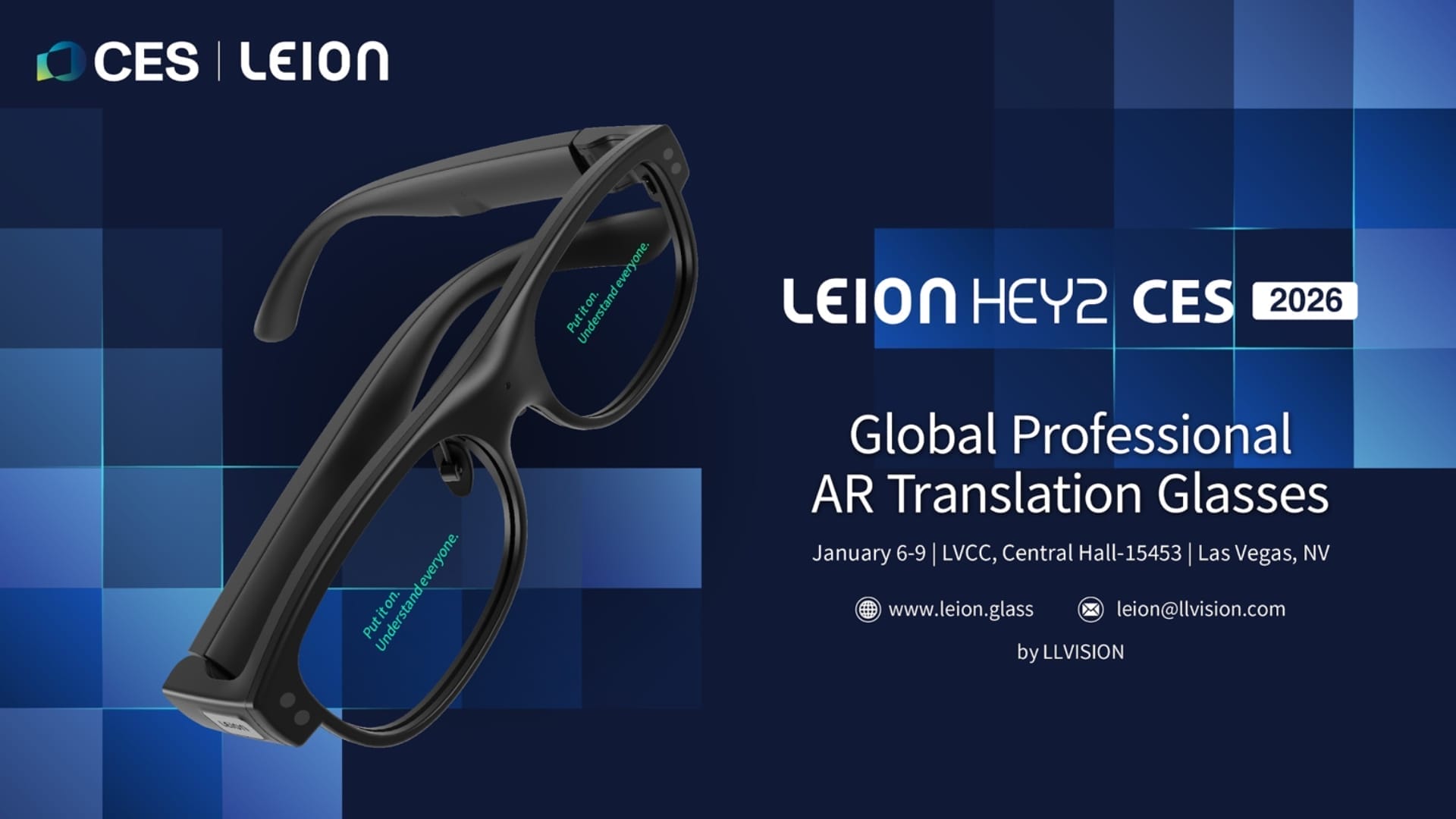
LLVision has unveiled Leion Hey2, positioning the device as the world’s first professional AR translation glasses, with the product making its official United States debut at CES 2026. Announced in Las Vegas, the launch marks a significant step for the company as it brings a purpose-built translation device to a global audience increasingly reliant on cross-border, face-to-face communication.
Leion Hey2 is designed to translate spoken language into real-time subtitles that appear directly in the wearer’s line of sight. The system supports more than 100 languages and dialects and delivers translation latency of under 500 milliseconds in real-world conditions. By removing the need for smartphones, handheld devices, or earbuds, the glasses aim to keep conversations natural and uninterrupted, preserving eye contact and conversational flow.
According to LLVision, the device can operate for six to eight hours of continuous translation on a single charge, with the charging case extending total usage to up to 96 hours. This performance positions the product for full-day professional use rather than short demonstrations or casual interactions.
“This is what translation really means to us,” said Dr. Wu Fei, founder and chief executive officer of LLVision. “It’s not just about words. It’s about giving people the freedom to speak, to connect, and to be truly understood.”
Founded in 2014, LLVision has spent more than a decade developing integrated AI and AR solutions focused on multilingual communication. Leion Hey2 builds on that work, following the first-generation Leion Hey, which has shipped more than 30,000 units worldwide.
Built around face-to-face communication
LLVision has framed Leion Hey2 around the idea that translation should support human presence rather than distract from it. While many smart glasses position translation as one of several features alongside entertainment, recording, or social media, Hey2 treats translation as its core purpose.
From its hardware architecture to its interaction design, the device is built for live, in-person conversation. Spoken language is converted into subtitles that appear directly within the wearer’s forward field of view, allowing dialogue to unfold naturally without forcing users to look down at a phone or pass a device back and forth.
The visual system uses waveguide optics paired with a micro-LED light engine to deliver stable, legible text across varying lighting conditions. LLVision has taken a restrained approach to the display, keeping visual elements minimal to avoid distraction during extended use. Subtitles can be adjusted in position and size, allowing wearers to tailor the experience to different environments and preferences.
This approach also enables real-time captioning for Deaf and hard-of-hearing users. By keeping subtitles continuously visible, the device provides accessibility support without requiring additional tools or workflows, broadening its use beyond language translation alone.
Battery life is another area where LLVision has emphasised professional use. With up to eight hours of continuous translation and multi-day support via the charging case, the glasses are designed to handle international meetings, conferences, travel days, and multilingual classrooms without frequent recharging.
Audio, AI and interaction design
Leion Hey2 has been engineered to handle the complexity of real-world conversations, where background noise and multiple speakers can easily disrupt translation accuracy. In face-to-face settings, the device uses a directional pickup system that prioritises the person directly in front of the wearer, focusing on voices within an approximately 60-degree forward range while suppressing side conversations and ambient noise.
A four-microphone array with 360-degree spatial voice detection continuously identifies the active speaker’s direction before processing begins. This is combined with proprietary beamforming and neural noise reduction to isolate speech in real time. The goal is to align audio pickup with natural human posture, translating the person being addressed rather than the loudest voice in the room.
Beyond translation, Hey2 includes an optional AI Q&A feature designed for quick, contextual look-ups rather than continuous interaction. Users can activate the function by pressing and holding the right touchpad, asking a question naturally, and releasing it to receive a response displayed in view. The process requires no manual text input and no phone connection, making it suitable for environments such as museums, exhibitions, city walks, and travel stops.
LLVision has positioned this AI capability as intentionally limited. Rather than competing for attention during conversations, it is meant to provide information when needed and then step back, reinforcing the device’s primary role of enabling understanding between people.
Design, privacy and real-world validation
Weighing 49 grams, Leion Hey2 is designed to resemble everyday eyewear rather than overtly signalling advanced technology. The glasses feature a lightweight magnesium-alloy frame, adjustable titanium nose pads, and a classic browline silhouette. A stepless spring hinge allows the frame to adapt to different face shapes, supporting comfort and stability throughout the day.
The design also reflects sensitivity to social and professional contexts. The glasses do not include a camera or external speakers, and audio input is used solely for translation. This approach aims to make the device appropriate for professional, educational, and diplomatic environments where privacy and discretion are critical.
LLVision states that all data processing follows GDPR-aligned privacy principles and is supported by secure cloud infrastructure built on Microsoft Azure. Users have control over their data, with options to review, manage, or delete translation history at any time.
The technology has already been tested in high-stakes environments. In 2025, Leion Hey2 was demonstrated at the United Nations Accessibility for All Exhibition in Geneva and used in diplomatic and international forums. It has also been deployed in large-scale live trials, including a two-hour presentation delivered entirely through the glasses by LLVision’s chief executive.
LLVision has also contributed to accessibility research, serving as an industry partner on a project recognised by the AIS Impact Award 2025 for improving communication access for Deaf and hard-of-hearing communities. The earlier Leion Hey model was recognised among the UNESCO Netexplo Innovation Award Top 10, with users averaging 150 minutes of daily use.
Demand for the new device appears strong. LLVision reported that the global unveiling of Hey2 in Seoul generated more than 10,000 pre-orders within a single day, indicating interest in a translation solution designed specifically for real-world, face-to-face use.
Leion Hey2 is now available for order in the United States through LLVision’s official online store, priced at US$549. From 6 January to 31 January, customers can pre-order the device at US$499. Pre-orders include a clip-on sunglass lens and 1,200 minutes of Pro translation service.