


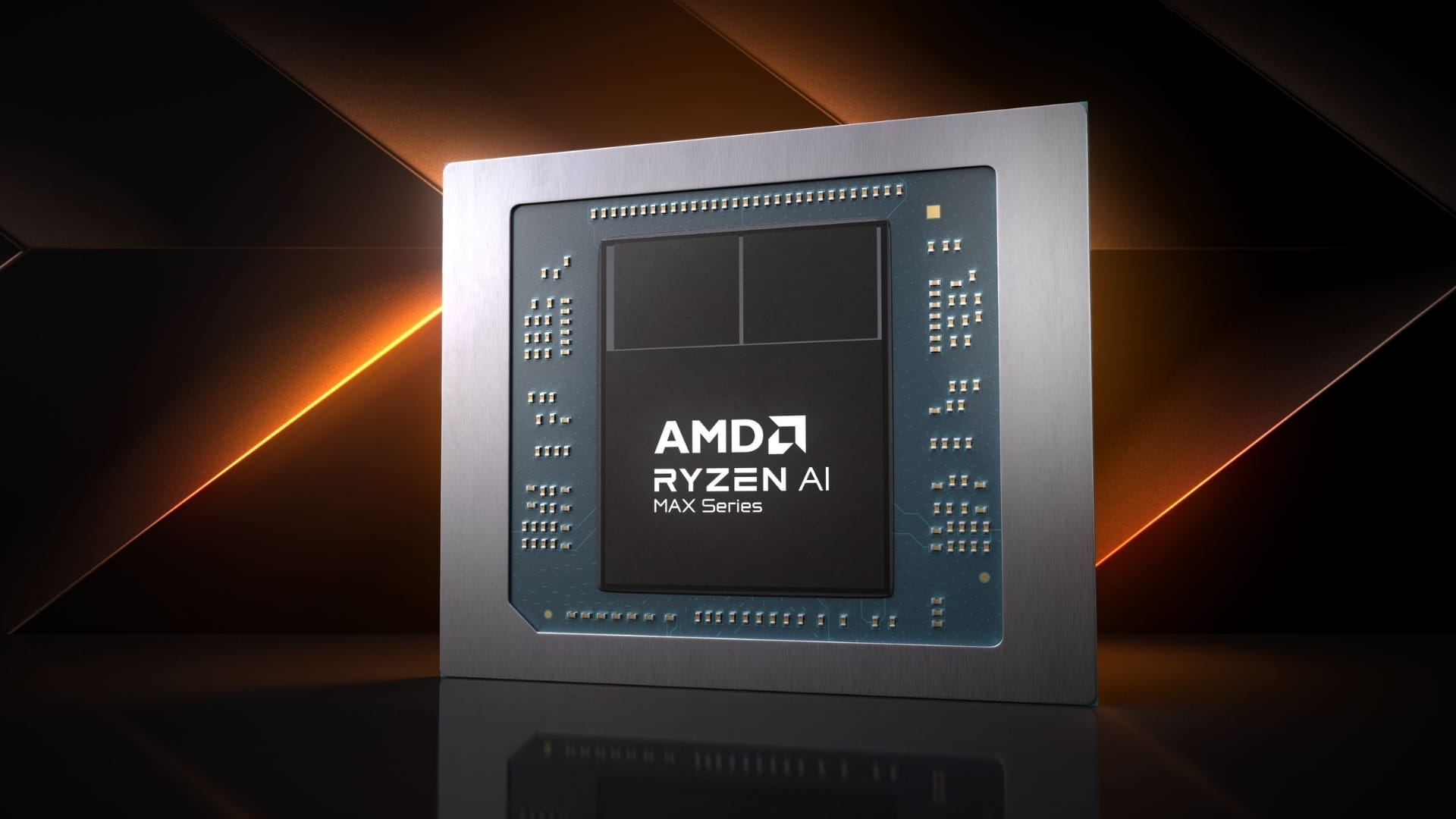
AMD used CES 2026 to outline a broad expansion of its processor, graphics and software roadmap, positioning artificial intelligence as a core capability across consumer, commercial, data centre and embedded platforms. The announcements span desktop and mobile processors, gaming technologies, AI software, data centre accelerators and new embedded systems, reflecting AMD’s strategy to push AI compute from the cloud to personal devices and edge deployments.
At the centre of the showcase was a focus on performance gains in gaming and AI workloads, alongside wider platform support through software and ecosystem partnerships. AMD said the new products are designed to meet growing demand for local AI processing, high-performance graphics and scalable infrastructure as AI adoption accelerates across industries.
Gaming processors and graphics technologies push performance boundaries
In gaming, AMD introduced the Ryzen 7 9850X3D desktop processor, positioning it as the fastest gaming CPU currently available. The chip expands the Ryzen 9000X3D family and combines second-generation 3D V-Cache technology with the Zen 5 processor architecture. It features eight high-performance cores and 16 threads, a boost frequency of up to 5.6GHz and 104MB of total cache. According to AMD, this configuration is designed to deliver ultra-low latency and high frame rates in modern, demanding titles. Systems powered by the Ryzen 7 9850X3D are expected to be available from OEMs and retail partners beginning in Q1 2026.
Alongside new hardware, AMD highlighted wider adoption of its FidelityFX Super Resolution Redstone suite, a set of machine learning-powered neural rendering technologies. The company said FSR Redstone is now supported in more than 200 gaming titles, reflecting growing uptake among developers. The suite includes ML-based upscaling to reconstruct high-quality visuals from lower-resolution frames, frame generation to insert predicted frames for smoother gameplay, and new ray tracing enhancements.
FSR Radiance Caching is designed to optimise ray tracing by predicting light behaviour, reducing render times while maintaining visual quality. This feature is currently available as a preview for developers. FSR Ray Regeneration further improves ray-traced reflections using neural networks and denoising techniques, with the aim of creating more realistic and immersive environments. Together, these features are intended to balance visual fidelity and performance as games increasingly rely on advanced lighting and rendering effects.
Consumer and commercial AI PCs focus on local AI compute
AMD placed significant emphasis on AI PCs, unveiling the Ryzen AI 400 Series for consumer systems. Built for next-generation Copilot+ PCs, the processors offer up to 60 TOPS of AI compute through an enhanced neural processing unit. AMD said systems featuring the Ryzen AI 400 Series will be available from major OEMs starting in Q1 2026, with desktop variants following in Q2 2026. At the top of the range, the Ryzen AI 9 HX 475 includes 12 Zen 5 cores, 24 threads and integrated Radeon 800M graphics, targeting generative AI applications, large language models and on-device AI assistants.
The company also expanded its Ryzen AI Max+ Series with new SKUs designed for ultra-thin laptops and compact mini PCs. The Ryzen AI Max+ 392 features 12 cores, 24 threads and 76MB of total cache, while the Ryzen AI Max+ 388 offers eight cores, 16 threads and 40MB of cache. Both processors combine Zen 5 CPU cores with Radeon 8060S series graphics and second-generation XDNA NPUs, delivering up to 50 system TOPS. Systems based on these processors are expected to ship from OEM partners beginning in Q1 2026.
For developers, AMD introduced Ryzen AI Halo, a compact developer platform built on the Ryzen AI Max+ architecture. Designed for advanced local AI workloads, the system supports up to 128GB of unified memory, enabling large models with up to 200 billion parameters to run locally. AMD said the platform delivers up to 60 TFLOPS of RDNA 3.5 graphics performance and ships with the latest ROCm software and hundreds of pre-loaded models to reduce setup time. Full Windows and Linux support is included.
On the commercial side, AMD announced the Ryzen AI PRO 400 Series, extending AI PC capabilities to enterprise fleets. The processors are backed by AMD PRO technologies for security, manageability and platform stability. The Ryzen AI 9 HX PRO 475 includes 12 Zen 5 cores, 24 threads, 36MB of cache and up to 60 TOPS of AI performance from a dedicated XDNA 2 engine. Systems powered by the Ryzen AI PRO 400 Series are expected to be available from OEM partners beginning in Q1 2026.
Data centre, software and embedded platforms extend AI reach
Beyond client devices, AMD outlined advancements across data centre, software and embedded segments. The company debuted the Instinct MI400 Series accelerators, led by the Helios system, which it described as a blueprint for rack-scale AI compute delivering up to three AI exaflops per rack for large-scale training. The lineup includes the MI440X, an eight-GPU on-premise solution targeting enterprise AI training, fine-tuning and inference workloads, and the MI430X, aimed at sovereign AI and high-performance computing deployments. Looking further ahead, AMD said the upcoming MI500 Series, planned for 2027, is expected to deliver up to 1,000 times the AI performance of the MI300 Series launched in 2023.
Software was positioned as a key enabler of this hardware roadmap. AMD highlighted ROCm 7.2, noting up to fivefold improvements in AI performance over the past year and a doubling of platform support across Ryzen and Radeon products in 2025. The software now supports the Ryzen AI 400 Series and expands compatibility across Windows and Linux. AMD also introduced the AMD Software Adrenalin Edition AI Bundle, an optional feature that simplifies local AI setup through a single installation, providing access to tools such as ComfyUI and Ollama, alongside new PyTorch support on Windows.
In embedded computing, AMD launched a new Ryzen AI Embedded processor portfolio targeting edge and physical AI applications. These processors integrate Zen 5 CPU cores, RDNA 3.5 graphics and XDNA 2 NPUs into a single chip. The P100 Series, launching first, features four to six cores, up to 35 percent faster GPU performance and up to 50 AI TOPS for in-vehicle and immersive experiences. Higher-core variants aimed at industrial automation and autonomous systems are expected to begin sampling in Q1 2026 and the first half of 2026.
AMD also highlighted partnerships advancing physical AI, including a collaboration with Generative Bionics to unveil GENE1.0, a humanoid robot designed around the concept of the body as part of the compute system. The demonstration underscored AMD’s ambition to extend AI beyond traditional data centres into real-world, human-centric applications.