

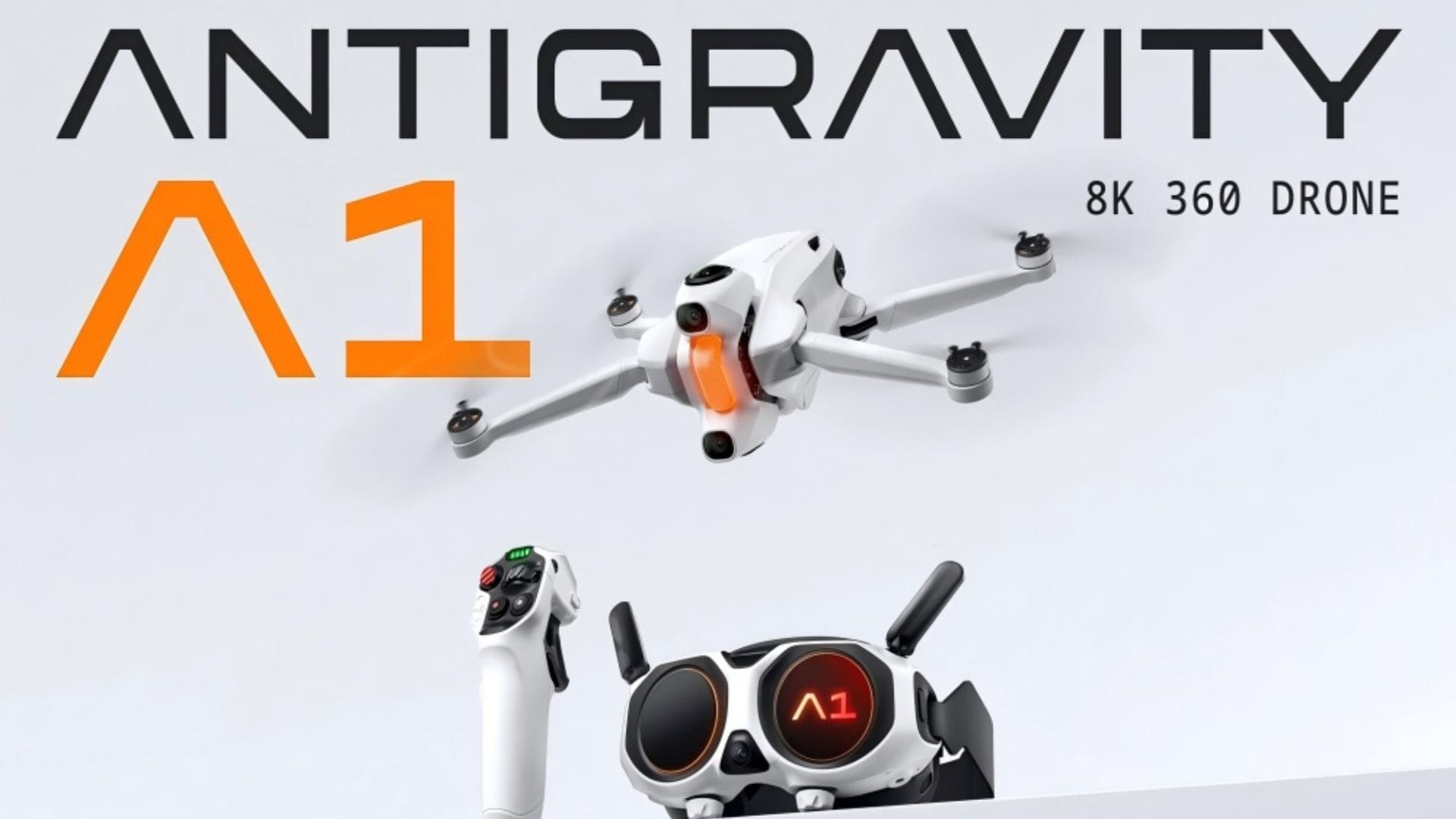
Antigravity, a new drone brand backed by the team behind Insta360, has launched its first consumer drone. The Antigravity A1 marks the company’s debut in the increasingly competitive compact drone segment, positioning itself as a fresh alternative to established names while offering a distinctive blend of FPV flight controls and 360-degree imaging. With Insta360’s background in immersive cameras, the A1 aims to appeal to creators, hobbyists, and newcomers looking for a new perspective in aerial videography.
Weighing just 249g, the drone has been designed to meet the sub-250g threshold enforced in many countries, including Singapore. In these regions, drones below this limit generally enjoy simpler regulatory requirements, allowing users to fly without registration. This lightweight design is achieved through a mainly plastic frame, but Antigravity attempts to address durability concerns by making key parts, such as the propellers and lenses, easily replaceable. This is particularly useful for beginners who may encounter scrapes, bumps, or misjudged manoeuvres during early flights.
The A1’s compact build is only one part of what Antigravity believes will set it apart from competitors, with the company placing strong emphasis on its immersive flight experience. Instead of the traditional dual-stick controller found on most consumer drones, Antigravity has opted for a motion-based control system. The included Grip controller translates natural hand movements into directional input, allowing pilots to steer simply by pointing. This aims to lower the learning barrier for newcomers who may find standard FPV controls intimidating.
Alongside the Grip controller, Antigravity includes a set of Vision Goggles to enhance immersion further. These goggles feature pancake optics and dual 1-inch Micro-OLED displays, offering a high-resolution view of the drone’s surroundings. They also mirror head movements in real time, enabling users to look around naturally as they fly. For experienced FPV pilots who prefer the traditional approach, Antigravity includes a classic FPV mode that retains full manual control.
Camera technology draws from Insta360’s expertise
Given Antigravity’s close connection to Insta360, expectations for the A1’s imaging system are naturally high. The drone features a dual-lens setup with a 1/1.28-inch sensor, capable of capturing full 360-degree footage. Users can record in 8K at 30 fps, 5.2K at 60 fps, or 4K at 100 fps, offering flexibility for creators who want high-resolution output or smooth, high-frame-rate video.
The 360-degree capture method aims to address common challenges in aerial filming, such as finding the right camera angle, adjusting the gimbal mid-flight, and ensuring the drone is pointing in the correct direction. By capturing everything around the drone at once, creators can reframe shots during editing without losing key moments.
Antigravity also includes Insta360’s FlowState Stabilisation technology, a system designed to smooth out sudden movements, wind resistance, or fast directional changes. This technology has been widely used in Insta360’s action cameras and has earned a reputation for delivering stable footage even in unpredictable conditions. Its inclusion in the A1 suggests that Antigravity intends to give a similarly polished experience for drone users.
The combination of immersive FPV controls and a fully stabilised 360-degree camera system positions the A1 as a unique alternative in the market, appealing to both traditional FPV users and creators who want the flexibility of post-flight reframing.
Battery life and flight performance
Antigravity states that the A1 can achieve up to 24 minutes of flight time using its standard battery. For pilots who require extended sessions, the company offers optional high-capacity batteries that increase flight duration to a claimed 39 minutes. By comparison, DJI’s Neo 2 drone has an advertised flight time of 19 minutes under ideal conditions, placing the A1 competitively in this category.
As with most lightweight drones, the actual flight time may vary depending on factors such as wind conditions, flying style, and recording settings. Still, Antigravity’s decision to offer higher-capacity batteries provides flexibility for users who need longer shooting sessions or repeated takes.
The company has also aimed to make flight as simple as possible, regardless of experience level. The motion-based Grip controller acts as the default option for new pilots, while seasoned FPV flyers can switch to classic FPV mode to make use of more advanced manoeuvres.
Editing workflow and storage options
Footage captured on the A1 can be stored on its 20GB of internal memory or on a microSD card up to 1 TB. Once recorded, clips can be transferred to the Antigravity app or Antigravity Studio on a desktop. Both platforms offer automatic reframing tools, colour adjustments, and a suite of video-editing features designed to help users create finished clips quickly.
This workflow closely mirrors the editing approach used by Insta360’s cameras, which rely heavily on software-driven reframing to output standard-format footage from spherical recordings. For creators already familiar with Insta360’s tools, the A1’s editing process should feel instantly recognisable.
The Antigravity A1 is available from today and comes in three bundles. The Standard Bundle is priced at S$1,869, the Explorer Bundle at S$2,169, and the Infinity Bundle at S$2,299. All bundles include the drone, Vision Goggles, and Grip controller, while the main differences lie in the number of included batteries and accessories. Antigravity also offers a Care subscription programme, which provides discounted replacements and protection against flyaway incidents.
The launch of the A1 marks Antigravity’s first step into the drone sector. With its combination of FPV immersion, motion-based controls, and high-resolution 360-degree imaging, the company is positioning the A1 as a fresh alternative for both hobbyists and content creators seeking a new way to capture aerial footage.