

ASUS has expanded its desktop PC hardware portfolio at CES 2026 with the launch of new AMD 800 series motherboards alongside the latest ROG Strix LC IV all-in-one liquid cooler range. The announcement introduces refreshed designs across the ROG, ROG Strix, TUF Gaming, and ProArt families, covering X870E, X870, and B850 chipsets for the AM5 platform. These boards are designed to support AMD Zen 5 Ryzen 9000 Series processors and target enthusiasts, gamers, and professional creators seeking higher performance and simpler system assembly.
The update places a strong emphasis on memory performance, connectivity, and system intelligence. ASUS has integrated new AI-assisted features across the lineup, including AI Cache Boost for accelerating large language model workloads and ASUS AI Advisor, a natural-language assistant designed to help users configure and optimise their systems. Support for USB4, WiFi 7, and a refreshed suite of EZ PC DIY features aim to reduce setup complexity while improving overall system responsiveness.
ASUS has also updated its UEFI BIOS across the new range, introducing a higher-capacity 64MB BIOS chip. This enables a more advanced interface and broader compatibility with current and future AM5 processors. A pre-installed WiFi driver allows users to connect to the internet during Windows installation without relying on external storage, while the new ASUS MLO Wizard evaluates network environments to optimise Multi-Link Operation performance for compatible WiFi 7 devices.
Optimised PCIe layouts and next-generation memory support
A key focus of the AMD 800 series refresh is improved PCIe lane allocation. ASUS has redesigned lane layouts on select models to allow users to install more high-speed storage devices without sacrificing graphics card bandwidth. For example, the ROG Strix X870E-E Gaming WiFi7 Neo supports two PCIe 5.0 M.2 SSDs and three PCIe 4.0 M.2 SSDs while maintaining PCIe 5.0 x16 performance for the graphics card, achieved by sharing bandwidth between USB4 ports and secondary M.2 slots.
At the higher end, the ROG Crosshair X870E Glacial introduces configurations designed for advanced gaming, streaming, and capture workloads. It enables full bandwidth on the primary PCIe 5.0 x16 slot and two PCIe 5.0 M.2 slots, while still supporting a secondary PCIe slot for additional expansion cards. The same board, along with the ProArt B850-Creator WiFi Neo, also supports x8/x8 PCIe configurations for multi-GPU creative and AI workstation setups.
Memory performance has been enhanced through a combination of manufacturing and firmware improvements. ASUS has adopted a server-grade PCB design with ultra-low-etch processes, 2-ounce copper power planes, PCB back drilling, and up to eight-layer construction. These changes improve signal integrity, thermal performance, and long-term stability, particularly for DDR5 memory and PCIe 5.0 devices. NitroPath DRAM technology further shortens signal paths between memory and CPU, increasing overclocking headroom and durability for frequent upgrades.
ROG Strix LC IV coolers and a stronger focus on DIY simplicity
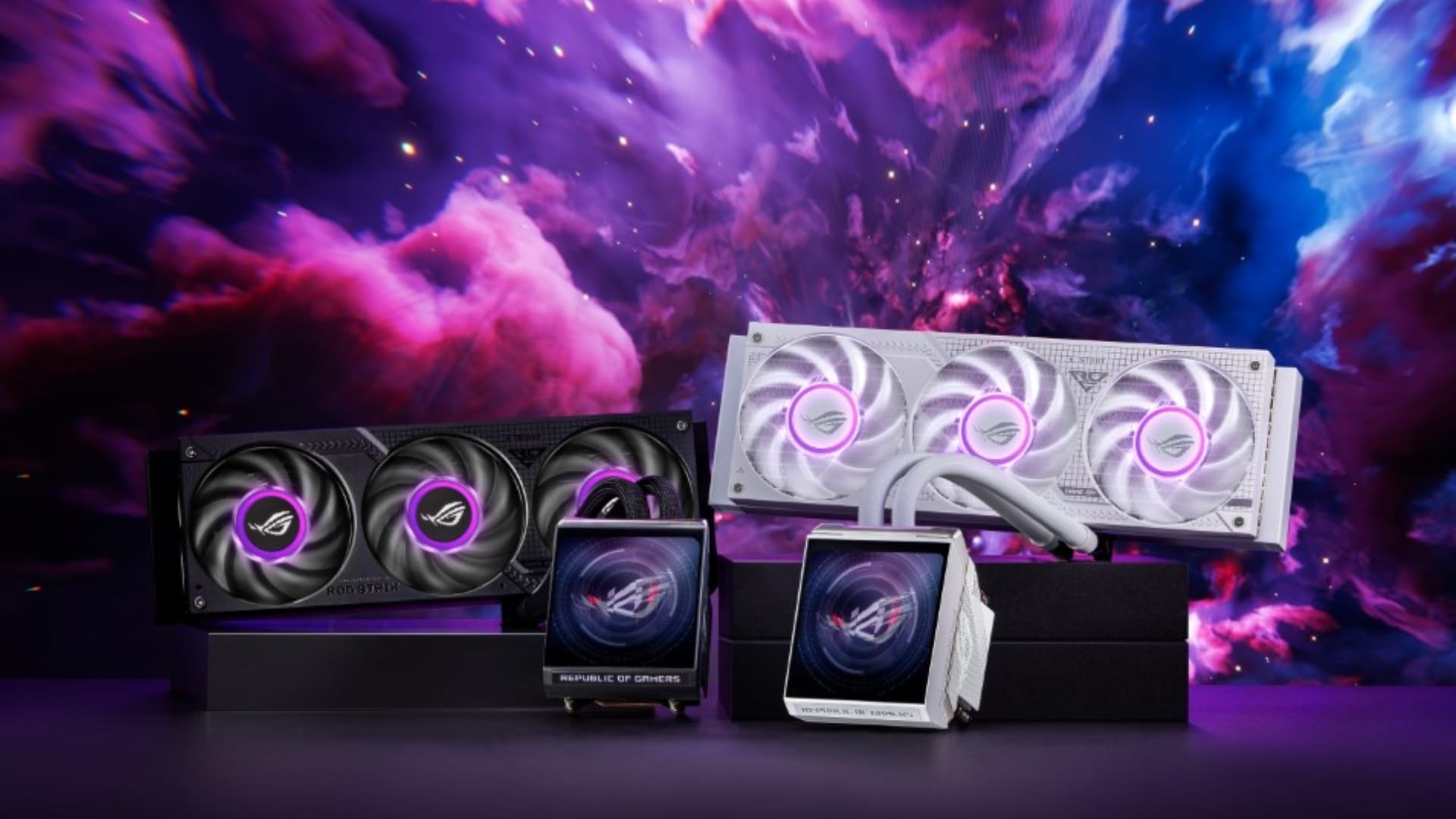
Alongside the motherboard refresh, ASUS introduced the ROG Strix LC IV Series AIO liquid coolers. The new range features a 5.08-inch full-colour display and is offered in both standard-tubing and short-tubing variants to accommodate different case layouts. ASUS positions the series as balancing thermal performance with lower noise levels, targeting users who prioritise both aesthetics and acoustic comfort.
The most notable addition is the AIO Q-Connector, a wire-free connection system designed to work with compatible ASUS motherboards. Instead of connecting multiple cables for pumps, fans, and displays, users align contact points on the cooler and motherboard, allowing control signals to be transmitted directly through the connector. This approach aims to simplify installation and significantly reduce visible cabling inside the case.
Ease of building extends beyond cooling. ASUS has continued to refine its tool-free and quick-release mechanisms across the AMD 800 series lineup. Features include the PCIe Q-Release Switch for easier graphics card removal, updated screw-less M.2 expansion cards supporting up to seven SSDs on select models, and enhanced M.2 heatsinks using 3D vapour chamber designs for improved thermal dissipation. Magnetic components such as the ROG Memory Q-Fan further reduce the need for tools during installation. Some models also support front-panel USB Type-C with up to 60W Quick Charge 4+ capability, reflecting the growing power demands of modern peripherals.
ASUS noted that feature availability varies by model, with different combinations of connectivity, cooling, and expansion options across the range. The overall update signals a continued push towards higher performance systems that are easier to assemble, maintain, and upgrade, as AMD’s AM5 platform matures into its next generation.