

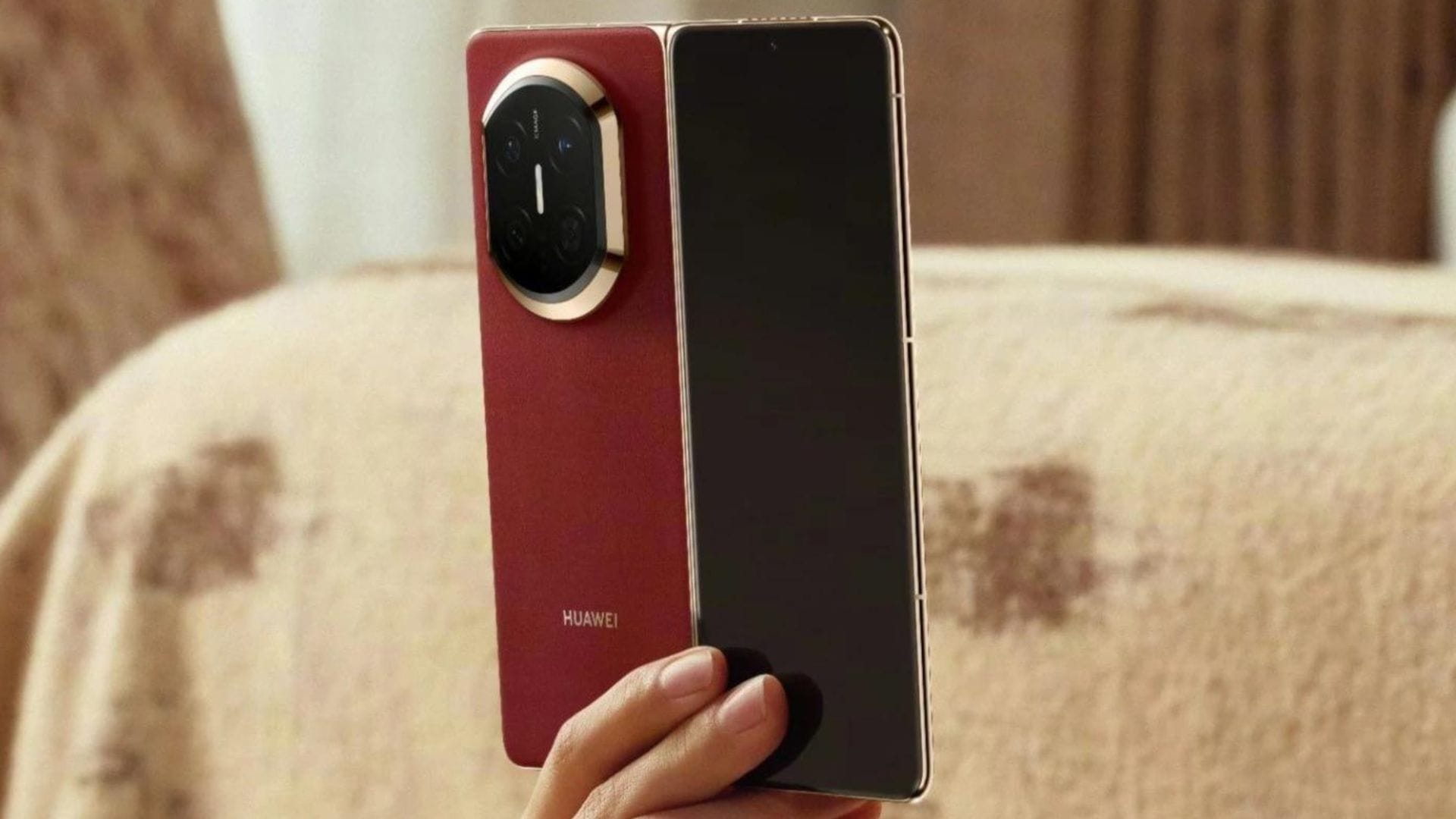
Huawei has officially introduced the global version of its latest book-style foldable smartphone, the Mate X7, expanding availability beyond its initial launch in Mainland China in November 2025. The international debut took place at a launch event in Dubai, United Arab Emirates, marking Huawei’s continued push to position its premium devices on the global stage despite ongoing market challenges.
Alongside the Mate X7, Huawei also showcased several other products, including the FreeClip 2 wireless headphones, a new Royal Gold finish for the Huawei Watch Ultimate Design, and an updated MatePad tablet. Together, these announcements highlighted the company’s focus on strengthening its hardware ecosystem across smartphones, wearables and tablets.
The Mate X7 sits at the top of Huawei’s foldable portfolio and represents the next step after the Mate X6. While the design language remains familiar, the company has made a series of refinements aimed at improving everyday usability, durability and camera performance, areas where foldable phones are often closely scrutinised.
Huawei Mate X7 design and build updates
The Huawei Mate X7 follows the traditional book-style foldable format, opening horizontally to reveal a large inner display while functioning as a conventional smartphone when closed. Compared with its predecessor, the physical changes are modest but deliberate. According to Huawei, the Mate X7 measures 9.5mm when folded, making it 0.35mm thinner than the Mate X6. It is also lighter by 3g, a small reduction that nonetheless reflects Huawei’s efforts to improve comfort in daily use.
Huawei has placed significant emphasis on the Mate X7’s durability. The company describes the device as featuring an Ultra-Reliable Foldable Architecture, which refers to its combination of hinge design, strengthened glass and internal structural components. While the terminology is marketing-led, the goal is clear: to reassure users that the foldable mechanism is robust enough for long-term use.
Heat management has also been upgraded. The Mate X7 includes a 3,550 m2 heat-dissipation system designed to manage thermal output during demanding tasks such as multitasking, photography, and extended media consumption. This is particularly important for foldable devices, which pack high-end components into a complex internal structure.
The phone is powered by a 5,600mAh battery, which is relatively large for a foldable handset. Charging options include 66W wired charging and 50W Huawei Wireless SuperCharge, enabling faster top-ups than many competing foldable models. Huawei has also confirmed that the Mate X7 carries IP58 and IP59 ratings, providing resistance to dust and water and placing it among the more resilient foldable phones currently available.
Camera system and imaging focus
One of Huawei’s key claims with the Mate X7 is that its camera performance now rivals that of standard flagship smartphones. The company states that colour accuracy has improved by 43 per cent thanks to its updated Ultra Lighting HDR Camera system.
The rear camera setup consists of three sensors. The main camera uses a 50MP sensor, paired with a 40MP ultra-wide camera and a 50MP telephoto macro camera offering 3.5x optical zoom. All three cameras use Huawei’s RYYB sensor technology, which replaces the traditional green sub-pixel with a yellow one to allow more light to enter, a design that Huawei has used across several generations of its flagship devices.
Huawei’s aim appears to be closing the perceived gap between foldable phones and conventional flagship handsets in photography. Foldables have often been criticised for compromising camera quality due to space constraints, and Huawei is positioning the Mate X7 as a device that avoids those trade-offs.
While Huawei did not provide extensive details on new photography features at the global launch, the company’s focus on hardware improvements suggests the Mate X7 is intended to appeal to users who prioritise imaging performance alongside the flexibility of a foldable display.
Software, connectivity and hardware considerations
As with other recent Huawei smartphones sold outside China, the Mate X7 runs on EMUI 15. The device does not support Google Mobile Services, meaning popular Google apps and services are not available by default. This remains a key consideration for users in many international markets.
The Mate X7 also lacks eSIM support and is limited to 4G connectivity through its dual-SIM physical card configuration. In an era where 5G is increasingly standard on premium smartphones, this limitation may influence purchasing decisions for some users. However, Huawei continues to integrate other up-to-date technologies where possible, including Bluetooth 6.0 and a USB-C port supporting USB 3.1 Gen 1 speeds.
Huawei has not officially disclosed the processor used in the Mate X7. However, GSMArena lists the device as running on the 6nm Kirin 9030 Pro chipset. While performance benchmarks were not discussed during the global launch, Huawei’s recent Kirin processors have generally been optimised for efficiency and stability rather than outright performance leadership.
The Huawei Mate X7 is being offered globally in a single configuration with 16GB of RAM and 512GB of internal storage. Buyers can choose from three colour options: Brocade White, Nebula Red and Black. The official retail price has been set at €2,099, placing the Mate X7 firmly in the ultra-premium segment of the smartphone market.
At the time of writing, Huawei has not confirmed local pricing or availability for specific regions such as Singapore. The company has indicated that further updates will be shared if and when the Mate X7 is introduced in additional markets.
With the global launch of the Mate X7, Huawei is signalling its intention to remain competitive in the foldable phone space, offering an alternative for users who are less invested in Google’s mobile ecosystem. While the updates may be evolutionary rather than revolutionary, the Mate X7 reflects Huawei’s continued refinement of its foldable design and its commitment to delivering flagship-level hardware in a challenging global environment.