

Researchers at Columbia Engineering have developed a human-like robotic face that can lip sync speech and songs by learning directly from online videos. The project shows how machines are increasingly able to copy complex human behaviour simply by watching and listening, rather than relying on hand-coded rules.
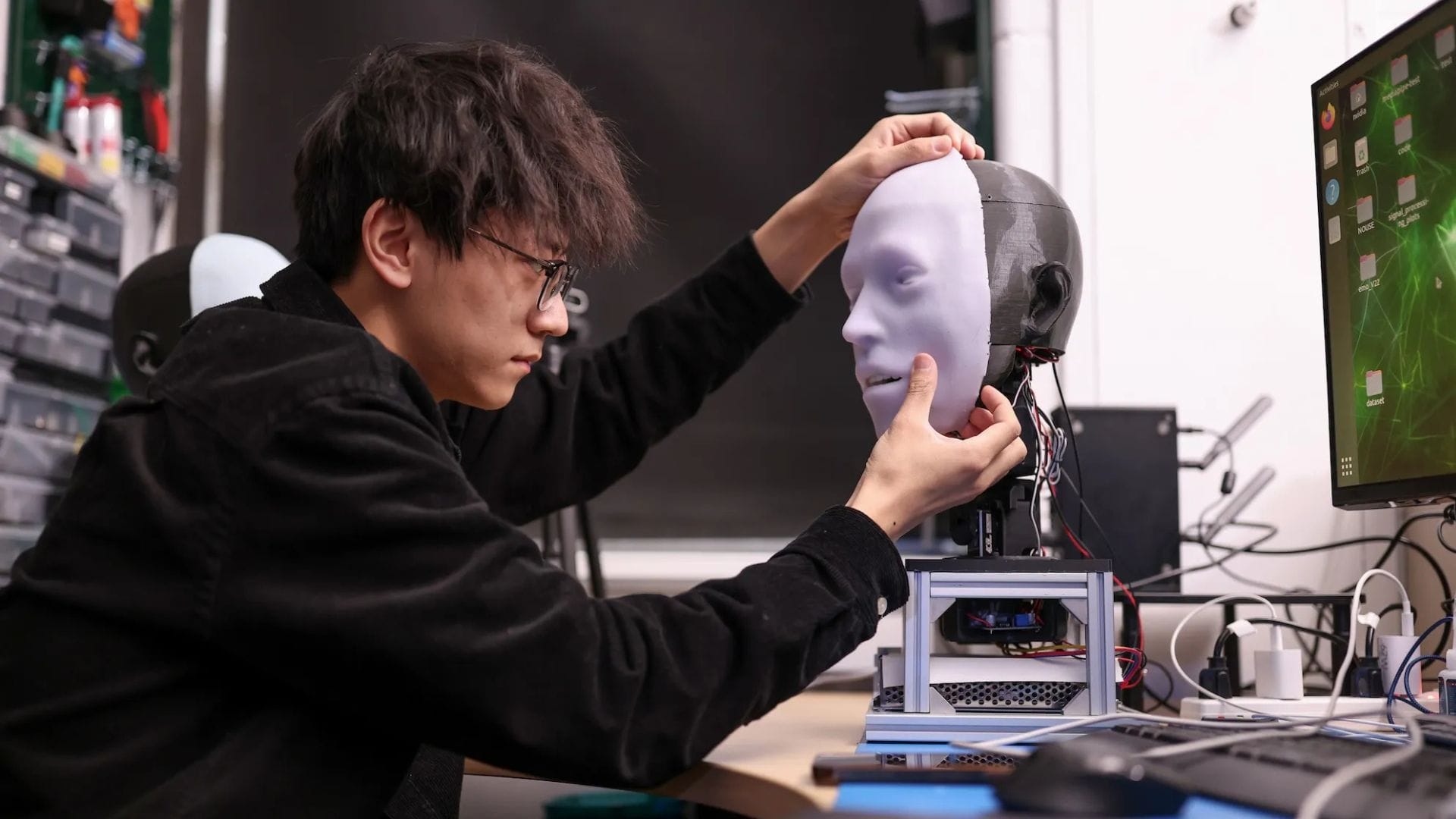
The robot, known as Emo, does not have a whole body. Instead, it has been designed as a highly realistic robotic face to study how people communicate through facial movement. By focusing solely on the face, the researchers aimed to address one of the most difficult challenges in social robotics: making machines look and behave in ways that feel natural to humans.
The work comes at a time when interest in robots for homes, offices and public spaces is growing quickly. As robots move closer to everyday environments, the ability to communicate clearly and comfortably is becoming just as important as physical capability.
Building a realistic robotic face
Emo has been built to resemble the structure and movement of a human face closely. It is covered with a soft silicone skin that stretches and folds like human skin. Beneath the surface, the face is driven by 26 independent motors that control the lips, jaw and cheeks.
These motors allow Emo to produce a wide range of detailed mouth shapes. In total, the system can form shapes that correspond to 24 consonants and 16 vowels. This level of control is essential for natural-sounding speech, as even small timing or shape errors can make a robotic face appear unsettling.
One of the main goals of the project was to reduce the so-called uncanny valley effect. This describes the discomfort people feel when something looks almost human but behaves slightly differently. In many robots, mismatched facial movements and audio are a key reason for this reaction. By improving lip synchronisation, the researchers hoped to make interactions with robots feel more comfortable and familiar.
Learning from online videos
Emo’s lip-syncing ability was developed through a staged learning process. In the first stage, the robot explored its own facial movements. By moving its motors while watching itself in a mirror, the system learned how different motor commands changed the shape of the face.
Once this self-exploration was complete, the researchers introduced a learning pipeline that linked sound to movement. Emo was shown hours of online video featuring people speaking and singing. An artificial intelligence model analysed the relationship between the audio and the visible movements of the lips and mouth.
Rather than focusing on language or meaning, the system studied raw speech sounds. A facial action transformer then processed these patterns, as the researchers describe, turning them into real-time motor commands. As a result, Emo could match mouth movements to sound without needing to understand the words being spoken.
This approach proved flexible. Emo was able to lip-sync not only in English but also in languages it had not been specifically trained in, including French, Arabic, and Chinese. The same method also worked for singing, which is more difficult because it involves extended vowels, shifting rhythm, and greater pitch variation.
Why natural lip syncing matters for robots
The researchers believe this work has important implications for the future of robotics. As robots work more closely with people, clear, natural communication will be essential. Facial cues such as lip movement play a major role in how humans understand speech, particularly in noisy environments.
The timing of the research aligns with broader momentum in the robotics industry. At CES 2026, companies showcased a range of robots aimed at both workplaces and homes. Demonstrations included Boston Dynamics’ Atlas humanoid, which is being prepared for real-world jobs, as well as household-focused robots from companies such as SwitchBot and LG that are designed to help with daily tasks.
Alongside progress in areas such as artificial skin that gives robots a sense of touch, advances in facial realism are making robots feel less like machines. When combined with accurate lip-syncing, these technologies suggest a future in which robots can act as social companions as well as functional tools.
Emo remains a research project rather than a commercial product. However, it offers a clear example of how robots may one day learn human skills in much the same way people do: by watching, listening and practising through observation.