

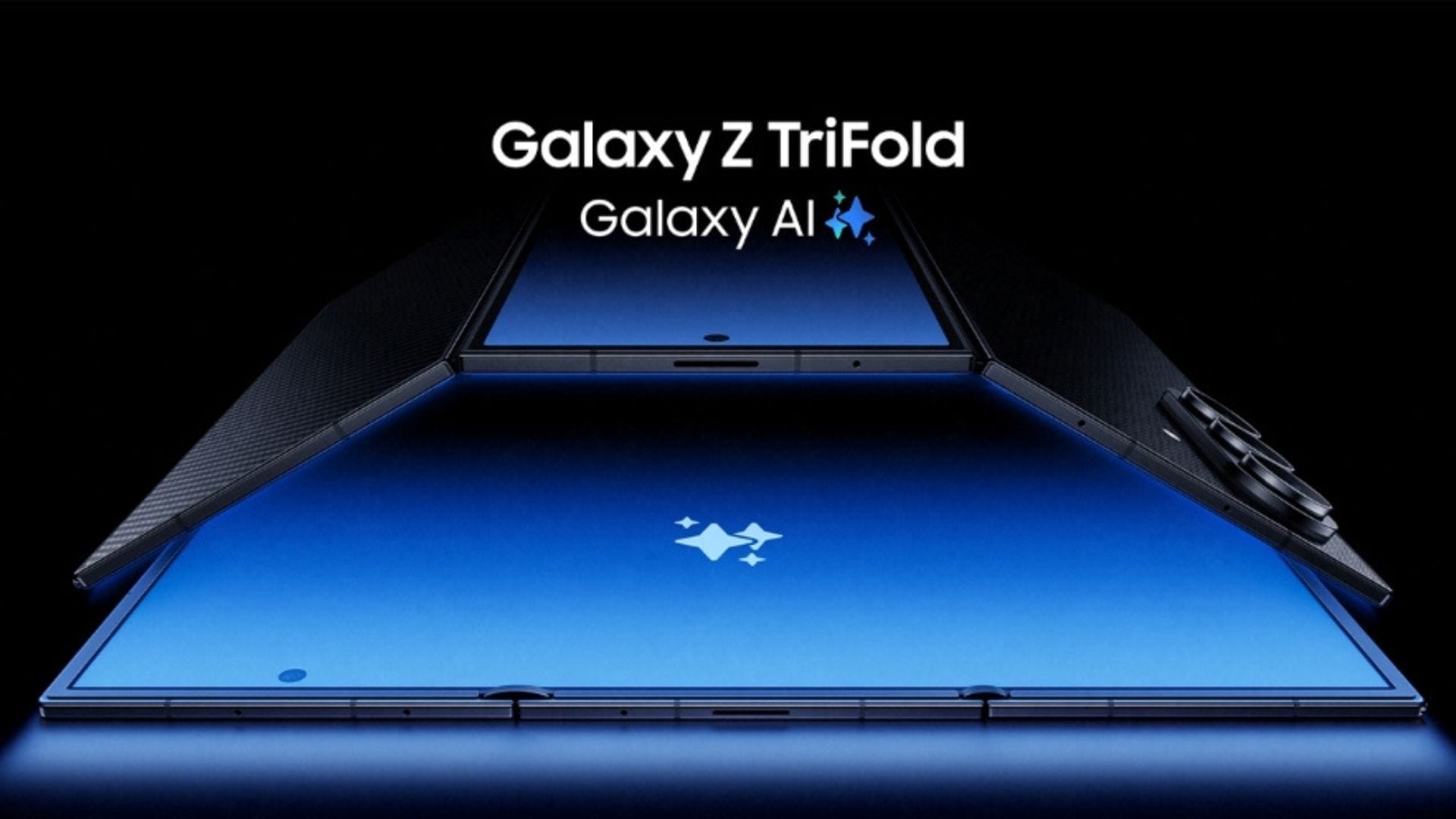
Samsung has officially introduced the Z TriFold, a foldable device that opens out into a large tablet-style display using two hinges. The company revealed the product on 2 December, confirming that it will first reach consumers in South Korea on 12 December. A US release is scheduled for the first quarter of 2026. Samsung has not shared US pricing, but the handset will retail in South Korea for KRW 3,590,400, which is roughly US$2,500 for the 512GB model.
The Z TriFold is Samsung’s most ambitious foldable yet, aiming to deliver a tablet-like experience in a device that folds down to the size of a phone. It arrives at a time when smartphone makers are experimenting with new form factors, and Samsung is positioning this model as a major step forward in its foldable portfolio.
Design and display
The Z TriFold opens to a 10-inch inner display with a resolution of 2160 x 1584 and a 120Hz adaptive refresh rate that scales down to 1Hz when needed. This large panel allows users to run three apps vertically in a split-screen layout. It also supports Samsung’s DeX desktop environment in standalone mode, allowing it to function as a productivity workstation without an external monitor.
The outer display resembles the panel found on the Z Fold 7. It measures 6.5 inches, features a 1080p resolution and uses a tall 21:9 aspect ratio. This cover screen serves as the main interface when the device is closed, working much like a traditional smartphone display.
Each of the TriFold’s three sections has a slightly different thickness. The centre panel, which houses the USB-C port on its bottom edge, is the thickest at 4.2mm. One of the outer panels measures 4.0mm, while the thinnest panel, at 3.9mm, includes a physical SIM tray. When folded, these outer panels close inward over the centre section. This is different from Huawei’s Mate XT, which uses a Z-shaped fold and exposes part of its internal display when closed. Samsung says the main screen “undergoes a 200,000-cycle multi-folding test, equivalent to folding the device approximately 100 times a day for five years”.
When folded, the Z TriFold measures 12.9mm thick, making it noticeably thicker than standard smartphones such as the Galaxy S25 Ultra, which measures 8.2mm, and the Z Fold 7, which is 8.9mm when folded. However, it is close in thickness to the previous Z Fold 6, which reaches 12.1mm when closed.
Build and durability
Despite its new form factor, the Z TriFold maintains dimensions and weight similar to Huawei’s Mate XT models. Samsung’s device weighs 309g, only slightly heavier than the Mate XT’s 298g, and is 12.9mm thick when folded compared to the XT’s 12.8mm.
Samsung has reinforced the back panel with what it calls a ceramic-glass fibre-reinforced polymer, designed to reduce the risk of cracking. The two hinges are not identical in size but share a dual-rail structure protected by a titanium housing. As with other recent foldables from the company, the Z TriFold carries an IP48 rating, which ensures full water resistance but does not guarantee protection against dust.
With a complex internal design, fitting in a complete camera system and battery layout is challenging. Nevertheless, Samsung has included a triple-camera setup on the rear: a 200-megapixel wide-angle lens with an f/1.7 aperture, a 12-megapixel ultrawide camera and a 10-megapixel telephoto unit with 3x optical zoom. Both the inner and outer screens also include 10-megapixel selfie cameras.
Each of the TriFold’s three panels contains part of the battery, resulting in a combined capacity of 5,600mAh. Samsung says this approach helps balance weight across the device and maintains stamina despite the large screens. Qualcomm’s Snapdragon 8 Elite powers the Z TriFold for Galaxy chipset, the same processor used in the Galaxy S25 series, and comes with 16GB of RAM.
Features and limitations
Although the Z TriFold offers an expansive display and is intended to be a hybrid of phone and tablet, it lacks one feature that many productivity-focused users may expect. Samsung spokesperson Elise Sembach confirmed that the Z TriFold does not support the S Pen. She said, “The TriFold lacks support for the company’s Bluetooth stylus”. Samsung previously offered stylus support on its Z Fold models, but removed the feature with the Z Fold 7 and has not reinstated it for the new triple-folding device.
Samsung has also chosen not to reveal detailed pricing outside South Korea for now. The company has stated only that more information will be shared closer to the US launch window. Until then, the South Korean price of roughly US$2,500 serves as the best indication of where the device will sit in the market.
The introduction of the Z TriFold marks a significant moment for Samsung’s foldable strategy. With a design that offers more screen space than any previous Galaxy foldable, the model is expected to appeal to early adopters and users who want a large digital workspace without carrying a separate tablet. However, its thickness, weight and premium pricing may limit its appeal to a wider market.
Analysts will be watching to see how consumers respond to Samsung’s dual-hinge approach, particularly as foldables continue to gain ground but remain a niche segment of the smartphone industry. With competition from Chinese manufacturers intensifying, Samsung is likely hoping that the Z TriFold’s unique design will reinforce its position as a leader in the category.