


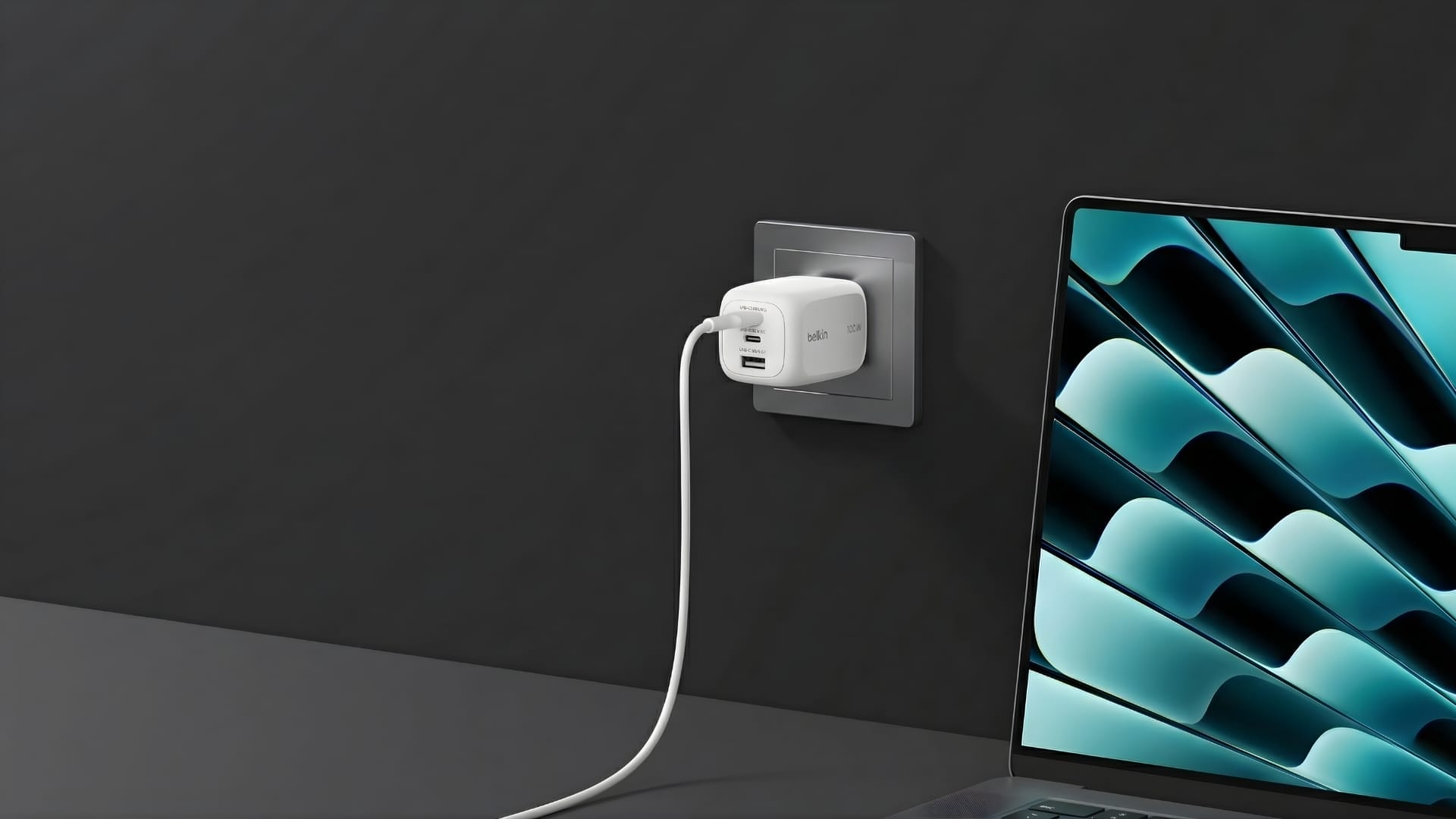
Most professionals today carry a laptop, a smartphone, and at least one or two accessories, such as wireless headphones or a smartwatch, in their bag. This shift has turned the simple act of charging into a logistical hurdle. The limited number of outlets in coffee shops, airport terminals, and hotel rooms has created a constant state of competition between these devices. For years, the only solution was to carry a dedicated power brick for every item, leading to a heavy, tangled mess of plastic and copper at the bottom of a backpack. The Belkin BoostCharge Pro 3-Port GaN Wall Charger 100W arrives as a direct response to this clutter, attempting to condense the power needed for an entire workstation into a single, pocketable unit.
Our verdict
A strong multiport charger that delivers laptop-grade power in a travel-friendly design, with tight port spacing and a slightly bulky front layout as its main compromises.
Pros
- Strong enough to power a laptop while charging two smaller devices at the same time.
- Smaller than many multiport chargers and easier to carry for travel.
- Interchangeable plug tips make it more flexible across different regions.
Cons
- Ports are close together, so thicker cables can make the front feel cramped.
- The body is still thick despite being compact for a 100W multiport charger.
This charger is a significant step forward in how people manage portable power. It has moved past being a basic utility and is now a specialised tool designed for the specific needs of modern remote work. By using Gallium Nitride technology, often referred to as GaN, Belkin has managed to bypass the limitations of older silicon-based chargers. Those older models were notoriously bulky and prone to overheating when pushed to their limits. GaN enables much higher efficiency in a smaller footprint, allowing more power to be delivered without the risk of the charger becoming uncomfortably hot to the touch. The goal here is simple, to provide a high-output charging hub that can power everything from a professional-grade laptop to smaller devices, while taking up less space than most multiport chargers.
Built for travel, with a shape that fits more setups
The physical design of a charger is often overlooked in favour of its technical specifications, but the shape of the BoostCharge Pro 100W reveals a deep understanding of how people actually use these devices in the real world. Most high-capacity chargers are designed as long, rectangular blocks that protrude several inches from the wall. While this looks fine, it creates a leverage problem in practice. In older buildings or public spaces where wall sockets have become loose over time, these heavy, protruding chargers tend to sag or fall out entirely under their own weight. Belkin addressed this by giving the unit a lower, wider profile that sits much closer to the wall. This shifts the centre of gravity toward the socket, ensuring the charger stays securely plugged in even when multiple heavy cables are pulling on it.
This flatter orientation also solves the problem of tight spaces. Anyone who has tried to plug a laptop into a socket hidden behind a heavy hotel headboard or a low shelf in a library knows that vertical clearance is often at a premium. Because this charger is wide rather than tall, it can fit into these narrow gaps where traditional bricks simply cannot. This level of thoughtfulness extends to the travel features as well. The unit comes with a set of interchangeable plug tips, allowing it to transition seamlessly between different international regions. Rather than carrying a separate, often flimsy universal adapter that adds bulk and instability, users can simply click on the appropriate regional plug. It turns the charger into a native device regardless of the country, maintaining its stable, flush fit against the wall.
However, there is a natural trade-off to this compact, triple-port design. Because the face of the charger is relatively small, the three ports are positioned quite close to one another. For users who rely on standard USB-C cables, this is rarely an issue. But if the setup involves heavy-duty or reinforced cables with large, chunky connector heads, the front of the device can quickly become congested.
Power distribution defines real-world usability
One of the key features of this charger is its ability to handle demanding hardware, but how power is managed across multiple ports defines the daily experience. When used in a single-port configuration, the BoostCharge Pro delivers its full 100W output via either USB-C port. This is more than enough to fast-charge a high-end 16-inch laptop or a powerful Windows workstation, often performing as well as, or even better than, the original power supply that came in the box. This makes it a legitimate primary charger, allowing a user to leave their heavy manufacturer brick at home without sacrificing any charging speed.
The real intelligence of the device is seen when all three ports are occupied. Charging multiple devices at once has ceased to be as simple as dividing the total wattage by the number of ports. Instead, this charger uses a specific power-sharing logic designed to support a primary workflow. When three devices are plugged in, the top USB-C port is prioritised, providing up to 60W of power. This ensures that even while other devices are charging, the laptop, which is the most power-hungry tool, continues to receive a steady flow of energy. The second USB-C port delivers up to 22W, ideal for fast-charging a smartphone or tablet, while the USB-A port provides a consistent 18W for smaller accessories like headphones or a smartwatch.
This distribution hierarchy reflects how people actually use their tech. It recognises a common setup in which phones and earbuds are secondary, while the laptop remains the primary device that requires consistent power during active use. By allocating the largest share of power to the main device, Belkin prevents the trickle-charge frustration often found in cheaper multiport adapters, where each new device added slows the others to a crawl. It creates a predictable, reliable environment where a user knows their core machine will stay powered regardless of what else is plugged into the brick.
Paired with a 240W magnetic cable in daily use
The charger provides the power, but the cable shapes how that setup fits into daily use. Pairing the 100W unit with the BoostCharge Pro Magnetic USB-C Cable 240W turns it into a more organised system. The cable is rated well above the charger’s output, so it is never a limiting factor. The more meaningful benefit is how it behaves when not in use.
Magnets along the cable allow it to coil neatly on its own, reducing clutter and speeding packing. It removes the need for cable ties and keeps bags free of tangled wires. The trade-off is added rigidity. The cable holds its coiled shape and does not always sit flat straight away, but that stiffness also points to a stronger build and longer-term durability.
The verdict: BoostCharge Pro 3-Port GaN Wall Charger 100W
The BoostCharge Pro 3-Port GaN Wall Charger 100W is a refined solution to a problem that has plagued the tech industry for a decade. It is a device that recognises that the era of carrying multiple single-device bricks has passed. Its strength lies in its balance; it is powerful enough to be the only brick a professional needs, yet small enough to disappear into a side pocket of a bag. The thoughtful, low-profile design ensures it remains useful in the unpredictable environments of travel, staying firmly planted in the wall when others would fail.
When paired with the magnetic cable, the charging setup feels more organised and easier to manage. It is a premium setup for those who have moved past the clutter and are willing to invest in a system that prioritises both performance and organisation. While the tight port spacing and the slight rigidity of the cable are minor points of note, they do little to detract from the overall utility of the package. For the remote worker, the frequent flyer, or the digital minimalist, this charger offers a reliable way to consolidate power without sacrificing the speed and safety that modern electronics require. It effectively turns a single wall outlet into a complete, high-speed charging station for an entire suite of gear.