


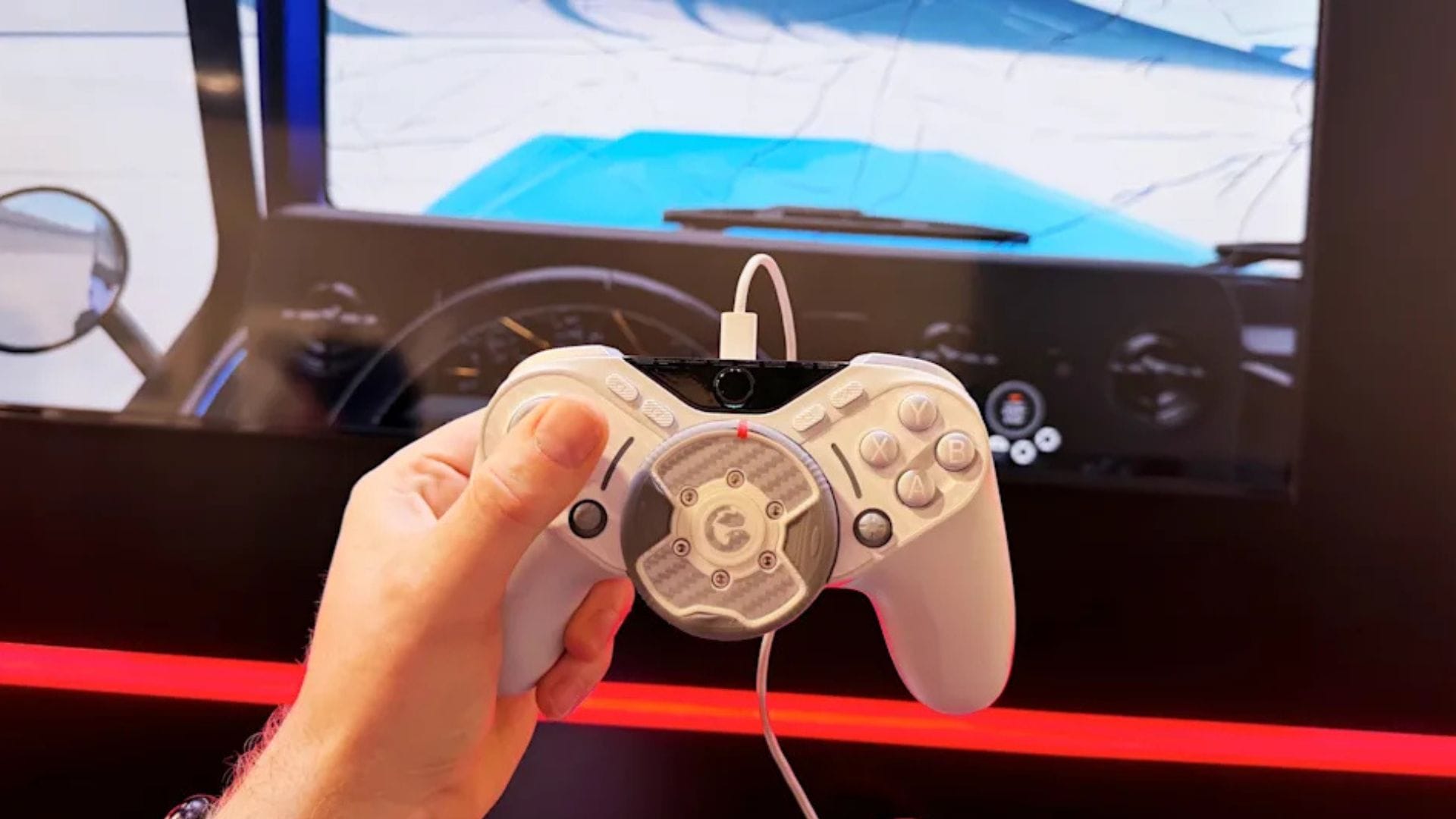
GameSir is introducing an unusual take on the standard game controller, revealing a device that places a compact force feedback steering wheel right in the middle of a familiar gamepad layout. The Swift Drive, which is said to be the working product name, recalls earlier niche hardware such as the JogCon released for the original PlayStation in the late 1990s, but brings modern engineering and technology to the idea. Instead of creating a full racing wheel setup, the company has attempted to merge precision driving controls with the convenience of a handheld controller.
At the heart of the design is a miniature steering wheel built into the centre of the controller. Unlike simple analogue inputs, this wheel supports force feedback, a feature usually reserved for dedicated and often bulky driving peripherals. According to GameSir, the wheel is supported by a “high precision” Hall Effect encoder that is designed to deliver “ultra-accurate” steering response during gameplay. Users can adjust the steering range from 30 degrees to 1080 degrees, allowing them to choose between tight arcade-style movement and wide, realistic steering.
The company has also integrated Hall-effect sensors into the more traditional joysticks and face buttons, aiming to improve durability and precision over time. Each trigger has its own haptic motor that can simulate driving conditions such as braking resistance or slipping tyres. On top of the controller, several RGB light strips mimic in-game RPM indicators, providing a playful nod to real vehicle dashboards while adding a visual layer to the experience.
Experience and performance
The controller was demonstrated on the show floor at CES, where attendees could test it using a simplified driving simulation. The demonstration involved piloting a large truck through a digital world of ramps and curved roads, designed to highlight how the steering wheel behaves during tight manoeuvres and sudden turns. Early impressions suggest that the force feedback is surprisingly strong for such a small wheel, providing resistance and motion similar to full-sized racing peripherals, yet contained within a controller frame that fits in the hand.
Those who tested the device found that rotating the wheel with both thumbs felt more natural than many might expect. The controller is designed to react when players oversteer or come to a stop, locking or resisting movement in a way that mirrors real driving conditions. GameSir has included customisable faceplates for the steering wheel, allowing players to adjust the look and potentially the grip of the central control depending on preference.
Despite the added mechanics, sensors, lighting and haptic motors, GameSir claims battery performance should remain practical for regular use. The Swift Drive is expected to last around 20 to 30 hours on a single charge, which would place it in line with many premium wireless controllers currently on the market. This will likely be an important factor for gamers who want an enhanced driving experience without sacrificing everyday usability.
Availability and outlook
A GameSir spokesperson stated that the Swift Drive is expected to be released later this year, although the company has not yet confirmed a price. That leaves questions about where the device will sit in the market, as the balance between novelty, engineering complexity and affordability will likely determine its success. If priced too closely to complete racing wheels, it may face competition from more established dedicated setups. If positioned nearer to standard controllers, it could attract players curious about driving games but unwilling to invest in large accessories.
The Swift Drive appears to be aimed at users who want deeper immersion in racing and driving titles without rearranging their living space to install a racing rig. It also looks positioned as a conversation piece, appealing to enthusiasts who enjoy unusual gaming hardware as much as the gameplay itself. With its mix of traditional controls and experimental engineering, it reflects the ongoing attempts by accessory makers to push beyond the familiar designs of mainstream controllers.
If the final retail model delivers on accuracy, comfort and reliability, the Swift Drive could become one of the more memorable gaming accessories to come out of recent years. For now, interest centres on how well this hybrid approach will translate from trade-show demonstrations to everyday gaming environments, and whether developers or players will truly embrace a steering wheel embedded in a controller.