


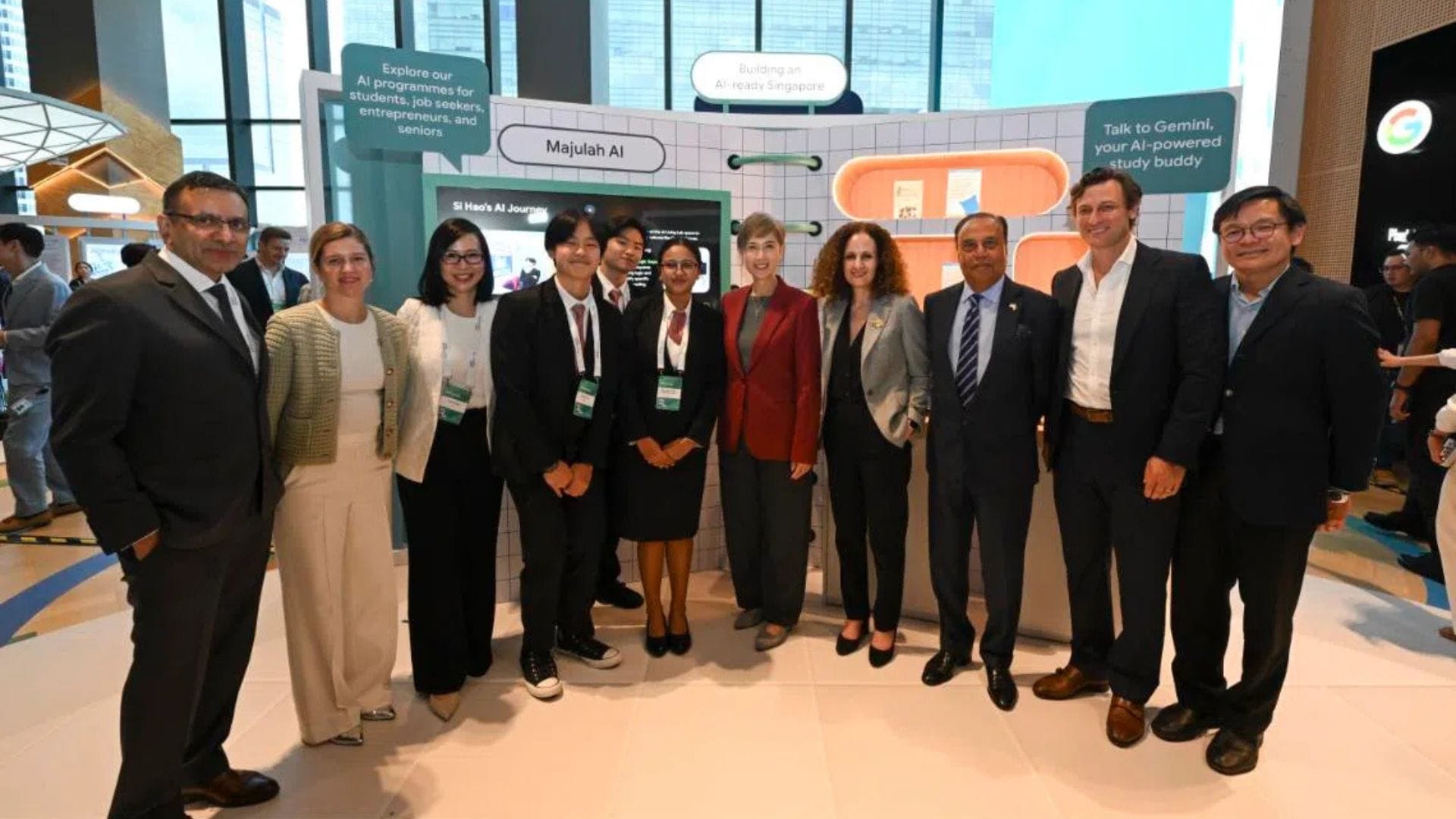
Google has announced a significant expansion of its artificial intelligence activities in Singapore, strengthening its research, talent development and trust initiatives as part of a broader commitment to the country’s national AI strategy. The announcement was made during the second Google for Singapore event, attended by Minister for Digital Development and Information Josephine Teo, and signals Google’s intention to deepen its long-term role in Singapore’s technology ecosystem.
Singapore has been Google’s Asia Pacific headquarters since 2007 and now employs nearly 3,000 staff locally. The company said its latest move builds on more than US$5 billion in technical infrastructure investment, including four data centres and cloud regions, as well as existing research facilities such as the Google DeepMind Research Lab, which focuses on advancing AI research across the region.
Strengthening research and industry innovation
Google said it is increasing its research and development footprint in Singapore by expanding specialist teams rather than investing solely in physical infrastructure. The company is growing its software engineering, user experience, research science and cloud engineering teams, to position Singapore as a deeper global research and development hub rather than a regional satellite office.
The company said this approach aligns with Singapore’s Research, Innovation and Enterprise Plan 2030, which prioritises building deep research capabilities with real-world impact. By developing technologies in Singapore that can be exported globally, Google aims to integrate its expansion with the country’s broader innovation agenda.
Ben King, managing director of Google Singapore, said the company views the expansion as a long-term partnership with the country. He said the goal is not simply to deploy technology locally but to work alongside Singapore to develop solutions that address local challenges while contributing to global innovation.
Google is also expanding its collaboration with AI Singapore to support the national healthcare AI infrastructure. Through access to its MedGemma medical model, the partnership aims to fine-tune a foundational health AI system tailored to Singapore’s healthcare environment. Google said the model is designed for local deployment so that sensitive patient data can remain within hospitals and research institutions rather than being transferred to external servers.
In addition, Google is working with local health technology startup AMILI on a precision nutrition programme that combines AMILI’s gut microbiome data with Google’s cloud and AI technologies, including Gemini. The programme aims to provide personalised nutrition and lifestyle guidance based on biological data, with the expectation that tailored recommendations could improve preventative health outcomes. The broader impact of the initiative will depend on future clinical studies and adoption within healthcare institutions.
Google.org has also provided US$1 million to support AI Singapore’s Project Aquarium, an open data platform designed to improve the representation of Southeast Asian languages in AI models. The initiative builds on earlier work such as SEA-LION, a family of language models developed for the region’s linguistic and cultural contexts.
To support enterprise innovation, Google is launching the Google Cloud Singapore Engineering Centre, a multidisciplinary hub where engineers will work directly with companies to address complex technical challenges. The centre will be located near the DeepMind Research Lab to shorten the path from research to real-world deployment. Moe Abdula, vice president of customer engineering for Google Cloud Asia Pacific, said the centre is intended to act as a global launchpad for companies based in Singapore, supporting expansion in fields such as robotics, clean energy and logistics.
Google is also introducing Startup School: Prompt to Prototype, a programme designed to help early-stage founders develop AI prototypes using tools such as Gemini and AI Studio without requiring advanced coding skills. The company said the initiative is the first of its kind in Southeast Asia.
Developing an AI-ready workforce
Alongside research and enterprise initiatives, Google is launching Majulah AI, a consolidated programme focused on workforce development in Singapore. The initiative brings together existing training programmes such as Skills Ignition SG, Google for Startups Accelerator: AI First, AI Cloud Takeoff and Gemini Academy, while adding new opportunities for students, educators and mid-career professionals.
A key component of Majulah AI is the introduction of Google AI Living Labs in partnership with the Ministry of Education. The first lab has opened at ITE College East, with plans to expand to Nanyang Polytechnic and other institutions. Google said the programme aims to reach 50,000 Singaporeans by 2027 and will provide hands-on environments for students and educators to experiment with AI tools and develop solutions for real-world business challenges, particularly for small and medium-sized enterprises.
Google is also partnering with the Infocomm Media Development Authority on the Skills Ignition SG AI Challenge, a three-month accelerator programme designed to equip 500 graduates and mid-career professionals with practical AI experience. The programme targets non-technical roles such as human resources, legal and marketing, offering hands-on training, mentorship and job-readiness support.
The company said these initiatives reflect its belief that AI infrastructure and innovation depend heavily on talent development. By training a broad range of professionals and students, Google aims to support Singapore’s ambition to build a strong and inclusive AI workforce.
Building trust, safety and security in AI
The final pillar of Google’s expansion focuses on building a secure and trusted AI ecosystem. The company is launching an AI Centre of Excellence for security in Singapore to research emerging risks, including those linked to advanced autonomous AI systems, while strengthening privacy and content safety across its platforms.
Google has also begun rolling out age-assurance solutions in Singapore, applying age-appropriate protections across products such as Search, Maps, YouTube, and Google Play. The system combines machine-learning-based age estimation with optional age verification, allowing younger users to receive protections while giving adults the option to correct any misclassification.
The company said these efforts build on existing partnerships with Singapore’s Cyber Security Agency and other organisations. Google Play Protect has blocked more than 2.9 million high-risk app installation attempts across more than 670,000 devices in Singapore over the past two years. Google has also worked with the Infocomm Media Development Authority and the Media Literacy Council to train 210,000 parents and children through the Be Internet Awesome programme.
Taken together, Google’s initiatives indicate a strategic commitment to Singapore as both a testbed for applied AI and a hub for exporting AI solutions globally. While the long-term economic and societal impact of these investments will depend on adoption and measurable outcomes, the scale of the programmes suggests sustained confidence in Singapore’s national AI direction.
Josephine Teo has previously emphasised that Singapore’s AI strategy prioritises trusted, inclusive and secure technology that delivers real value rather than rapid deployment for its own sake. Google’s expanded investment appears designed to align with that vision by combining research, talent development and security initiatives under a unified strategy.