

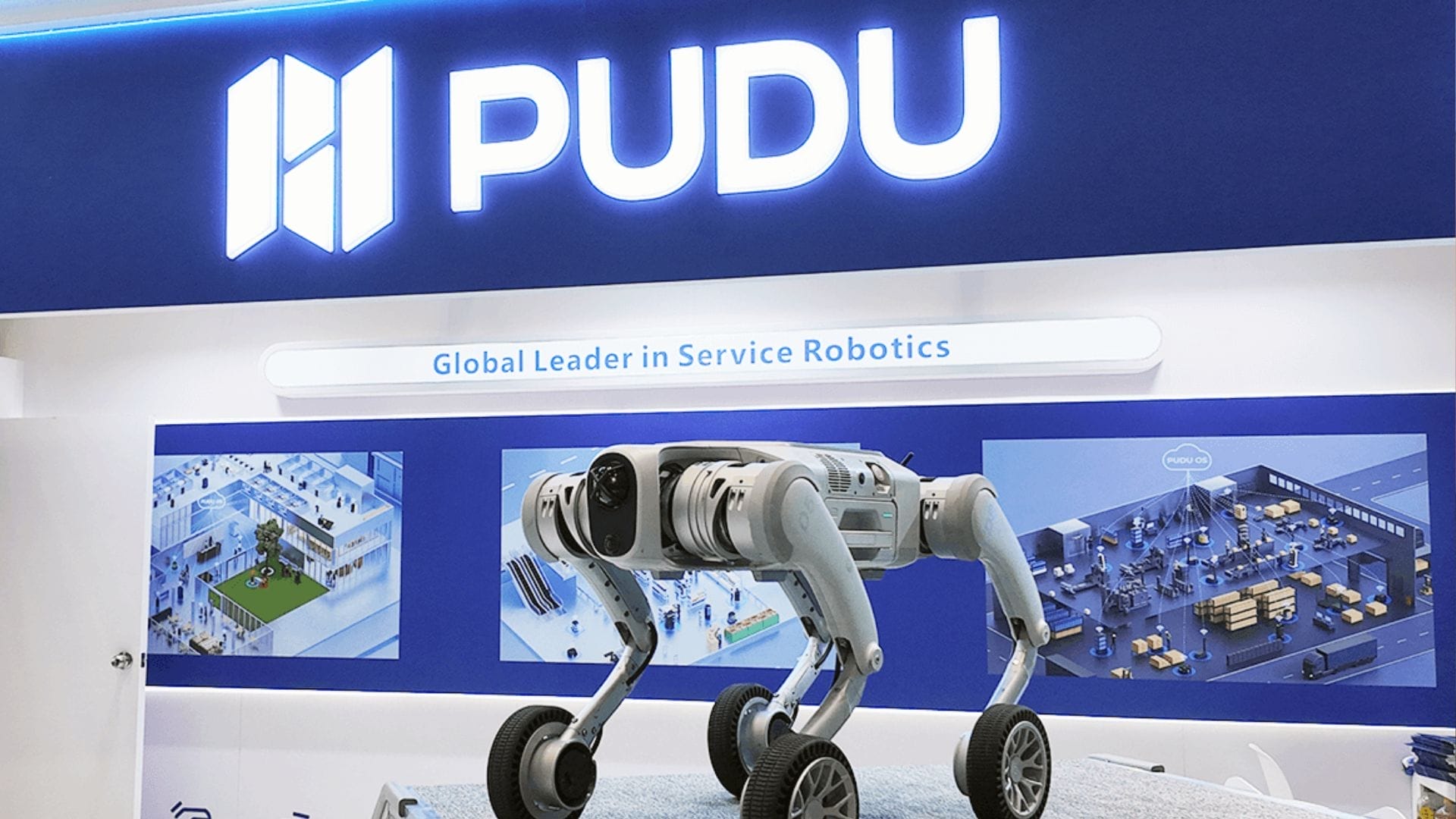
China’s Pudu Robotics has introduced its newest robot dog, the D5, as part of a wider push to strengthen its presence in overseas markets. The company showcased the four-legged machine at the International Robot Exhibition (IREX) in Tokyo, held from 3 to 6 December at Tokyo Big Sight. The D5 drew steady crowds during demonstrations, where it was seen descending stairs, avoiding obstacles, and even lifting one of its front legs in a gesture that resembled a greeting. Despite its canine form, the nearly one-metre-tall device moves on wheels, enabling it to glide smoothly across the exhibition floor.
The D5 is the second robot dog from Pudu, following a smaller, less agile model introduced in 2022. The company said rapid advances across the robotics sector in recent years have influenced the development of its latest machine. Improvements in motion-control algorithms, component quality and embodied intelligence have helped shape the D5’s capabilities. Chinese competitors such as Unitree Robotics and Deep Robotics have also contributed to this momentum, as their machines increasingly find practical uses in real-world industries.
Pudu’s chief executive, Felix Zhang Tao, said robot dogs are becoming more relevant across a range of environments. “Robot dogs have great application potential, from inspection and delivery to a wide range of industry-specific functions which can be customised, powered by high-performance computing,” he said in an interview.
Features and capabilities of the D5
According to the company, the D5 was designed to operate autonomously in a variety of environments, including rough terrain and challenging weather conditions. It is powered by Nvidia’s Orin chip and fitted with four fisheye cameras that offer 120-degree coverage. It also includes lidar sensors installed at both the front and rear to help it navigate surrounding obstacles without human assistance.
The machine uses joint modules and motors developed in-house by Pudu, which the company says contributes to its resilience and precision. The company views the D5 not as a consumer gadget but as a versatile working robot that can support businesses that need reliable inspection, monitoring, or delivery tools.
Shenzhen-based Pudu has carved out a strong presence in the service-robot sector. Its machines are often found in restaurants, hotels, factories, and logistics centres, where they help with routine tasks. The firm has sold more than 100,000 robots to over 80 countries and regions, reflecting a rapid expansion beyond its home market.
Growth and positioning in global markets
Founded in 2016, Pudu began by focusing on food-delivery robots for restaurants. Zhang, who studied engineering at the Hong Kong University of Science and Technology and has a background in tech media and unmanned aircraft ventures, directed the company toward markets where service robots could immediately address labour shortages or improve efficiency. Over the years, Pudu has established what it describes as a global network of more than 700 distributors and after-sales partners.
The company said Europe now contributes around 30 per cent of its revenue, while the Americas, the Asia-Pacific region outside China, and mainland China each account for roughly 20 per cent. Japan has remained a key market for Pudu since it entered the country in 2019 through partnerships with firms such as Skylark and SoftBank. Zhang said that rising political tensions between China and Japan had not had a noticeable impact on its local operations.
While Japan has been a long-standing leader in industrial robotics, Chinese companies have taken a strong lead in developing service robots. This advantage is partly driven by China’s large number of real-world testing grounds, rapid product cycles and falling manufacturing costs. Alongside Pudu, major contributors to the sector include Keenon Robotics, Yunji Technology and Robint Technology.
Zhang said Pudu’s next stage of growth would involve developing more specialised robots and expanding into semi-humanoid and humanoid forms. He said the company aimed to design machines that closely match the needs of customers in different industries.
Industry momentum and Pudu’s future plans
China’s humanoid-robot industry has grown rapidly in recent years, supported by government policy and technological advances. A research note from Morgan Stanley in December said leading companies in the sector had set ambitious goals for 2026. The note highlighted that orders announced in the second half of the year had already exceeded 2 billion yuan, or about US$282 million. Analysts warned, however, that limited capabilities in current-generation humanoid robots could slow growth in the near term.
After operating for nearly a decade, Pudu is approaching break-even and preparing for an initial public offering, according to Zhang. The company, once a popular choice for investors, raised more than 1 billion yuan through at least 10 funding rounds. Reports indicated that Pudu underwent layoffs and restructuring in 2022, a period that affected many technology firms as global economic conditions shifted.
Despite these challenges, Zhang said the company remains focused on long-term development. He believes the market for service robots is still far from saturated. “Robot penetration is still extremely low,” he said. “We work backwards, from what customers need, and that tells us what kind of robots must be built.”
Pudu’s latest debut at IREX highlights its efforts to remain competitive in a quickly evolving field, where innovation and real-world usefulness are increasingly important. The company sees the D5 as a demonstration of how service robots can move beyond novelty and into everyday operations for industries worldwide.