


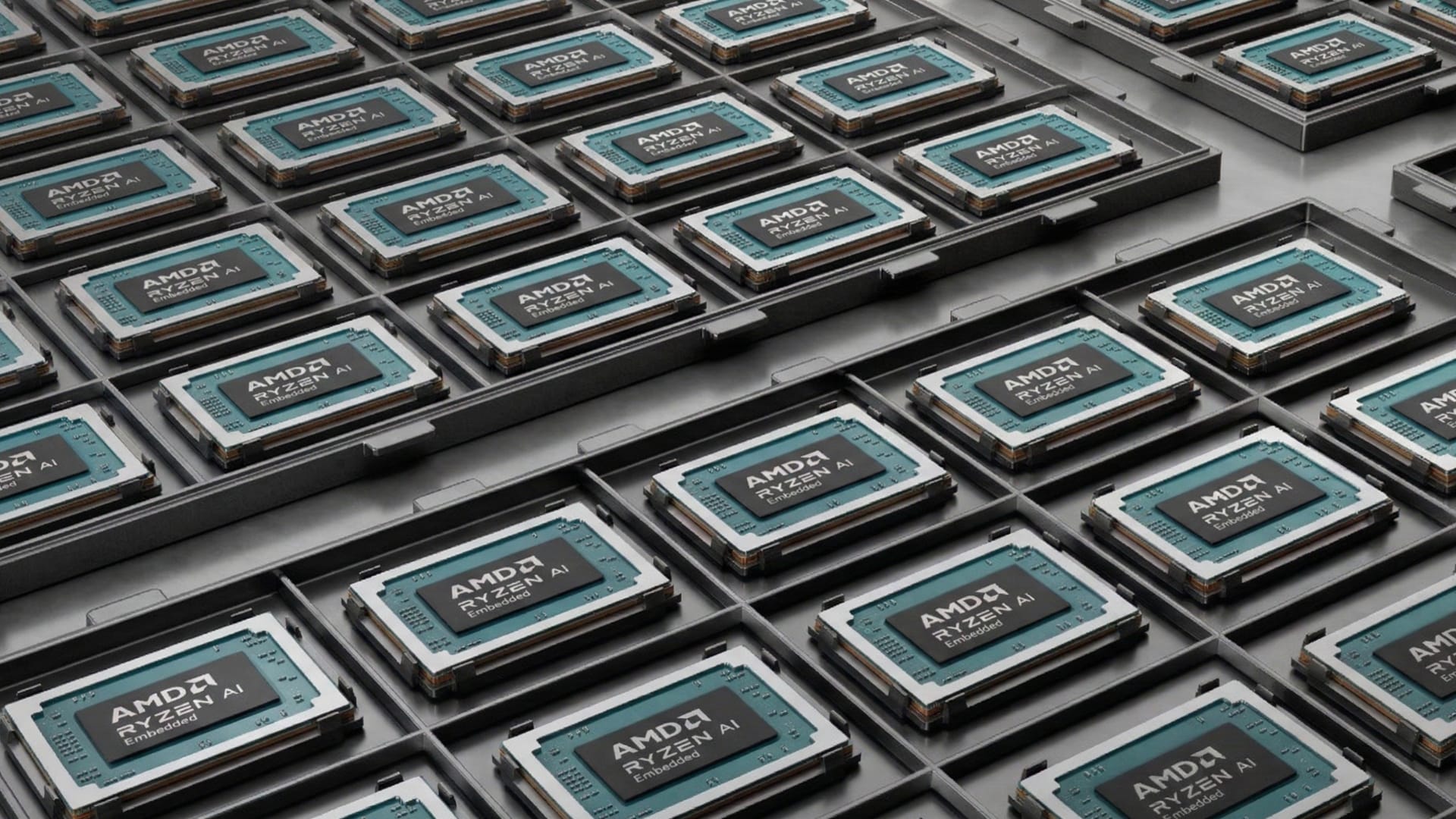
Demand for real-time artificial intelligence processing is expanding beyond cloud environments into factories, robots, and medical devices. AMD has extended its Ryzen AI Embedded P100 Series processor portfolio, targeting industrial and edge deployments that require high performance AI inference within compact and long-life embedded systems.
The expanded lineup is designed to support applications such as factory automation, mobile robotics, and medical imaging where computing platforms must deliver deterministic performance while operating continuously. AMD states the new processors provide higher compute density within the same compact ball grid array package.
Edge AI workloads reshape embedded processor design
Industrial AI systems increasingly combine vision processing, control logic, and inference workloads on a single platform. AMD says the expanded P100 Series processors deliver up to twice the CPU core counts and up to eight times higher GPU compute compared with previously announced P100 Series processors, alongside an estimated 36% increase in system tera operations per second performance.
The processors integrate eight to 12 Zen 5 CPU cores, AMD RDNA 3.5 graphics, and a neural processing unit based on the AMD XDNA 2 architecture. According to AMD, the architecture enables up to 80 system TOPS for physical AI acceleration while supporting real-time visualisation and low latency AI inference on a single chip.
Embedded deployments also place strict requirements on reliability and environmental tolerance. The processors support industrial temperature ranges from -40 C to 105 C, continuous 24/7 operation, and a 10 year lifecycle designed for embedded systems deployed in long term industrial environments.
Industrial automation and robotics drive new deployments
Factory automation represents one of the primary target environments for the new processors. AMD says the platform enables programmable logic controllers, machine vision systems, and human machine interfaces to run on a single industrial PC while maintaining the CPU performance required for inspection and process optimisation.
Mobile robotics is another deployment scenario highlighted by AMD. In these systems, the CPU manages navigation, motion control, and route planning while the GPU processes multicamera feeds for spatial awareness and visual simultaneous localisation and mapping workloads.
Healthcare imaging is also identified as a potential use case. The processors can support 3D imaging for ultrasound systems, endoscopes, and diagnostic imaging workflows, while AI models can assist with tasks such as tissue classification, tumour detection, and automated reporting at the edge.
Open software ecosystem aims to simplify deployment
Alongside the hardware expansion, AMD is extending support for its ROCm open software ecosystem to embedded applications. The platform allows developers to run standard AI frameworks while relying on open source compilers, runtimes, and libraries, which AMD says reduces the effort required to deploy AI workloads on embedded systems.
ROCm uses the Heterogeneous-computing Interface for Portability programming model, which separates GPU programming from the underlying hardware. AMD says this approach helps reduce vendor lock-in and enables developers to run AI workloads without rewriting code for different accelerators.
The processors also support a virtualised reference stack built on the Xen hypervisor. This allows operating systems including Linux, Windows, Ubuntu, and real time operating systems to run in isolated domains, enabling mixed workloads that require deterministic behaviour and safety isolation.
Hardware partners develop industrial systems around the platform
Embedded hardware vendors are already building systems based on the processors. AMD says production solutions powered by the Ryzen AI Embedded P100 processors are available from partners including Advantech, congatec, and Kontron.
“Advantech is proud to announce a comprehensive lineup powered by the scalable AMD Ryzen AI Embedded P100 processor portfolio. Featuring Computer-on-Modules, Single Board Computers, and Edge AI and Intelligent Systems, this portfolio leverages an enhanced integrated AI architecture to deliver high-efficiency multitasking that drives next-gen Edge AI advancement,” said Aaron Su, Vice President, Embedded IoT Sector, Advantech.
“With the launch of the AMD Ryzen AI Embedded P100 Series, congatec is able to expand its computer-on-module portfolio for embedded computing and edge applications with a highly versatile platform. It enables customers to precisely tailor performance, power, and cost to their specific application needs by offering four to 12 CPU cores and highly scalable GPU performance. This extraordinary level of flexibility is essential as edge workloads become more diverse, from industrial automation to AI-accelerated systems,” said Florian Drittenthaler, product line manager, congatec.
“The AMD Ryzen AI Embedded platform is a game changer for industrial and AI-driven applications at the edge. Our P100 based K4131-Px mITX will be equipped with four-core to 12-core APUs allowing us to offer customers an array of solutions that deliver high compute performance and AI acceleration in the same compact footprint,” said Thomas Stanik, senior sales & business development manager, Kontron.
Processors featuring eight to 12 CPU cores are currently sampling, with production shipments expected to begin in July 2026. Four to six core processors are also sampling now, with production expected in the second quarter of 2026.