


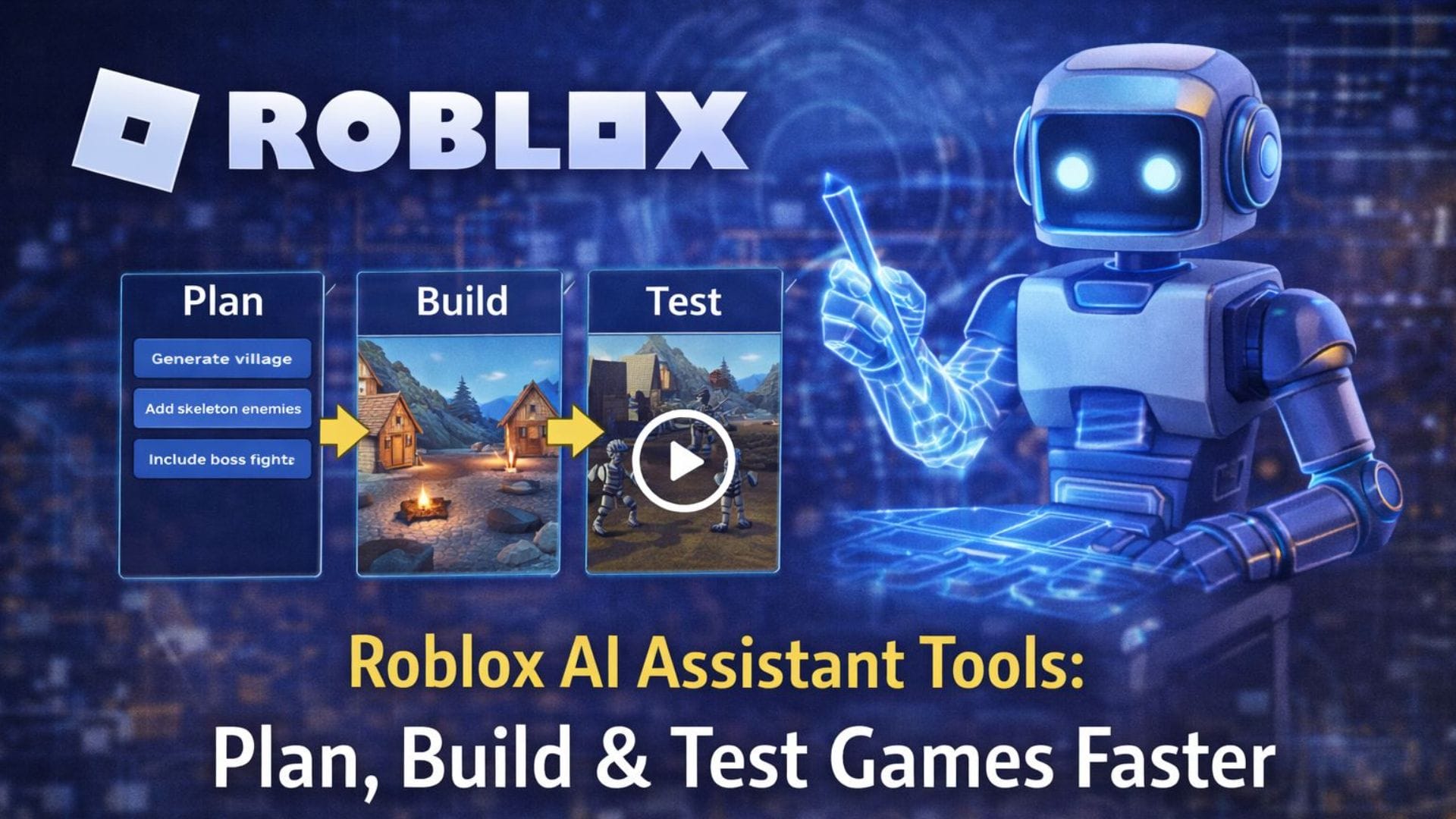
Roblox has introduced a series of new agent-based artificial intelligence features designed to help developers plan, build and test games more efficiently on its platform. The company revealed the updates as part of a major revamp of Roblox Assistant, its plain-language AI tool designed to support creators throughout the development process.
The updated assistant is intended to move beyond simple prompt-based outputs, which often deliver a single result without fully understanding the creator’s intentions. Instead, the new tools position the assistant as a collaborative partner capable of analysing project data, asking follow-up questions and guiding developers through structured workflows.
Planning mode transforms the development workflow
Central to the update is an enhanced feature called Planning Mode, which allows the assistant to analyse a game’s code and data model before generating a detailed action plan. Rather than immediately generating results, the assistant first asks clarifying questions better to understand the creator’s goals and creative direction.
The company explained that this approach helps ensure the final output matches the developer’s original vision. Creators can review the proposed plan, refine specific elements and add further context before any development work begins. This step-by-step method aims to reduce errors and avoid unnecessary revisions later in the process.
For instance, if a developer requests a park-themed mini game featuring a fountain and surrounding foliage where players collect coins, the assistant may ask about the preferred visual style. Options could include cartoony, realistic or fantasy-based designs. It may also ask how specific assets should be created, offering alternatives such as building from scratch, using existing models from the Creator Store or combining both methods.
Once a plan has been agreed upon, the assistant uses other integrated AI tools to carry out the development tasks. This process enables creators to maintain oversight while allowing the system to handle repetitive or technically demanding tasks, potentially reducing the time required to move from concept to a playable game.
New AI tools accelerate 3D asset creation
Alongside Planning Mode, Roblox has introduced two additional tools designed to speed up the creation of 3D assets: Mesh Generation and Procedural Model Generation. These features are intended to simplify early-stage development, when placeholder assets are typically used to test gameplay ideas.
Mesh Generation allows developers to create fully textured 3D objects directly within the game environment. Instead of relying on simple placeholder shapes, creators can generate detailed models that better represent the intended design. This approach enables teams to evaluate player interaction within a more realistic setting from the outset.
For example, a developer could instruct the assistant to create a campfire object, add lighting effects to enhance realism and set the scene at night. By producing more refined assets early in development, the system helps reduce the need for repeated revisions later in the process.
Roblox also revealed plans to introduce Procedural Models, which will enable developers to generate editable 3D structures using code and plain-language prompts. Because the assistant understands spatial relationships and object placement, creators can define how items should be positioned or scaled relative to one another.
This capability allows certain attributes to be adjusted dynamically. Details such as the number of shelves in a bookcase or the height of a staircase can be modified instantly, creating flexible components that can be reused across different parts of a game. The company believes these reusable elements will improve efficiency and encourage consistent design standards.
Nick Tornow, senior vice president of Engineering at Roblox, said the new tools represent a shift in how games can be created on the platform. “The launch of our agentic features in Roblox Studio reduces barriers between creative vision and execution,” he said in a statement. “Creating with Planning Mode and our Procedural Generation tools is a powerful new method for creators to turn their concepts into gameplay. Assistant works as a multi-step, collaborative development partner — accelerating the process of planning, building, and testing so that creators can get from idea to reality faster.”
Automated testing and future multi-agent workflows
The updated assistant also introduces enhanced testing capabilities designed to identify issues during development. As Planning Mode executes its assigned tasks, it uses integrated playtesting tools to monitor performance and detect potential problems.
These tools analyse output logs, capture screenshots and simulate player inputs using devices such as keyboards and mice. By reviewing gameplay interactions in real time, the assistant can identify bugs or design flaws and recommend corrective actions. In some cases, it can automatically apply fixes without requiring developer intervention.
Roblox explained that these features rely on agentic loops, a process in which the system repeatedly tests different elements, evaluates results and incorporates improvements into future iterations. This feedback cycle allows the assistant to refine its outputs over time, making it increasingly accurate and reliable.
“With the new capabilities across planning, building, and testing, Assistant is better at using agentic loops to test different aspects of the game, surface suggested solutions, and then incorporate the results into future planning loops, creating a self-correcting system that becomes more accurate over time,” the company stated in a blog post.
Looking ahead, Roblox confirmed that it is developing additional capabilities to enable multiple AI agents to work together simultaneously. These agents are expected to run complex workflows in cloud environments, handling tasks such as coding, testing and generating more realistic in-game characters.
The company also plans to expand compatibility with third-party development tools. Future updates aim to enable seamless integration with external systems, including Claude, Cursor, and Codex, enabling developers to use familiar workflows alongside Roblox Studio.
As competition intensifies in the game development sector, the introduction of agent-based AI tools highlights a growing shift towards automation and collaboration between human creators and intelligent systems. Roblox’s latest updates suggest the company is positioning its platform as an increasingly accessible environment for both experienced developers and newcomers seeking to bring their ideas to life.