

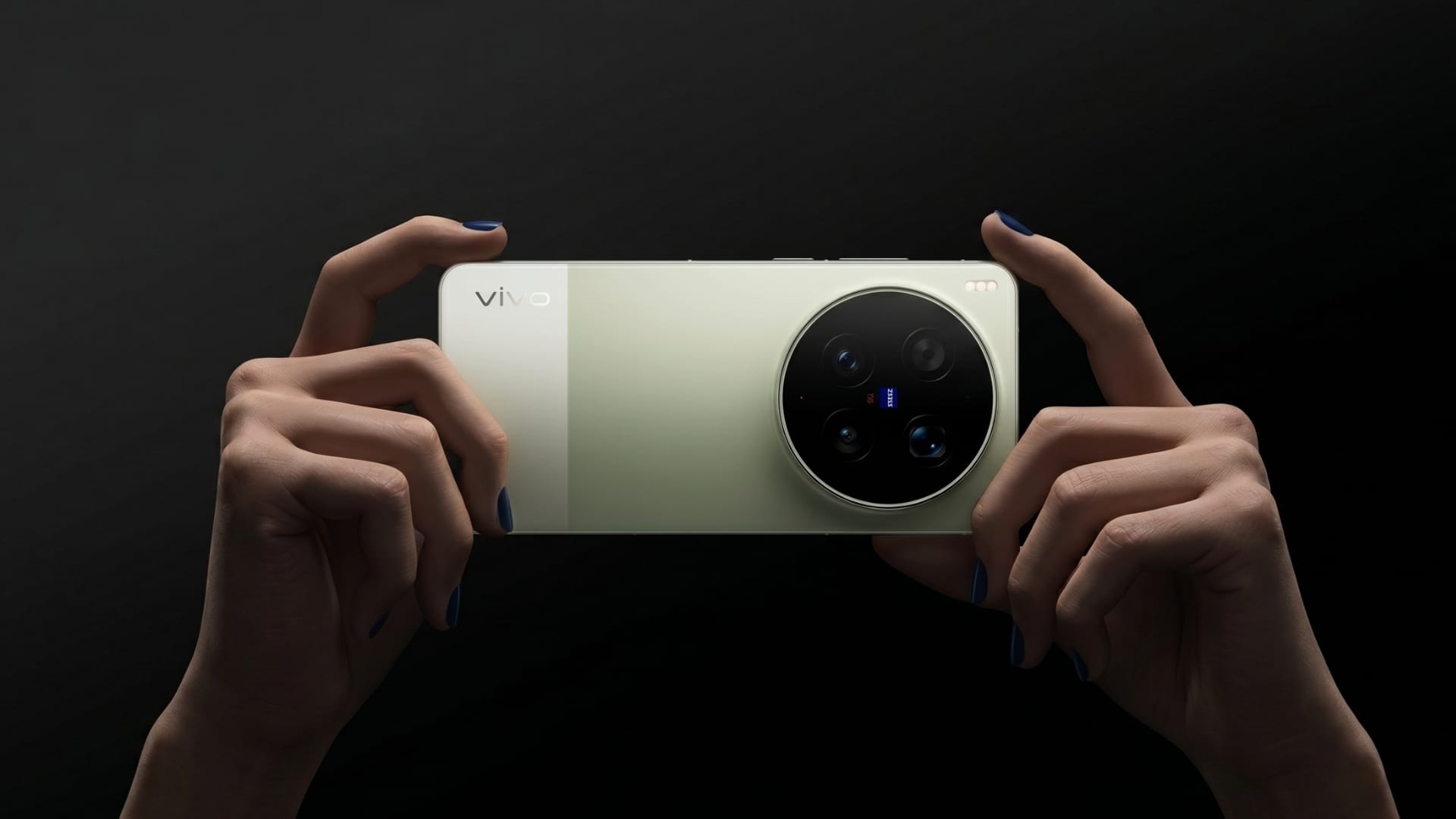
The vivo X300 Ultra makes a clear statement from the moment it leaves the box. This is not a device attempting to balance portability with performance in the conventional flagship sense. It leans entirely into imaging capability, building the phone around what the camera system requires rather than what fits comfortably in a pocket. Where most manufacturers keep camera systems modest enough to preserve slim profiles, vivo has taken the opposite approach.
Our verdict
The vivo X300 Ultra is a camera-first flagship that offers dual 200MP sensors, and a modular ZEISS photography kit to deliver optical reach and image quality that computational approaches cannot replicate.
Pros
- Dual 200MP rear cameras provide genuine resolution and crop flexibility
- ZEISS photography kit with 400mm/200mm extender for serious telephoto work
- Exceptional stabilisation with CIPA 6.0 and 7.0 ratings delivering smooth video
Cons
- Hi-Fi audio support absent
- Photography kit adds bulk and requires separate carrying
This design philosophy extends beyond the camera module itself. The 6600mAh battery exists because high-resolution sensors and physical stabilisation systems demand substantial power. The thick chassis accommodates the gimbal mechanism that enables CIPA ratings up to 7.0. The 1TB storage tier is necessary because 200MP RAW files and high-bitrate 4K video consume space rapidly. Each specification choice reinforces the camera-first hierarchy.
Heavy build houses dual 200MP sensors
The X300 Ultra is a substantial phone before the photography kit is attached. The Steppe Green model weighs 237g and features a glass back, while the Volcano Black version weighs 232g and features a glass fibre rear. Both measure 162.98 × 76.81 mm, with the green model slightly thicker at 8.49 mm compared with 8.19 mm on the black model.
That difference is small on paper, but it matters for a phone already carrying a large circular camera module. The rear housing protrudes clearly from the back, giving the device a camera-first profile rather than the cleaner silhouette of a standard flagship. It also makes the phone feel visually and physically weighted towards the top, especially when used one-handed or held in landscape orientation for shooting.
The flat-sided frame and large camera ring give the X300 Ultra a more deliberate, equipment-like appearance. It does not try to hide the camera hardware, and that honesty works in its favour. The trade-off is that the phone will not suit users looking for a slim, pocket-friendly flagship. It is built for those who are prepared to accept size and weight in exchange for a more ambitious imaging setup.
Durability also supports the outdoor shooting direction. Both variants carry IP68 and IP69 ingress protection, with IP69 providing resistance to high-pressure, high-temperature water jets in addition to standard dust and water protection. This does not make the phone risk-free in every shooting environment, but it gives users more confidence when using the device in rain, around water, or in less controlled conditions.
4500 nit display excels in outdoor visibility
The 6.82-inch AMOLED display offers 3168 × 1440 resolution with 510 ppi pixel density. The panel uses Q10 plus light-emitting material, which represents an advancement in OLED technology that improves both brightness efficiency and colour accuracy. The adaptive refresh rate spans from 1 Hz to 144 Hz, offering better power efficiency than the 10 Hz to 120 Hz range common in many flagships.
The most critical specification for photographers is the local peak brightness of 4500 nits. This figure represents localised brightness rather than full-screen brightness, achieved through advanced HDR processing and per-pixel brightness control. During midday testing in Singapore, the screen remained clear even under direct overhead sun, whereas many competing devices washed out entirely. This capability is fundamental for professional outdoor photography, where framing accuracy and exposure assessment depend on seeing the image clearly under all lighting conditions.
The display supports the P3 colour gamut and 105% NTSC colour saturation. The P3 gamut covers a wider range of colours than standard sRGB, particularly in greens and reds, which is essential for reviewing footage that will be displayed on professional monitors. The colour reproduction is accurate rather than oversaturated, which suits professional work where colour fidelity matters more than visual impact.
Camera system favours optics over computation
The rear camera system features three ZEISS-branded sensors with distinct focal lengths and capabilities. The 35mm ZEISS Documentary Camera uses the Sony LYTIA 901 sensor with 200MP resolution, a 1/1.12″ sensor size, and CIPA 6.5 stabilisation. The 85mm ZEISS Gimbal-Grade APO Telephoto Camera employs the Ultra-Sensing HP0 sensor with 200MP resolution, a 1/1.4″ sensor size, CIPA 7.0 stabilisation, and 3° OIS with 60 fps autofocus tracking. The 14mm ZEISS Ultra Wide-Angle Camera uses the Sony LYTIA 818 sensor with 50MP resolution, a 1/1.28″ sensor size, and CIPA 6.0 OIS. All three sensors feature ZEISS T* coating for improved contrast and flare control.
The dual 200MP design is particularly amazing. The Sony LYTIA 901 sensor at 1/1.12″ is substantially larger than sensors in most competing flagships, while the HP0 telephoto sensor at 1/1.4″ is among the largest periscope sensors in any smartphone. The CIPA 7.0 rating on the 85mm telephoto camera indicates the device can compensate for 7 stops of shake, comparable to professional gimbal systems used in filmmaking. The 3° OIS system physically tilts the sensor to counteract motion, providing a wider range than the typical 1 to 1.5° systems found in competing devices.
On top of this, the native 85mm telephoto camera delivers optical reach that most flagships cannot match without heavy computational processing. During testing of architectural subjects in Singapore, the 200MP HP0 sensor captured genuine detail and texture rather than algorithmically reconstructed sharpness. This is where the optical approach diverges fundamentally from computational zoom systems. Computational zoom uses AI reconstruction to predict what details should exist based on patterns learned from training data. The algorithm guesses where edges should be and sharpens accordingly, producing images that look sharp at first glance but lack the organic micro-contrast and tonal gradation of true optical resolution. The X300 Ultra’s 85mm telephoto captures actual light information, preserving subtle variations in tone and texture that computational systems smooth away.
Video stabilisation delivers a clear hardware advantage through the physical gimbal OIS system. During walking video tests, footage exhibited a gliding aesthetic with minimal vertical bounce. The sensor physically moves to counteract motion, rather than digitally cropping and warping the image. Panning motion was smooth and linear, with no stick-and-slip stutter. At the edges of the frame, trees and buildings remained rectilinear and stable, whereas electronic image stabilisation often produces corner wobble as the algorithm warps edge pixels.
Video taken with vivo X300 Ultra + 400mm lens (left) vs video taken with Samsung S25 Ultra (right) – 4K (est. 600-800m away)
The vivo applies ZEISS colour science, which favours accuracy over saturation. ZEISS colour profiles are calibrated to reproduce colours as they appear to the human eye under controlled lighting conditions. In direct comparisons with the Samsung Galaxy S25 Ultra, the X300 Ultra produces images with grounded colours and preserved tonal gradients. Samsung’s computational approach uses multi-frame processing and AI scene recognition to lift shadows aggressively and saturate colours, creating vibrant images that perform well on social media but can flatten the lighting hierarchy that gives photographs depth.


Photo taken with vivo X300 Ultra (left) vs photo taken with Samsung S25 Ultra (right)
The vivo allows shadows to remain dark, preserving cinematic contrast in night photography. Light from street lamps creates natural gradients rather than artificial halos, and the ZEISS T* coating on all three main sensors suppresses purple fringing around high-contrast edges. The T* coating is a multi-layer anti-reflective treatment that reduces internal reflections within the lens assembly, improving contrast and reducing flare in challenging lighting conditions.
The camera interface supports professional workflows through advanced modes. Log video recording preserves the maximum dynamic range by applying a logarithmic curve to the image data, compressing highlights and shadows into a flat image that retains more information for colour grading. The app includes modes for Spatial Camera, Stage Dual View, Underwater, Super Macro, Street Photography, and Pro Photo and Pro Video with manual controls. The 60 fps autofocus tracking on the 85mm telephoto camera ensures the 200MP sensor locks onto moving subjects quickly, which is essential for sports and wildlife photography.
Flagship performance and battery for extended shoots
The Snapdragon 8 Elite Gen 5 Mobile Platform powers the X300 Ultra, built on a 3nm process node with an octa-core CPU configuration of 2 × 4.6 GHz and 6 × 3.62 GHz. Paired with 16GB of LPDDR5X Ultra Pro RAM and 1TB of UFS 4.1 storage, the device sits at the top of the current flagship performance hierarchy.
Geekbench 6 results show a single-core score of 3,451 and a multi-core score of 10,055, outperforming competing flagships from Samsung, Xiaomi, and OnePlus. The single-core score reflects how quickly the device handles tasks that cannot be split across multiple processors, such as launching the camera app, autofocus calculations, or interface responsiveness. The multi-core score of 10,055 reflects performance when all processor cores work simultaneously, as when processing 200MP RAW files, applying computational photography effects, and running background tasks. Scores above 10,000 mean computational photography tasks that take 15 to 20 seconds on mid-range devices complete in under five seconds here. The processing power also handles productivity tasks such as editing documents, managing spreadsheets, or running multiple apps simultaneously without performance degradation.
The Adreno 840 GPU handles graphics with a Geekbench GPU OpenCL score of 23,611, reflecting its ability to handle parallel calculations for real-time bokeh effects, HDR processing, and AI-based scene detection. The 3DMark Wild Life Extreme score of 6,622 tests sustained performance under load, relevant when recording extended 4K video with filters applied. The Solar Bay score of 12,031 tests ray tracing performance, which is increasingly relevant for photography apps that use hardware-accelerated lighting simulations. The GPU also handles demanding mobile games at maximum settings with stable frame rates, though the 237g weight makes extended gaming sessions less comfortable than lighter devices.
The 1TB storage uses UFS 4.1 technology with sequential read speeds up to 4200 MB/s and write speeds up to 2800 MB/s. This allows the camera to capture multiple 200MP frames in burst mode without the buffer filling, and ensures 4K video is recorded at high bitrates without dropped frames. When transferring large files via USB 3.2, the storage speed keeps pace with the connection rather than becoming the bottleneck.
Photography kit transforms phone into modular camera
The vivo X300 Ultra Photography Kit includes the vivo ZEISS Telephoto Extender Gen 2 Ultra 400mm Lens, vivo ZEISS Telephoto Extender Gen 2 200mm Lens, phone case, tripod collar ring, lens cap, lens adapter, grip, strap, and filter adapter ring. The 400mm/200mm extender functions as an external optical element that mounts in front of the 85mm telephoto lens, adding physical glass elements that extend the effective focal length without degrading image quality through digital magnification.


Photo taken with Photo taken with vivo X300 Ultra + 400mm lens (left) vs photo taken with Samsung S25 Ultra (right)


Photo taken with Photo taken with vivo X300 Ultra + 400mm lens (left) vs photo taken with Samsung S25 Ultra (right)
During long-distance testing from roughly 1.65 km away, the external lens paired with the phone sensor captured distant signage and building textures with a level of clarity that digital zoom alone would struggle to reproduce. The combination preserves the physical relationship between focal length, aperture, and depth of field, which computational systems can only simulate. However, the setup requires the tripod collar for stability. At 400mm equivalent focal length, the magnification factor amplifies even minor hand movements, making handheld shooting impractical for sharp results. The tripod collar distributes the weight evenly around the mounting point, reducing torque and improving stability.
The grip includes its own independent battery, which powers the shutter button and extends shooting time. The camera interface displayed the grip’s battery level during testing, indicating proper software integration. The 62 mm filter adapter ring allows the use of standard photographic filters, including polarisers and neutral density filters. Polarising filters reduce reflections and enhance colour saturation, while neutral density filters reduce light entering the lens, allowing for longer exposures or wider apertures in bright conditions.
The verdict: vivo X300 Ultra + Photography kit
The vivo X300 Ultra is a specialist flagship built for a specific audience. Its 237g weight and substantial camera protrusion make it impractical as a general-use device, but mobile photographers, travel creators, and event shooters who need genuine optical capability will find value in the hardware approach. The device represents a deliberate departure from the computational photography consensus that has dominated flagship development in recent years.
The device is best suited for users who will regularly utilise the external lens kit and the high-resolution Sony LYTIA 901 and HP0 sensors. The 60 fps autofocus tracking on the 85mm telephoto camera and the CIPA 7.0 stabilisation are features that matter primarily to users shooting fast-moving subjects or working in challenging conditions. This is not a general flagship with a good camera. It is a camera-led flagship that happens to carry the rest of the modern checklist.
This is important because the phone is easiest to justify when its imaging hardware will be used frequently rather than treated as an occasional premium feature. The lack of Hi-Fi audio support is a minor drawback, though it reflects the focused nature of the device. The inclusion of IP69 protection and 1TB of fast UFS 4.1 storage reinforces its position as a rugged workstation designed for field use. This is a specialist tool that delivers optical quality computational systems cannot yet match, provided buyers understand the compromises involved and are prepared to work within the constraints of a modular camera system rather than expecting the simplicity of a point-and-shoot device.