

HONOR wants the 600 Pro to be seen as a “Next-Gen AI Imaging” phone, but that is only part of the story. After extended use, the clearer case for the device lies elsewhere. This is a flagship built around a 7000mAh battery, fast charging, controlled thermals, and a camera system that prioritises consistency over heavy-handed processing.
Our verdict
The HONOR 600 Pro delivers genuine flagship performance and imaging capability wrapped around a 7000mAh battery that redefines what all-day power actually means, though it trades benchmark dominance for thermal discipline and real-world balance.
Pros
- Exceptional battery life with genuine all-day comfort even under heavy mixed use
- Strong gaming performance with disciplined thermal behaviour
- Consistent camera output with natural colour science and reliable detail at standard focal lengths
Cons
- CPU multi-core performance sits below the most aggressively tuned Snapdragon 8 Elite rivals
- AI image-to-video tools suffer from spatial awareness failures and geometric instability
The HONOR 600 Pro takes a more measured route. It combines Snapdragon 8 Elite hardware, a 7.8mm chassis, IP69K durability, and a large 7000mAh battery in a package aimed more at everyday usability than spectacle. The real question is whether that mix, together with HONOR’s AI imaging pitch, adds up to a better flagship experience in daily use.
A design that looks familiar
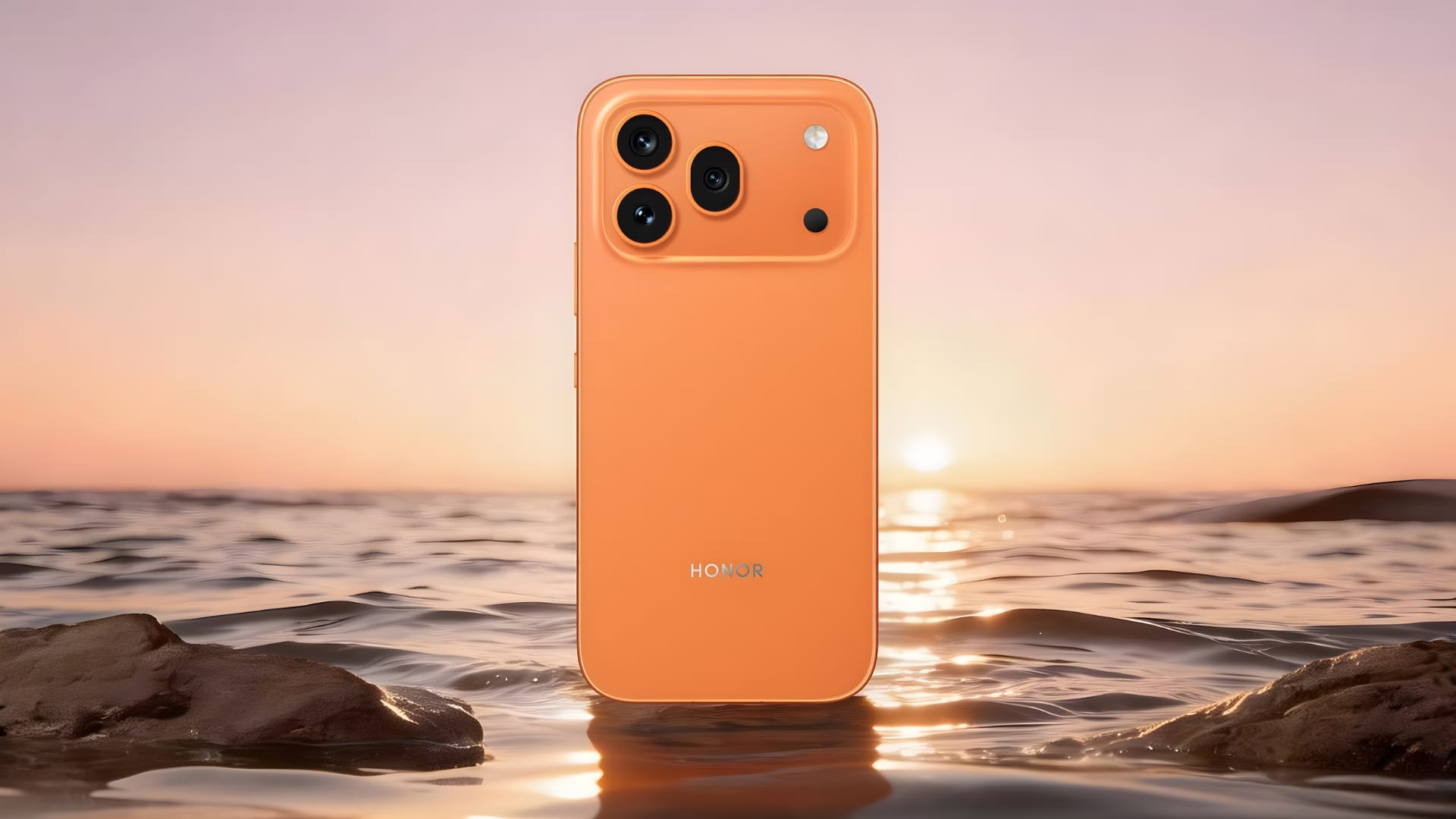
The HONOR 600 Pro does not work hard to hide its similarities to the iPhone 17 Pro Max. Its flat sides, symmetrical large-radius corners, large rounded-rectangle rear camera island, and even its orange colourway all contribute to a look that feels immediately familiar. The triple-camera layout is neat and well integrated, with the periscope telephoto sitting more prominently than the other modules, but the overall design feels closer to adaptation than distinction.
HONOR describes the phone as having a precision-carved unibody design. That may be marketing language, but the finish is clean, and the build feels polished. The frame, rear panel, and camera housing come together neatly, even if the phone does little to establish a visual identity of its own.
At 200g, the phone sits on the heavier side of the flagship category. That weight is noticeable during extended one-handed use or longer video recording sessions, though it never becomes unwieldy. The 7.8mm thickness helps offset some of that density, so the phone does not feel bulky in a pocket or overly slab-like in the hand. The camera island is more noticeable, creating a raised ledge at the back, but that is a familiar compromise for a phone with this kind of camera hardware.
HONOR also claims the device has the market’s narrowest black bezel at 0.98mm. The display does look clean and tightly framed, which helps the front appear more refined. The volume and power buttons sit on the right, while a dedicated AI button sits lower on the frame for quick access to image-to-video tools.
Durability is another part of the package. The IP69K rating goes beyond the more common IP68 standard, adding resistance to high-pressure, high-temperature water jets. That level of protection is more often associated with rugged devices than mainstream flagships. It may not change daily use for most buyers, but it does show that HONOR is treating durability as part of the product story.
Snapdragon 8 Elite performance with controlled thermals
The HONOR 600 Pro runs on Qualcomm’s Snapdragon 8 Elite, built on a 3nm process with the Oryon CPU architecture, paired with the Adreno 830 GPU and 12GB of RAM. That places it firmly in flagship territory, but the test results suggest HONOR is not pushing the chip as aggressively as some rivals.
Geekbench 6 returned 2845 in single-core and 8756 in multi-core. The single-core figure is close to those of the Samsung Galaxy S25 Ultra and S25 Plus, which matches the phone’s quick app launches, smooth interface movement, and responsive day-to-day use. The multi-core score is lower than some more aggressively tuned Snapdragon 8 Elite phones from brands such as vivo and OnePlus, so the HONOR 600 Pro is not leading this category in raw CPU throughput.
The graphics numbers are more interesting. In 3DMark Wild Life Extreme, the HONOR 600 Pro scored 6092 at an average of 36.48 FPS. Solar Bay returned 11,052 with 42.03 FPS, while Steel Nomad Light reached 2525 at 18.71 FPS. Those are strong results for a flagship phone, but the more useful detail is temperature. Surface temperatures stayed between 38°C and 42°C across these runs, indicating graphics performance stayed within control rather than rising quickly and forcing the phone to pull back.
That translates into a fairly clear gaming profile. In tests, Mobile Legends Bang Bang and Call of Duty Mobile run comfortably at high settings, while more demanding titles such as Genshin Impact are still very playable with a few heavier options lowered, especially during longer sessions. Shadows, effects quality, and render resolution are the first settings worth stepping down in such scenarios. The phone has enough graphics capabilities for most of the latest mobile games, but its CPU figures still sit behind the most aggressively tuned Snapdragon 8 Elite rivals.
A camera system built around consistency
The rear camera system centres on a 200MP main sensor with a 1/1.4-inch format and optical image stabilisation. That is joined by a 50MP periscope telephoto with 3.5x optical zoom and OIS, plus a 12MP ultrawide with a 112-degree field of view. The front camera uses a 50MP sensor with an f/2.0 aperture. It is a versatile hardware setup, and the results lean more towards consistency and natural rendering than dramatic processing.


Photo taken with HONOR 600 Pro (left) vs photo taken with iPhone 17 Pro Max (right)
Daylight shots from the main sensor are clean and dependable. Detail is strong without looking oversharpened, and colour balance leans slightly rich without tipping into obvious exaggeration. Greens remain believable, skies hold texture, and highlight control is measured enough to avoid harsh clipping in mixed lighting. HDR is present, but restrained. Shadow areas are not pushed aggressively, which keeps images looking more natural, even if they can appear less immediately striking next to phones that apply heavier HDR treatment.
The 3.5x periscope telephoto is one of the stronger parts of the camera package. It provides useful optical reach without collapsing into overly soft, processed results. Beyond that range, the phone leans on digital zoom and AI-assisted reconstruction. At 30x, the camera can still produce usable images for identification and casual sharing, but fine detail drops away, and processing artefacts become easier to spot. That is typical for this class of hybrid zoom, and the HONOR 600 Pro handles it competently without pretending it is delivering true optical clarity at extreme range.


Photo taken with HONOR 600 Pro (left) vs photo taken with iPhone 17 Pro Max (right)
The ultrawide camera maintains reasonable consistency with the main sensor in exposure and colour, though edge detail is weaker and overall sharpness is less impressive. Distortion is well controlled, with straight lines largely intact and edge stretching kept within reason. It is a dependable ultrawide rather than an exceptional one, which fits the wider character of the camera system.


Photo taken with HONOR 600 Pro (left) vs photo taken with iPhone 17 Pro Max (right)
Low-light photography relies heavily on computational photography. Night mode combines multiple exposures to lift shadow detail and restrain highlights, and it usually produces bright, usable images with decent balance. The downside is that some scenes can look slightly overprocessed, especially when facial details are softened or background textures are cleaned up too aggressively. The 200MP headline figure also needs context. Most standard shooting modes do not output full 200MP images. The sensor’s real advantage lies more in light capture and dynamic range than in producing extremely high-resolution files every time the shutter is pressed.
Video stabilisation is especially strong. In side-by-side walking footage against the iPhone 17 Pro Max, the HONOR 600 Pro produces a very smooth result, with aggressive electronic stabilisation doing a lot of work to flatten footfall movement and vertical bounce. The iPhone preserves more motion for a more natural-looking clip, while the HONOR aims for a more processed, almost gimbal-like finish. That can look impressive in isolation, though edge warping does appear at times when the system is working hardest to correct movement. Exposure handling and highlight control are both very solid, and colour from the HONOR leans cooler and more neutral than the iPhone’s warmer, richer treatment.
Viewed as a whole, the HONOR 600 Pro’s camera system is defined more by reliability than drama. It does not try to dominate with exaggerated HDR, oversharpening, or overly stylised colour. Instead, it delivers balanced results across different lighting conditions and focal lengths, with relatively few outright misses. For users who prefer a steadier camera character over punchier but less predictable processing, that approach has real value.
A 7000mAh battery that shapes the whole experience
The most important feature of the HONOR 600 Pro is its 7000mAh battery. That capacity is unusually large for a phone that is still presented as slim and premium, and it changes how the device feels in daily use. Mixed-use testing across a heavy 16-hour day, including 5G connectivity, camera use, navigation, social media browsing, video streaming, and gaming, consistently left 30% to 40% charge remaining by the end of the day. Lighter routines can keep the phone going for a second day without much difficulty.
Standby performance is also well controlled. Overnight, the drain typically sat at around 2% to 3% over eight hours, with background sync and notifications active. That points to effective power management rather than brute-force battery capacity alone. The large cell is clearly doing the heavy lifting, but the software is also avoiding unnecessary drain when the phone is idle.
Charging is fast enough to keep that big battery convenient. HONOR’s 80W wired SuperCharge can take the phone from low battery to full in roughly 50 minutes, depending on charger behaviour and thermal conditions. Wireless charging at 50W is also unusually practical, offering speeds that are fast enough to matter rather than existing as a feature on the specification sheet.
This is the area where the HONOR 600 Pro separates itself most clearly. Plenty of flagship phones are fast. Far fewer combine that level of performance with this much battery capacity and charging speed without becoming awkwardly thick or difficult to use.
AI features with mixed real-world value
HONOR markets the 600 Pro heavily around AI image-to-video generation and voice-driven photo editing. The flagship feature is AI Image to Video 2.0, which creates short clips from one to three reference images using text prompts. The dedicated AI button on the side of the phone is meant to reduce friction and make those tools easier to reach.
The ambition is obvious, but the results are uneven. Single-image video generation struggles with spatial awareness and object permanence. In one test using a static shot of the Singapore Flyer, the system hallucinated a second ferris wheel behind a building that was not present in the original image. Vehicles stretched and smeared across the road, while building lines warped as the virtual camera moved across the frame. The result was visually interesting, but not convincing as realistic motion.
Two-image generation works better because the system has more visual context. Even so, it still behaves more like a 2D morph than a true understanding of three-dimensional structure. In a test using two photos of a mechanical keyboard, the keys warped into one another during transition frames, rather than maintaining their shape and spacing. Perspective changes looked artificial rather than camera-like.
Voice-driven editing through AI Photo Agent is more practical. Object removal, scene adjustments, and prompt-based edits generally work, though the quality still depends heavily on scene complexity and how clearly the instruction is phrased. For casual edits, the feature is useful. For anything that requires precision, it remains less dependable than manual editing.
That leaves HONOR’s AI pitch in an awkward place. The tools are not useless, but they do not yet feel like the main reason to buy the phone. They are better understood as supplementary features attached to an already strong flagship package rather than as the centrepiece of the device.
MagicOS and ecosystem features
The Honor 600 Pro ships with Android 16 and MagicOS, HONOR’s custom interface layer. The software is clean by modern Android standards, with most bloat kept to app suggestions rather than heavy pre-installed clutter. Day-to-day navigation is smooth, app switching is fast, and multitasking rarely feels strained.
HONOR Connect is designed to link the phone with other HONOR devices such as the MagicBook Art 14, Pad X8b, Watch 4 Pro, and Earbuds 4. That usually means faster file transfers, a shared clipboard, and easier switching between connected devices. The catch is obvious. These features matter most to users who already own more than one HONOR product. Outside that ecosystem, they are less central to the experience.
The verdict: HONOR 600 Pro
The HONOR 600 Pro makes a stronger case through daily use than through novelty. Its 7000mAh battery gives it a level of stamina that many flagship phones still struggle to match, while fast wired and wireless charging keep that large battery convenient rather than cumbersome. The phone also handles gaming, multitasking, and extended camera use without heat becoming a constant concern, and the camera system is generally dependable across its main, telephoto, and ultrawide lenses.
Its weaknesses are just as clear. The AI features are present, but they do not yet feel mature enough to define the product. The camera is reliable, but it is not the strongest in every condition, particularly when zoom is pushed hard or low-light processing becomes too visible. The design, while polished, also borrows heavily from a familiar flagship template.
Even so, the HONOR 600 Pro gets the fundamentals right in ways that matter. It lasts a long time, charges quickly, stays manageable under load, and takes consistently good photos without trying too hard to impress at first glance.