

Framework has introduced the Laptop 13 Pro, a new premium version of its modular notebook that continues the company’s focus on repairability and long-term compatibility. The device marks the latest step in Framework’s expansion from a niche hardware maker to a more widely recognised laptop brand, while maintaining its commitment to interchangeable components.
According to the company, the new model is a “ground-up redesign” of the existing 13-inch platform. Despite the extensive changes, most parts remain compatible with earlier models, including the original Laptop 13 released in 2021. This means users can transfer components between generations with minimal difficulty, supporting the company’s goal of reducing electronic waste and extending device lifespan.
Chief executive Nirav Patel said the redesign reflects feedback gathered from a dedicated user base over several years. The updated model introduces a new chassis, larger battery, updated memory technology and a haptic trackpad. It is also offered in a black finish, which Patel acknowledged draws comparisons to business-focused laptops such as ThinkPad models. When this comparison was mentioned during discussions, Patel responded with a knowing smile, suggesting he regarded the similarity as complimentary.
Major hardware redesign focuses on battery life and performance
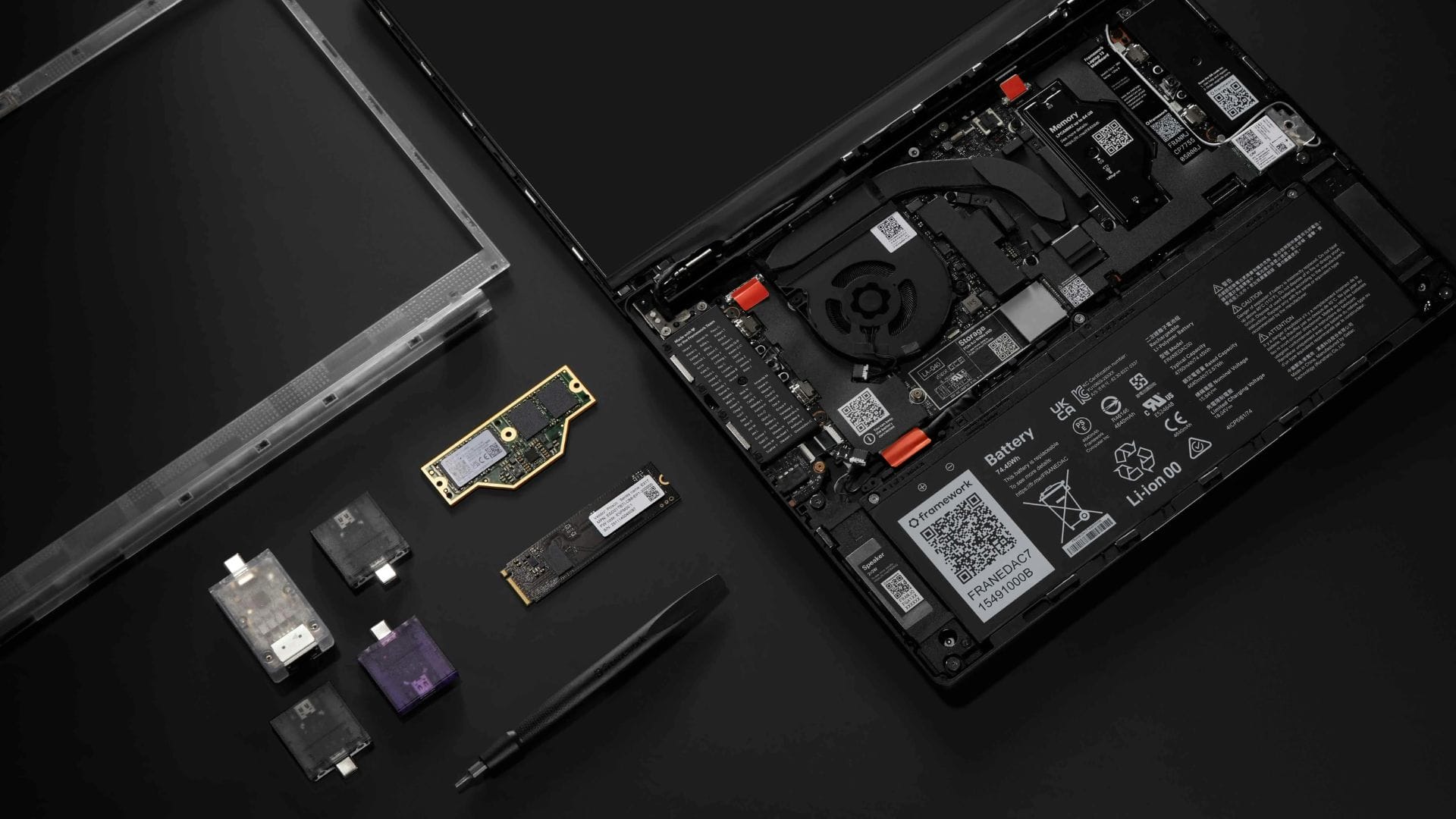
One of the most significant changes in the Laptop 13 Pro is its larger 74Wh battery, designed to address earlier criticism regarding battery longevity. This marks the second major increase in battery capacity, following earlier upgrades from 55Wh to 61Wh in previous versions. To accommodate the larger cell, Framework redesigned the lower chassis, smoothing out existing contours and creating additional internal space.
Framework claims the larger battery can deliver up to 20 hours of use during 4K video streaming. The company has indicated its intention to publish demonstration videos online to support this claim. However, the new battery cannot be installed directly into older models without additional components. Patel explained, “You’ll need the new bottom cover to fit, but because we’ve also increased the thickness of the battery, you have to switch over to the new input cover that has the haptic trackpad.”
Although certain upgrades require multiple parts to work together, Patel stressed that the modular philosophy remains intact. He stated that no component can be retrofitted into earlier devices, even if the process requires additional compatible parts. The redesigned chassis also introduces side-firing speakers certified for Dolby Atmos audio, improving sound quality compared with earlier versions.
Performance improvements are supported by Intel’s latest Core Ultra Series 3 processors, based on the Panther Lake architecture. These chips are designed to deliver strong performance while maintaining high energy efficiency. Framework offers several processor options, including Core Ultra 5, X7 and X9 models. According to the company, these processors can handle demanding games such as Cyberpunk 2077 alongside everyday productivity tasks. In addition to Intel configurations, the Laptop 13 Pro will also be available with AMD Ryzen AI 300-series mainboards, which are compatible with the 2025 generation of the standard Laptop 13.
New memory design and display enhancements expand usability
Another notable change is the move from traditional SO-DIMM memory modules to LPCAMM2 memory. This newer standard supports LPDDR5X memory, offering improved power efficiency and faster bandwidth. Unlike soldered memory designs found in many modern laptops, Framework’s implementation allows users to upgrade memory capacity later, reinforcing the device’s long-term upgrade potential.
Thermal performance has also been updated, an area previously identified as a challenge for earlier models. Patel said the cooling system has been refined once again with input from Intel engineers. During demonstrations, he noted that the test unit used for discussions had not activated its cooling fans for approximately 30 minutes. While this suggests improvements, final thermal performance will depend on real-world usage and testing conditions.
Display technology has also received substantial upgrades. The Laptop 13 Pro features a 13.5-inch touchscreen with a 3:2 aspect ratio and a resolution of 2,880 x 1,920 pixels. The display supports a variable refresh rate from 30Hz to 120Hz and delivers brightness up to 700 nits. Framework also reports a contrast ratio of 1800:1 and per-unit colour calibration, indicating a focus on visual accuracy.
The inclusion of touch support marks a shift from the company’s earlier stance. Patel explained that customers had requested touch capability since the original model launched in 2021. Initially, Framework resisted the idea, believing touch input was unnecessary for a productivity-focused laptop without a rotating hinge. However, experience gained during the development of the smaller Laptop 12 altered that view. Patel said, “It was a slam dunk. We know people want it, we used it on the 12, we like it, and it doesn’t actually cost that much. Let’s just add it in.”
Modular philosophy continues with upgrades and market availability
Framework has also introduced a haptic touchpad system designed to improve responsiveness and compete with premium laptops known for precise input control. The touchpad uses four piezo elements to simulate clicks, aiming to deliver a more consistent experience than traditional mechanical designs. The keyboard layout remains largely unchanged, retaining the fingerprint sensor and familiar typing feel from earlier models.
Design adjustments include a revised keyboard colour scheme combining shades of grey and black. Patel described the aesthetic as part of a broader effort to create what he called “the ultimate developer laptop”. This reflects the company’s ongoing focus on professional users who value flexibility and repairability alongside performance.
Existing Framework customers may be concerned about how the introduction of a “Pro” label affects current models. However, the company has emphasised that earlier systems can be upgraded incrementally to match the new model’s capabilities over time. This approach continues to distinguish Framework from traditional laptop makers that often limit compatibility between generations.
The Laptop 13 Pro is available for pre-order, with shipments expected to begin in June. The pre-built Windows configuration is priced from US$1,699, while the do-it-yourself version starts at US$1,199. These pricing options allow customers to choose between a ready-to-use system or a configuration assembled from selected components.
Framework’s latest release highlights the growing demand for repairable technology and demonstrates how modular hardware can evolve without abandoning earlier users. By combining new processors, expanded battery capacity and improved display features, the Laptop 13 Pro aims to strengthen the company’s position in the competitive premium laptop market.