

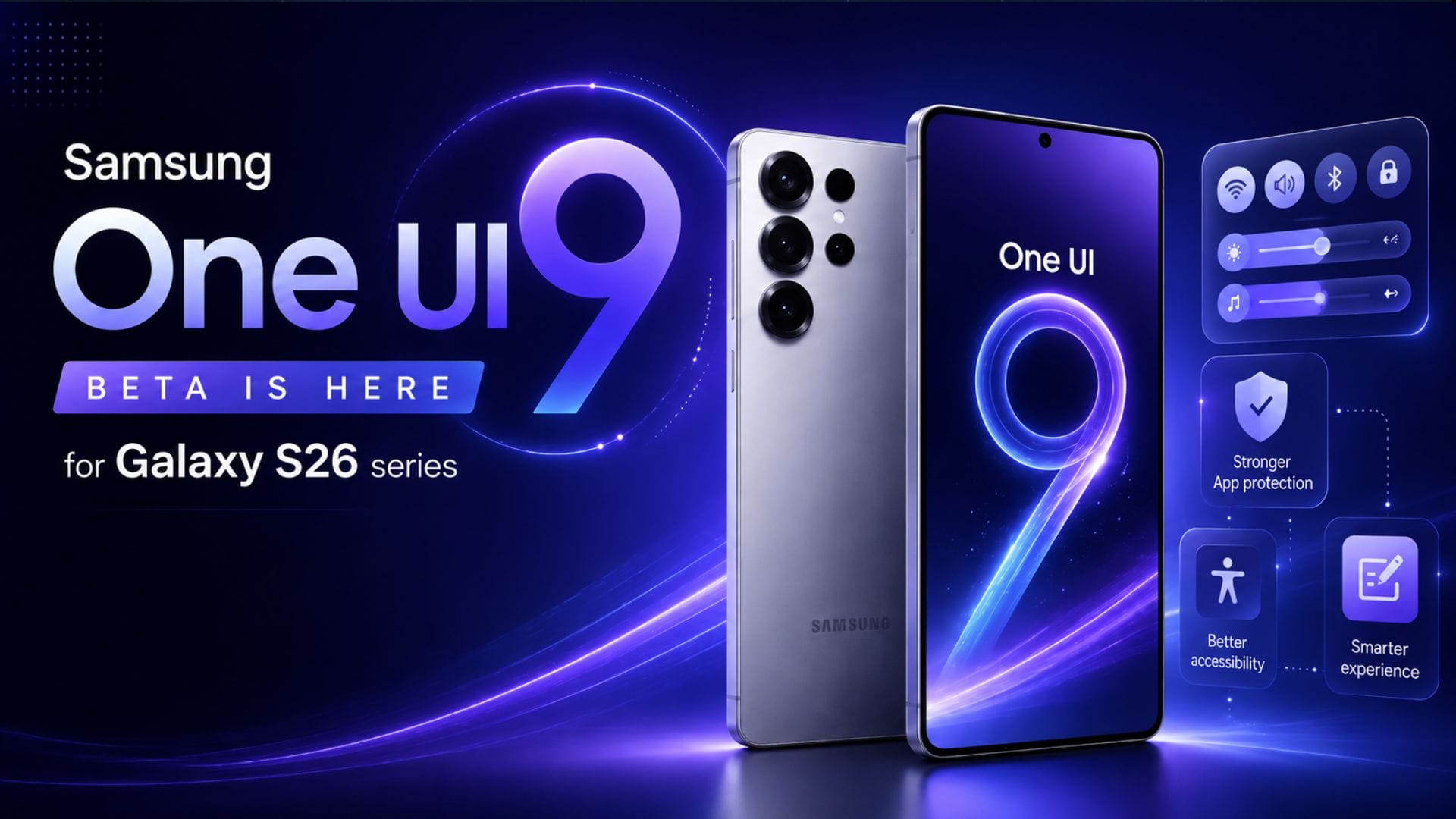
Samsung has begun rolling out the One UI 9 beta for Galaxy S26 users, giving selected customers early access to its latest Android 17-based software update. The beta programme launches this week in several markets, including the UK, the US, Germany, India, Poland and South Korea.
The update introduces a range of changes across accessibility, security and customisation tools. While some additions are relatively modest, Samsung has indicated that more advanced artificial intelligence features are being reserved for the final public release later this year.
Galaxy S26 owners interested in joining the programme can register through the Samsung Members app. The company said availability will vary by market and that the rollout will begin gradually over the coming days.
Accessibility and security receive major attention
Accessibility features appear to be a major focus in One UI 9. Samsung has introduced several tools to improve usability for people who rely on assistive technologies or external hardware.
One of the new additions allows users to adjust the mouse key speed when using an external keyboard. The feature is designed to improve navigation and make keyboard-based controls more responsive to individual preferences. Samsung has also added a tool called Text Spotlight, which enlarges and clarifies selected text in a floating window to improve readability.
The company has further updated TalkBack, its built-in screen reader that uses text-to-speech technology. In One UI 9, TalkBack is now integrated with Google’s equivalent accessibility service. The change is expected to create a more consistent experience for users who depend on spoken feedback and screen navigation assistance.
Security has also been strengthened in the beta software. Samsung said One UI 9 can detect high-risk apps and warn users before installation. In some cases, the system may block installation entirely if malicious behaviour is suspected. The feature is intended to reduce the risk of harmful applications being installed outside trusted app stores.
The company has not provided detailed technical information on how the detection system works. However, the move reflects growing industry attention on smartphone security as cyber threats targeting mobile devices continue to increase.
New design changes and creative tools arrive
Alongside accessibility and security updates, One UI 9 introduces several visual and creative changes across Samsung’s apps and interface.
The Quick Panel has been redesigned, with brightness, sound, and media player controls now separated for more flexible adjustments. Samsung has also expanded the panel’s sizing options, allowing users to customise the layout more freely according to their preferences.
Samsung Notes has gained new decorative digital tape designs and additional pen line styles. The changes are intended to offer users more creative options when organising notes or sketching content within the app. While these updates are relatively minor compared with larger system-wide features, they continue Samsung’s broader focus on personalisation tools.
The Contacts app has also been updated to include Creative Studio integration. This allows users to create personalised profile cards directly within the Contacts application, without switching between multiple apps. Samsung appears to be positioning the feature as a simpler way for users to customise contact profiles with graphics and visual elements.
Despite these additions, some early reactions to the feature list have been muted. Many of the visible changes focus on refinements rather than major redesigns or entirely new experiences. Samsung itself has acknowledged that more significant AI-powered functions are still to come.
Samsung hints at broader AI plans for final release
Samsung said the final version of One UI 9 will launch on “upcoming Galaxy flagship devices later this year”. Although the company did not confirm specific products, the statement is widely expected to refer to Samsung’s next-generation foldable smartphones, which are rumoured to debut in July.
The company has suggested that advanced AI features will be introduced with the full release rather than the beta version. Samsung has not yet outlined the exact capabilities it plans, though the wider smartphone market has increasingly focused on AI-driven productivity, image editing, and personal assistant tools.
By limiting some of these features to the final launch, Samsung may be aiming to generate greater interest in its upcoming flagship devices. The strategy would also allow the company more time to refine AI functions before making them available to a wider audience.
The beta programme allows Samsung to collect user feedback before the public release. Beta testing has become a common part of smartphone software development, allowing manufacturers to identify bugs, optimise performance and fine-tune features before a broader rollout.
For Galaxy S26 users, the update offers an early look at Samsung’s evolving software direction, particularly in accessibility and device security. However, the company’s decision to hold back major AI features means the final version of One UI 9 may ultimately play a larger role in shaping user expectations for Samsung’s next-generation devices.