

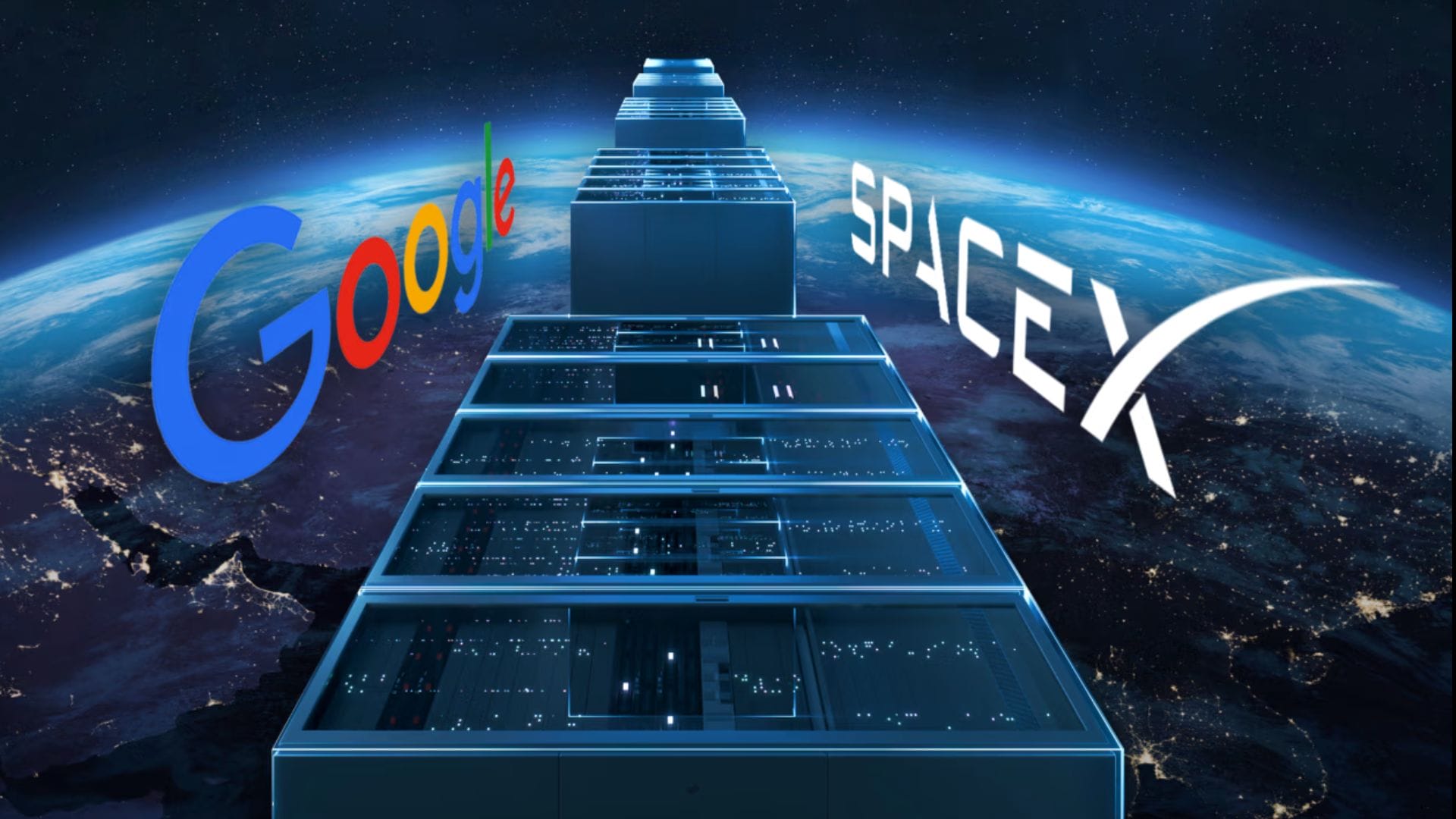
Google is reportedly in talks with SpaceX about a potential partnership to support the technology giant’s plans for orbital data centres. According to a report by The Wall Street Journal, the discussions could lead to the two companies collaborating on projects to deploy data-processing infrastructure in space.
If an agreement is reached, the partnership would bring together two firms that are also competing in the growing market for artificial intelligence and cloud computing services. The discussions reflect increasing interest among technology companies in using satellites and orbital systems to expand computing power beyond Earth-based facilities.
Google first revealed its ambitions for space-based data centres in November through Project Suncatcher. The initiative was presented as an exploratory effort to study whether data centres operating in orbit could become technically and commercially viable in the future.
Companies push forward with orbital computing plans
Google’s announcement came months before Elon Musk revealed plans to combine SpaceX with artificial intelligence company xAI. In February, Musk said the merged businesses intended to deploy one million orbital data satellites to support AI computing infrastructure.
The Wall Street Journal reported that Google has also held discussions with other rocket-launch providers as it explores options for launching future orbital systems. The company is already working with satellite imaging specialist Planet Labs to help design and develop the satellites required for Project Suncatcher.
Executives from both companies have publicly described orbital computing as a likely long-term development for the technology industry. Speaking to Fox News in November, Google chief executive Sundar Pichai said: “There’s no doubt to me that a decade or so away, we’ll be viewing it as a more normal way to build data centres.”
Musk has also argued that satellites could become a major source of AI computing capacity. During the announcement of the SpaceX and xAI merger, he said that within three years, satellites would be the cheapest way to generate AI compute power.
The growing demand for artificial intelligence processing has placed pressure on existing data centre infrastructure worldwide. Technology companies are investing heavily in new facilities as AI models require ever-increasing computing power and electricity. Orbital systems are being explored as a possible way to reduce pressure on land-based facilities and provide additional computing capacity.
Supporters of orbital data centres argue that systems operating in space could potentially benefit from continuous solar energy and global connectivity. Advocates also believe that space-based infrastructure may eventually help companies avoid some of the environmental and land-use challenges linked to constructing large data centres on Earth.
Technical and environmental concerns remain
Despite the ambitious plans, several experts have questioned whether large-scale AI computing in space is currently achievable. Specialists interviewed by Engadget in February raised concerns about the practical limitations of operating advanced computer hardware in orbit.
One major issue is the impact of cosmic radiation on graphics processing units (GPUs). These processors are essential for AI workloads but could face reliability problems in space due to constant radiation exposure. Experts warned that such conditions could increase the risk of calculation errors and hardware failures.
Cooling systems also present a significant engineering challenge. On Earth, data centres rely on air or liquid cooling systems to remove excess heat generated by powerful computer processors. In space, where there is almost no atmosphere, heat cannot be dispersed in the same way and instead must be slowly radiated away.
This limitation could make it difficult to operate large-scale AI systems efficiently in orbit. Engineers would need to develop entirely new cooling technologies capable of supporting continuous high-performance computing in extreme conditions.
The cost and complexity of launching large numbers of satellites also remain considerable. Although reusable rockets have reduced launch costs in recent years, deploying millions of satellites would still require a substantial financial investment and sustained logistical support.
Debate grows over impact on space and Earth
Environmental concerns are also becoming a central part of the debate surrounding orbital data centres. Critics warn that launching vast numbers of satellites into low Earth orbit could pose serious risks to the atmosphere and future space operations.
Experts have cautioned that an increase in satellite traffic could worsen congestion in orbital pathways, making it more difficult for governments and private companies to launch and operate spacecraft safely. The possibility of collisions between satellites and space debris remains a growing concern for the industry.
Scientists have additionally raised questions about the environmental effects of repeated rocket launches and satellite re-entry into Earth’s atmosphere. Some researchers fear that large-scale orbital infrastructure projects could contribute to atmospheric pollution and long-term ecological damage.
Despite these concerns, major technology companies continue to explore the possibilities of space-based computing. Rapid advances in artificial intelligence, satellite technology, and reusable launch systems have encouraged firms to explore ideas previously considered impractical.
For now, Google’s reported discussions with SpaceX highlight how competition in artificial intelligence infrastructure is increasingly extending beyond traditional data centres on Earth. Whether orbital computing becomes commercially viable remains uncertain, but interest in the concept continues to grow among some of the world’s largest technology companies.