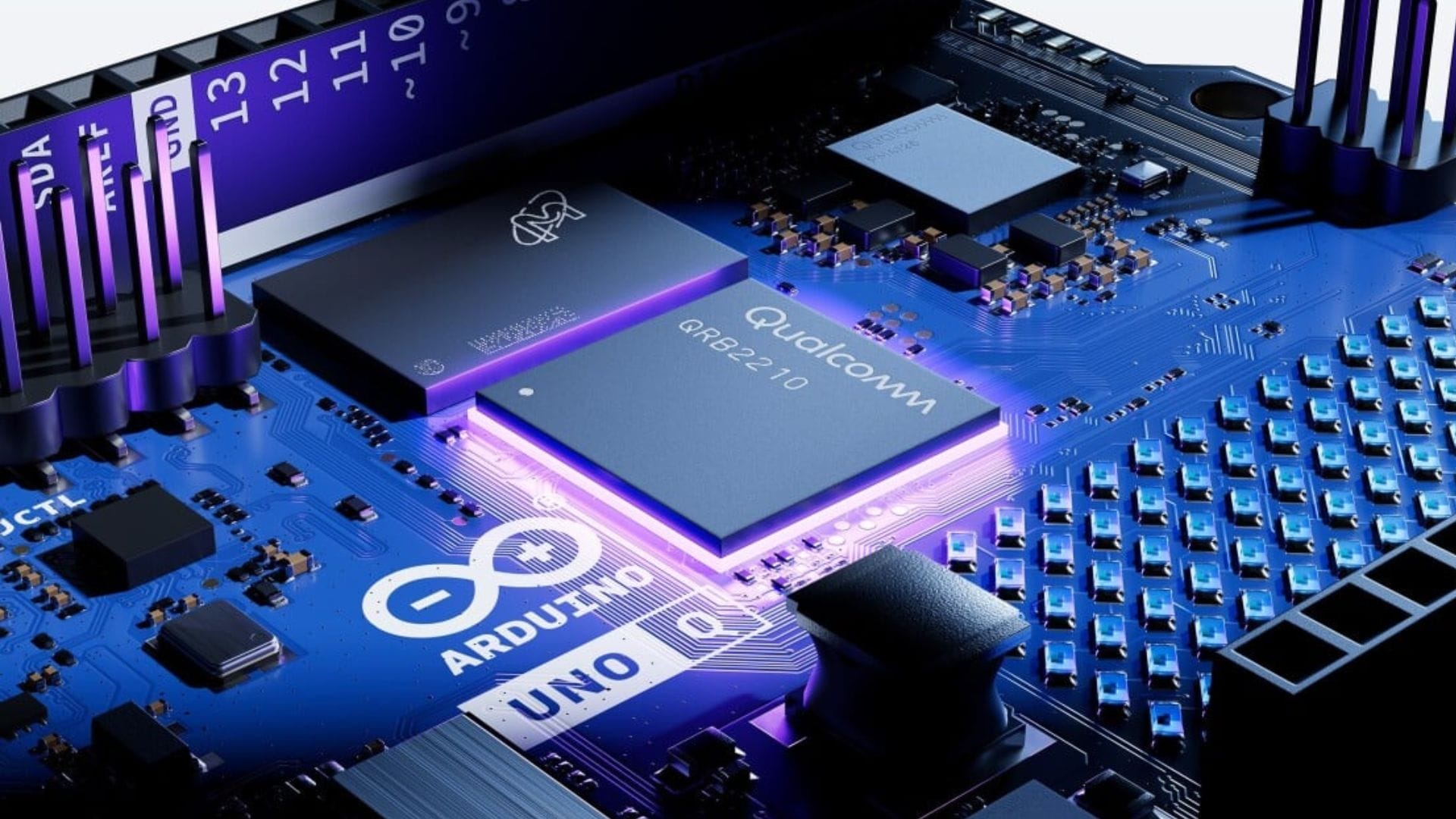
Qualcomm has introduced a new single-board computer designed to support artificial intelligence and robotics development. The product, called the Arduino Ventuno Q, combines advanced AI processing with hardware designed for real-time control of physical systems.
The launch follows Qualcomm’s acquisition of microcontroller board maker Arduino last year. The new platform is aimed at developers building intelligent machines that interact directly with the physical world, including robotics systems, automation tools and edge AI devices.
New platform built for robotics and physical computing
The Arduino Ventuno Q has been developed to bridge the gap between artificial intelligence software and real-world machines. Qualcomm said the system was designed to support devices that move, sense their surroundings and respond to changing environments with accuracy.
“Ventuno Q is engineered specifically for systems that move, manipulate and respond to the physical world with precision and reliability,” the company said on the product page.
At the centre of the board is Qualcomm’s Dragonwing IQ8 processor, which provides the computing power required for complex AI tasks. The chip integrates an eight-core ARM Cortex CPU, an Adreno ARM Cortex A623 GPU and a Hexagon Tensor neural processing unit capable of reaching up to 40 trillion operations per second.
Alongside the main processor, the board includes a dedicated STM32H5 microcontroller designed for low-latency operations. This secondary microcontroller helps manage tasks that require fast and predictable response times, such as motor control and sensor interaction, which are essential in robotics applications.
The hardware configuration is significantly more advanced than typical Arduino boards, which are usually designed for simpler embedded systems. Qualcomm’s approach reflects a growing demand for development platforms capable of running sophisticated AI workloads directly on devices rather than relying on cloud computing.
Hardware designed for edge AI workloads
The Ventuno Q includes 16GB of LPDDR5 memory and 64GB of built-in eMMC storage. Developers who require additional capacity can expand storage through an M.2 NVMe Gen 4 slot, allowing the system to handle larger AI models and datasets.
Connectivity options are also aimed at demanding edge computing environments. The board supports Wi-Fi 6, Bluetooth 5.3 and a 2.5Gbps Ethernet port for high-speed networking. USB camera compatibility enables integration with computer vision systems, which are commonly used in robotics, surveillance and automated monitoring.
These features make the platform suitable for projects that require powerful on-device processing. Running AI locally can reduce latency, improve privacy and allow devices to continue operating even without internet connectivity.
Qualcomm and Arduino said the board can support applications such as intelligent kiosks, healthcare assistants and traffic flow analysis systems. In these scenarios, the ability to process data directly on the device can be crucial for real-time decision making.
The board is also intended for edge AI vision systems that rely on cameras and sensors to interpret the environment. Combined with deterministic motor control, the platform can power machines that detect objects, analyse movement and perform precise mechanical actions.
AI models and tools designed to run offline
A key component of the Ventuno Q ecosystem is Arduino App Lab, a software environment included with the platform. The toolkit provides developers with access to a range of pre-trained AI models that can run locally on the device.
These models cover a wide range of AI capabilities. They include large language models, vision-language models, automatic speech recognition and gesture recognition systems. The software also supports pose estimation and object tracking, which are widely used in robotics and computer vision.
By enabling these models to run entirely offline, Qualcomm aims to make the platform suitable for environments with limited internet access or where sensitive data cannot be transmitted to cloud services.
The system also supports a full robotics development stack. This includes vision processing combined with precise motor control, allowing developers to build machines that can perceive their surroundings, analyse information and perform physical tasks.
Qualcomm said the platform is also suitable for educational and research use. Universities and laboratories working in areas such as computer vision, generative AI and edge computing could use the board for experimentation and rapid prototyping.
“With Ventuno Q, AI can finally move from the cloud into the physical world,” the company said. “This platform enables building machines that perceive, decide, and act — all on a single board. Our goal is to make advanced robotics and edge AI accessible to every developer, educator, and innovator.”
The Arduino Ventuno Q is expected to be available during the second quarter of 2026 through the Arduino Store and other retailers. Qualcomm said the board is expected to be priced at under US$300, positioning it as an accessible option for developers looking to experiment with AI-powered robotics.