


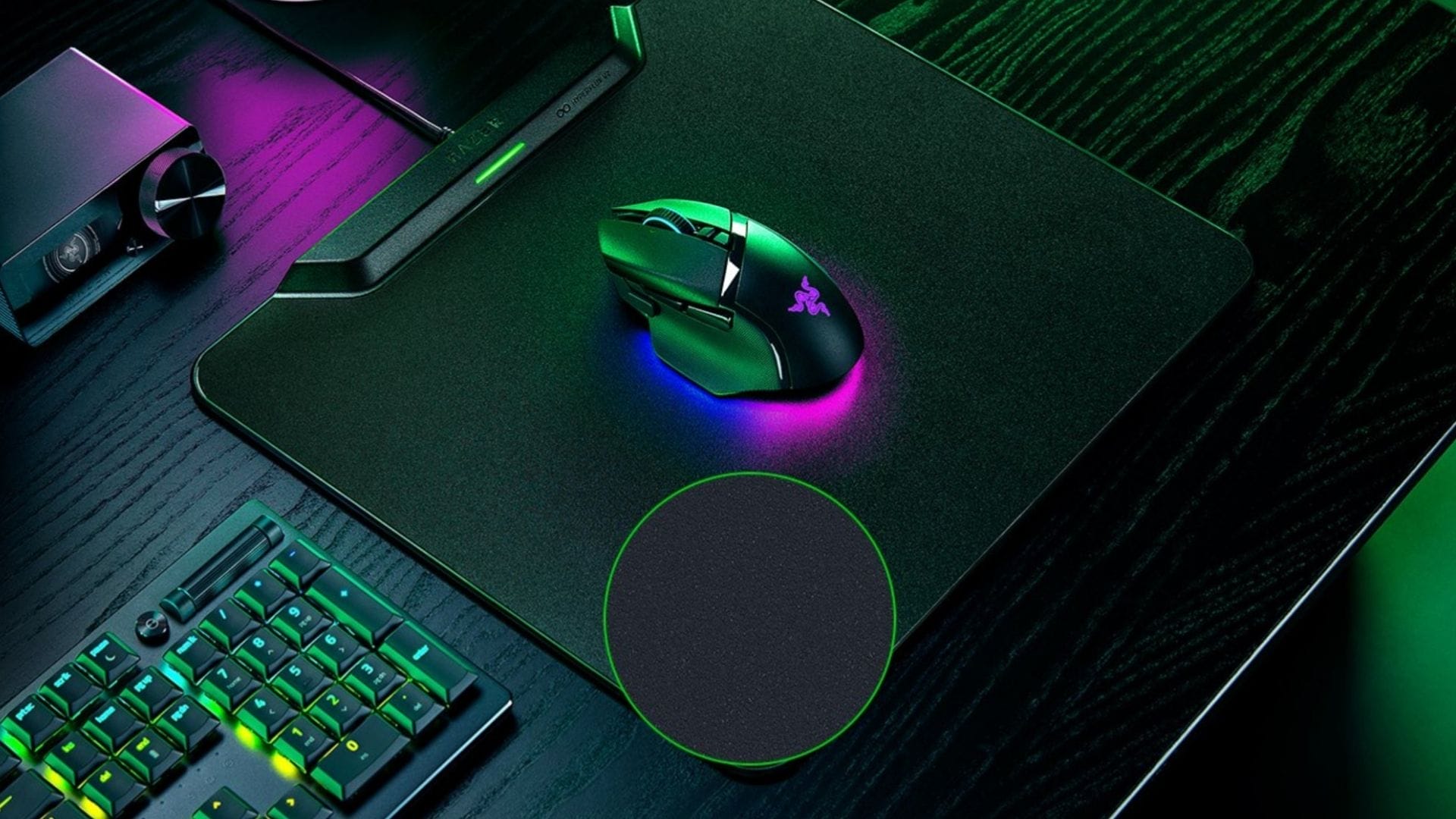
If you’ve followed Razer’s tech releases over the years, you may recall a bold experiment they tried in 2018. That was the year Razer introduced the Mamba HyperFlux mouse and the Firefly HyperFlux mat. What made them special was their complete lack of a battery. Instead, the mouse drew its power wirelessly from the mat, which was plugged into a power source and generated a magnetic field to keep everything running.
It was an interesting idea and certainly felt like a step into the future, but there were some limitations. The biggest problem was that the Firefly HyperFlux only worked with the Mamba HyperFlux. You couldn’t use any other Razer mouse with it. At the same time, Logitech had already installed its wireless charging mouse pad—PowerPlay—which supported a wider range of devices. Given the steep price and limited use, Razer’s HyperFlux didn’t catch on.
Since then, Razer has remained silent on the future of HyperFlux, leading many to believe the idea had been shelved for good. But that silence has just been broken. On June 4, Razer officially launched the HyperFlux V2 mouse mat.
Designed for wider use and better performance
Just like before, the idea behind HyperFlux V2 is to let you power your gaming mouse without cables or batteries. But this time, Razer has fixed one of the most frustrating parts of the old system: compatibility. Instead of being tied to a single mouse, the HyperFlux V2 supports multiple models. If you’ve got a Basilisk V3 Pro, Basilisk V3 Pro 35K, Cobra Pro, or Naga V2 Pro, you’ll be pleased to know you can use any of them with this new mat.
Rather than using a direct magnetic connection, the system now relies on a charging puck with the mat. You install this puck on the bottom of your compatible Razer mouse, and it automatically draws power from the mat. It’s familiar and straightforward—similar to how Logitech’s system works—but with some modern upgrades.
More than just a power source
The HyperFlux V2 isn’t just about charging your mouse. It also includes a built-in receiver, which means you don’t need a USB dongle taking up space. Once you set your mouse to 2.4GHz mode and place it on the mat, it connects with your mouse directly. Razer has made the process as easy as possible, and the connection is managed through Razer Synapse software.
Another smart feature is HyperSpeed multi-device support. This also allows the HyperFlux V2 to work as a receiver for your Razer keyboard. If you’re using models like the BlackWidow V2 Mini HyperSpeed, BlackWidow V3 Pro, or the full-size or TKL versions of the DeathStalker V2 Pro, you can connect those through the same mat. That means fewer cables and fewer dongles cluttering your desk.
Razer also offers the HyperFlux V2 in two styles. Whether you prefer a hard surface for faster mouse movements or a soft cloth surface for more control, you can choose the one that best suits your needs.
A comeback seven years in the making
It’s taken Razer seven years to return to the wireless charging mouse mat idea; interestingly, Logitech has already made another move of its own. A few months ago, they released the PowerPlay 2, aiming again to lead the space. This time, however, Razer seems to have added more than just charging to its mat. The HyperFlux V2 is a complete desktop solution with advanced features like multi-device support and direct pairing.
The Razer HyperFlux V2 is now available for US$179. The hard and cloth editions are also available. They can be found on Razer’s official online store, at RazerStores, and through selected authorised retailers.