Singapore is taking significant steps to strengthen its position as a hub for quantum technology by establishing local quantum computers, officials have said. Minister for Digital Development and Information Josephine Teo highlighted the importance of having domestic quantum infrastructure as the country aims to develop real-world applications for the technology.
Speaking at the inauguration of Horizon Quantum’s new quantum computer on 26 January, Mrs Teo noted that the nation’s investments in quantum research rely on a comprehensive ecosystem that includes both government initiatives and private-sector participation. “Our national programmes cannot unlock the promise and potential of quantum computing on their own – we also need a healthy ecosystem of industry, enterprise, investors and start-ups,” she said.
Singapore has been investing in quantum technology since 2002, with total funding reaching US$700 million, including a recent US$300 million top-up in 2024. The National Quantum Computing Hub, which hosts the country’s first research-focused quantum computer, has been exploring applications across finance, drug discovery and logistics. These efforts aim to position Singapore at the forefront of practical quantum solutions.
Horizon Quantum launches commercial system
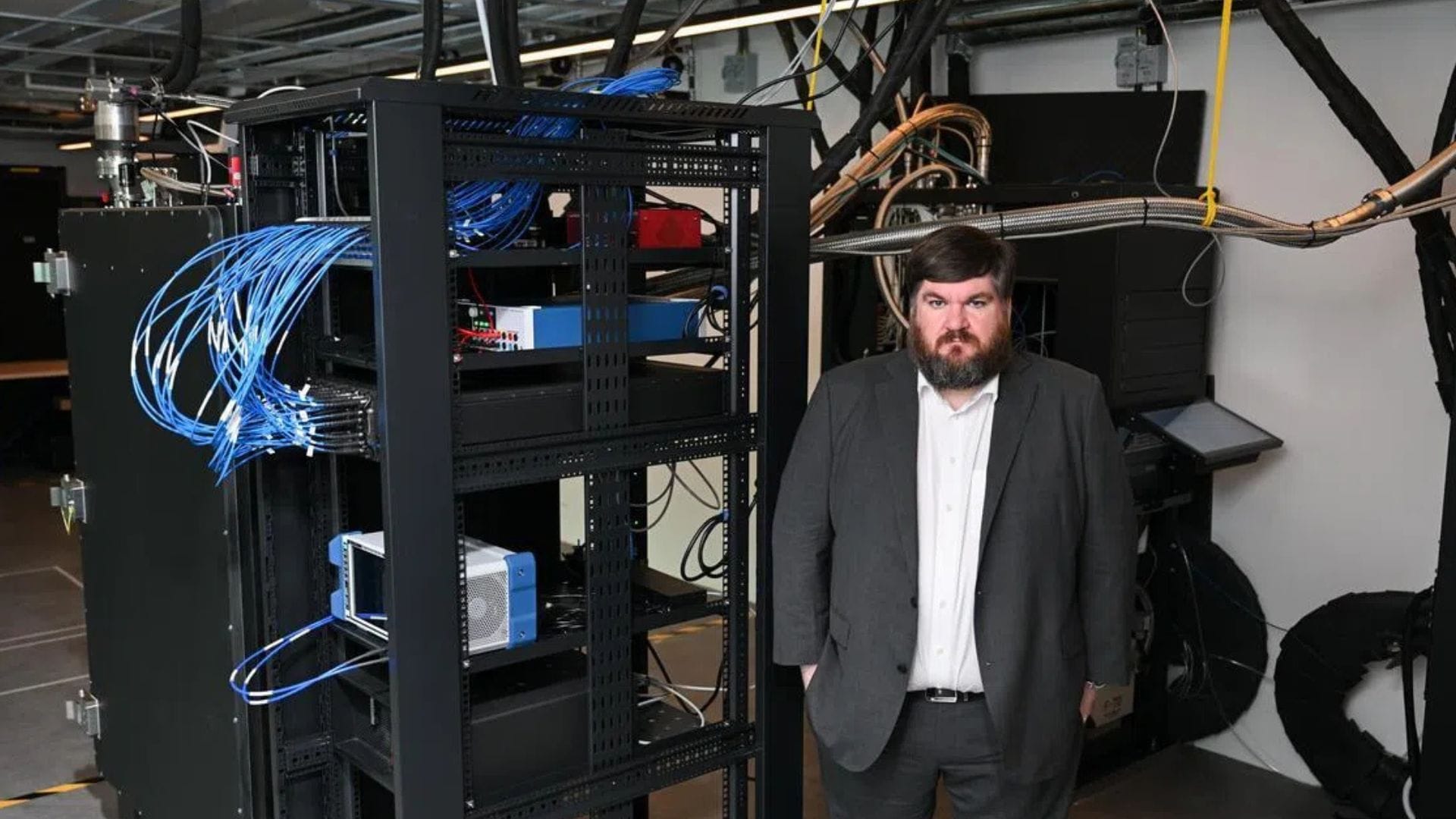
Horizon Quantum has become the first company in Singapore to operate a commercial quantum computer for hire. The two-tonne system, housed at the start-up’s headquarters in one-north, is designed to accelerate the development of practical quantum applications. Quantum computers can analyse vast numbers of possibilities in hours, a task that would take conventional computers centuries.
Founded in 2018 by Dr Joe Fitzsimons, a former associate professor at the Singapore University of Technology and Design, Horizon Quantum developed the US$2.3 million computer, which includes control electronics and a superconducting quantum processor cooled to around minus 270 degrees Celsius. The system uses nine superconducting qubits to process information in a complex mix of 0s and 1s simultaneously. Dr Fitzsimons explained that expanding the number of qubits exponentially increases the machine’s power.
“We expect that owning and operating our own hardware will help us to accelerate the development of real-world quantum applications across multiple sectors,” he said. He added that the technology could speed up Monte Carlo simulations, which are widely used in the pricing of financial derivatives. Horizon Quantum’s 45-strong team includes 13 scientists from the Centre for Quantum Technologies and Nanyang Technological University, reflecting Singapore’s ability to attract and develop top quantum talent.
Plans for further expansion in 2026
Looking ahead, Singapore plans to establish another quantum computer in 2026 through a partnership between the National Quantum Office and US-based firm Quantinuum. The company will also set up a research and development centre in One-North and hire engineers, software specialists and researchers to support local clients.
Mrs Teo has highlighted the potential of quantum computing to improve operational efficiency in Singapore’s ports. She noted that optimising container movements could reduce the cost of everyday products. “If we can use quantum computing to improve the efficiency of how a port operates, that serves as a very useful way for us to make a small contribution and be more competitive and, as a result, sustain the relevance of our maritime centre,” she said.
By combining government support, local start-ups and international partnerships, Singapore is positioning itself to lead the development and application of quantum technology across multiple industries.