

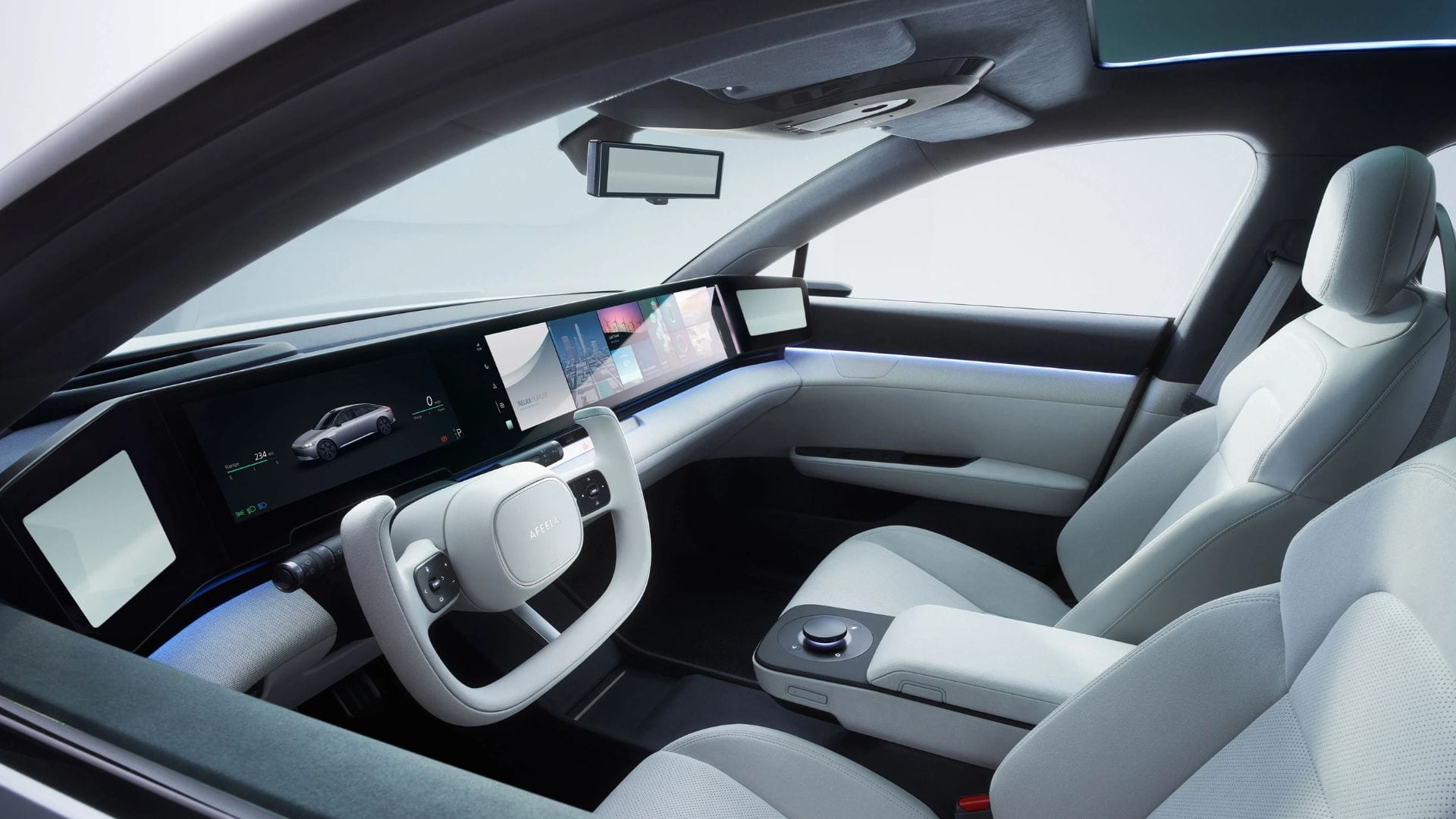
Sony and Honda are preparing to blur the line between home entertainment and in-car technology with their first jointly developed electric vehicle. The Afeela, created by Sony Honda Mobility, will support PlayStation Remote Play, allowing occupants to stream games from their PlayStation consoles directly to the car’s infotainment system. The feature is aimed primarily at passengers and parked drivers, turning long journeys and waiting time into an extension of the living room gaming experience.
The announcement highlights Sony Honda Mobility’s intention to position the Afeela not just as an electric vehicle, but as a digital platform built around software, connectivity and entertainment. While the idea of playing console games inside a car may appeal to a specific audience, the company believes it reflects changing expectations of what a modern vehicle should offer, particularly as cars become more connected and autonomous features continue to evolve.
PlayStation gaming moves into the car
At the centre of the announcement is PlayStation Remote Play, Sony’s existing technology that allows users to stream games from their PlayStation consoles to other screens over the internet. In the case of the Afeela, this means the vehicle’s large integrated display can act as a remote screen for PlayStation 5 and PlayStation 4 games running on a console elsewhere, such as at home.
Sony Honda Mobility confirmed that users will be able to connect to their own consoles and resume games exactly where they left off. Passengers can bring a DualSense controller, pair it with the vehicle, and continue playing without installing games in the car. The system effectively turns the Afeela into another endpoint within the PlayStation ecosystem, similar to how smartphones, tablets and PCs already support Remote Play.
Connectivity will play a key role in how well the feature performs. Sony Honda Mobility said a broadband connection of at least 5 Mbps is required for Remote Play to function. In comparison, speeds of 15 Mbps or higher are recommended for a smoother, more responsive experience. These figures align with Sony’s existing guidance for Remote Play on other devices, suggesting the in-car version is built on the same underlying technology.
Although the company has not positioned the feature for use while driving, it opens new possibilities for passengers on long trips or for drivers waiting in parked vehicles. Charging stops, rest breaks, and pick-up waits could become gaming opportunities rather than idle time, particularly as public charging infrastructure continues to expand.
Afeela and Sony Honda Mobility’s broader vision
The inclusion of PlayStation Remote Play fits into Sony Honda Mobility’s wider strategy for the Afeela brand. The joint venture was formed to combine Honda’s experience in vehicle manufacturing with Sony’s strengths in software, entertainment and sensor technology. From the outset, the partners have emphasised that their electric vehicles will be defined as much by digital services as by hardware.
The Afeela concept was first revealed as a showcase for this approach, featuring a large panoramic display inside the cabin, advanced driver assistance systems, and a heavy reliance on cloud connectivity. The ability to stream games from a home console reinforces the idea of the car as a connected device that forms part of a user’s digital life, rather than a standalone machine.
Sony Honda Mobility previously demonstrated PlayStation Remote Play running inside an Afeela prototype at CES 2024, where it drew attention as one of the more unusual features on show. At the time, the company suggested that entertainment would be a major focus for the brand, particularly as vehicles move closer to higher levels of automated driving. The latest announcement builds on that early demonstration and confirms that Remote Play will be part of the production offering.
The first production model, known as the Afeela 1, is scheduled to begin deliveries in 2026. While many technical details about the vehicle remain limited, Sony Honda Mobility has indicated that software updates and digital services will play an ongoing role throughout the car’s lifespan. This raises the possibility of adding additional entertainment features over time, depending on customer interest and network capabilities.
Gaming in cars and the wider industry trend
Sony and Honda are not the first companies to explore gaming inside vehicles, but their approach reflects a shift in how carmakers view in-car screens and processing power. Tesla previously made headlines by offering Steam gaming support in its Model S and Model X vehicles, allowing owners to play PC games directly on the car’s display. However, Tesla later removed this feature, citing safety concerns and shifting priorities.
Other manufacturers have experimented with casual games or app-based entertainment systems, but full console-level gaming remains relatively rare. By relying on Remote Play rather than local processing, Sony Honda Mobility avoids the need to equip the car with high-end gaming hardware, instead using the vehicle as a streaming client. This approach also ties users more closely to Sony’s existing PlayStation ecosystem.
The move comes at a time when cars are increasingly equipped with large, high-resolution displays and constant internet connections. As electric vehicles become more common, charging times and longer stops are prompting manufacturers to think about how drivers and passengers use their time inside the car. Entertainment, productivity and communication services are all being positioned as ways to add value beyond transportation.
For Sony, integrating PlayStation services into the Afeela also extends its gaming business into new environments. Remote Play already allows users to access their consoles from multiple devices, and the car becomes another location where that access is possible. It reinforces the idea of PlayStation as a platform that travels with the user, rather than something confined to a living room.
Despite the novelty, Sony Honda Mobility has been careful not to overstate gaming as a core selling point. The company has described it as one of many features designed to enhance the in-car experience, rather than a defining reason to buy the vehicle. Safety considerations remain paramount, and there has been no suggestion that gaming would be available to drivers while the car is in motion.
As the Afeela moves closer to production, it will become clearer how customers respond to this blend of mobility and entertainment. For now, the announcement signals Sony and Honda’s intent to differentiate their electric vehicle through software-driven experiences, using familiar brands and services to make time spent in the car more engaging.