


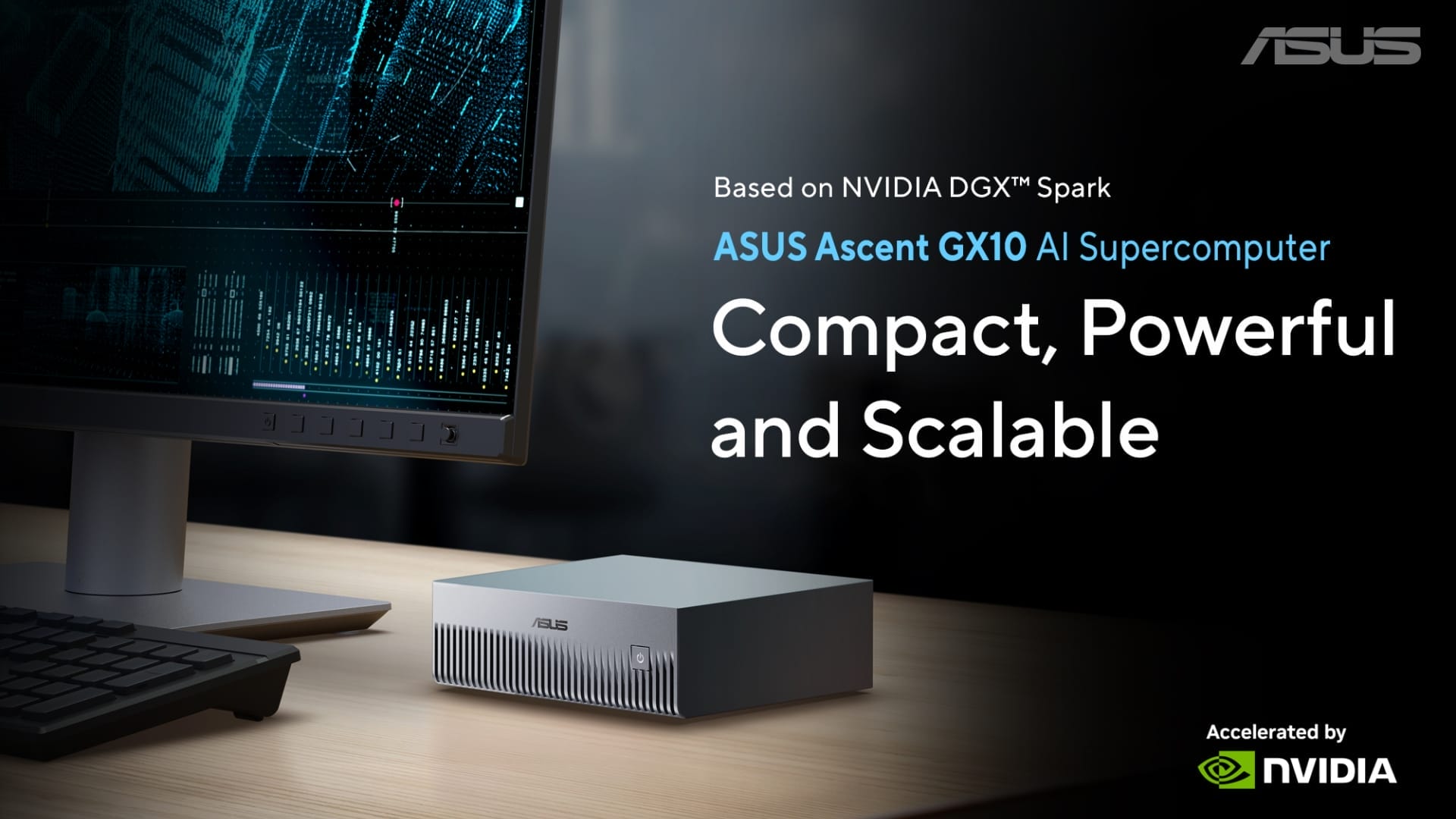
ASUS has announced the launch of its new Ascent GX10 personal AI supercomputer, which will be available from 15 October 2025. Designed to make high-performance artificial intelligence development more accessible, the compact desktop system is aimed at developers, AI researchers, and data scientists. Powered by the NVIDIA GB10 Grace Blackwell Superchip and the NVIDIA AI software stack, the Ascent GX10 delivers petaflop-scale performance in a small footprint, bringing advanced AI capabilities into standard workspaces.
Jackie Hsu, Senior Vice President and Co-Head of the Open Platform Business Group and AIoT Business Group at ASUS, said: “ASUS offers a comprehensive suite of personal AI supercomputers, from workstations to NVIDIA MGX servers accelerated by NVIDIA RTX PRO 6000 Blackwell Server Edition GPUs, and large-scale infrastructure featuring the NVIDIA HGX B300 and NVIDIA GB300 NVL72 platforms. As we nurture accounts, we will support customers on their AI journey to expand their footprint across the NVIDIA ecosystem.”
High performance in a compact form
At the heart of the Ascent GX10 is the NVIDIA GB10 Superchip, which combines a 20-core NVIDIA Grace CPU with a Blackwell GPU to deliver up to 1 petaflop of AI performance. This level of power enables fast inference and model fine-tuning, supporting projects with models of up to 200 billion parameters on a desktop system. The Ascent GX10 comes with 128GB of unified memory, allowing users to work on large-scale AI tasks without relying on cloud resources.
Measuring just 150 x 150 x 51 mm, the Ascent GX10 fits easily on any desk, making high-end AI computing more practical for individuals and small teams. Despite its size, it offers a full-stack AI solution, thanks to the NVIDIA AI software stack, which includes all the tools needed for prototyping, fine-tuning, and deploying models for applications such as robotics, computer vision, and vision-language models (VLMs).
The system’s architecture is designed for scalability and flexibility. Two Ascent GX10 units can be linked using NVIDIA ConnectX-7 high-speed network interfaces, doubling performance to 2 petaflops and increasing unified memory to 256GB. This setup also provides 8TB of storage, enabling more complex AI workloads and larger models to be handled locally. The system offers enterprise-grade security by keeping sensitive data on-site rather than in the cloud.
Flexible storage and efficient cooling
ASUS is offering several storage options for the Ascent GX10 to support different AI workloads. The base model includes a 1TB M.2 2242 NVMe PCIe 4.0 x4 SSD, suitable for beginners working with smaller datasets or testing models. A 2TB version, also using PCIe 4.0 x4, will be available for those handling multiple models or larger datasets. For the most demanding projects, ASUS plans to release a 4TB M.2 2242 NVMe PCIe 5.0 x4 model, which is designed for users running extensive workflows and managing numerous datasets simultaneously.
Thermal performance is a key part of the GX10’s design. The system includes a precision-engineered cooling solution that offers 1.6 times greater thermal efficiency than comparable compact systems. It features a seven-level fan control system, ultrawide fins, five heat pipes, and twin 140 x 80 mm fans that draw air through discreet bottom vents. This advanced cooling setup allows the system to maintain peak performance even under heavy workloads.
Availability and pricing
The ASUS Ascent GX10 personal AI supercomputer will be available from 15 October 2025 at 8:00 a.m. Pacific Time through authorised ASUS partners and retailers. Pricing details have yet to be announced.