


Hewlett Packard Enterprise has unveiled a set of networking and compute innovations ahead of Mobile World Congress 2026, positioning them as a foundation for service providers seeking to modernise their infrastructure for AI-driven workloads. The updates span core, edge and cloud environments, reflecting growing pressure on operators to handle rising data traffic, tighter latency requirements and more complex service demands driven by AI adoption.
The company framed AI infrastructure as a central growth driver for service providers, particularly as AI workloads move from experimentation into production environments. According to HPE, the latest solutions are designed to allow customers to build and operate their own AI infrastructure using low-latency, high-capacity systems that are AI-native by design, supporting deployment from the network core through to the edge.
Rami Rahim, executive vice president, president and general manager of Networking at HPE, said the company’s focus is on enabling service providers to modernise and virtualise their networks while simplifying operations. He highlighted the combination of high-performance infrastructure, unified management across compute, storage and networking, and built-in security as critical enablers for new services and advanced AI capabilities. The goal, he said, is to help customers support increasingly complex operations while creating higher-value offerings on top of modernised networks.
Juniper integration and next-generation routing platforms
A key element of the announcement is the continued integration of Juniper Networks into HPE’s service provider strategy. The expanded approach centres on secure, high-performing, AI-native networks that can proactively resolve issues, assure quality of service for AI applications and deliver cloud-like agility for managed services. HPE said the combined strengths of both companies bring together large-scale service provider infrastructure experience with expertise across networking, compute, security and cloud.
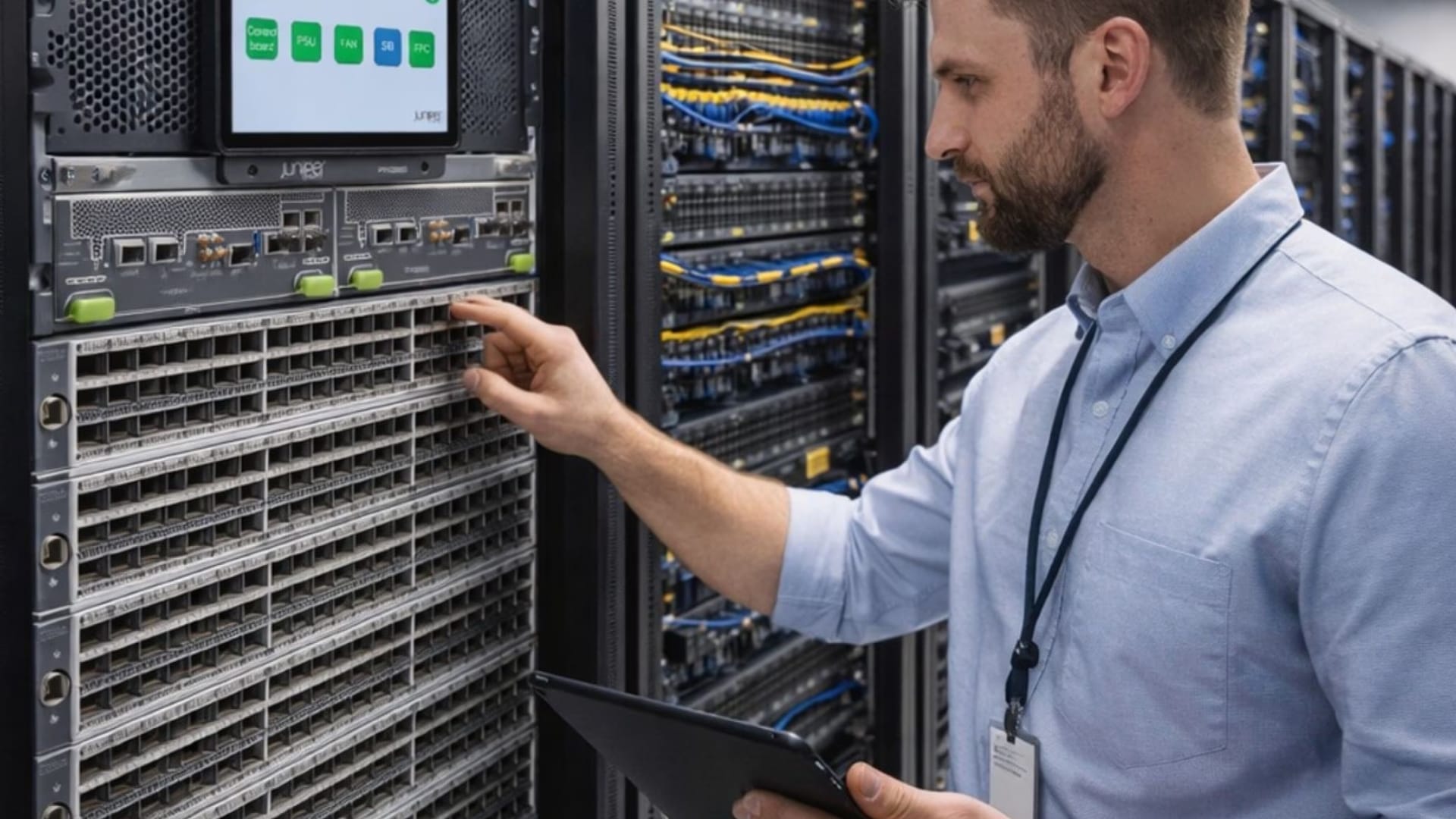
Within this strategy, HPE highlighted updates to its data centre and routing infrastructure portfolio aimed at supporting high-growth AI workloads. Central to these capabilities are Juniper PTX Series routers, built on the Juniper Express 5 ASIC. HPE stated that these routers deliver a 49% improvement in power efficiency compared with the previous generation, while offering higher density, operational efficiency and secure connectivity between data centres.
Several new routing platforms will be showcased at MWC 2026. The Juniper PTX12000 line of modular routers is designed to help network operators scale AI and cloud traffic without repeated infrastructure redesigns. The platform supports ultra-dense 800G port density on 1.6T-ready systems and is engineered to sustain predictable, low-latency performance as traffic volumes increase. The PTX12008 scales to 345.6T, while the PTX12012 reaches 518.4T, enabling capacity expansion while reducing latency, power consumption and overall costs.
HPE also introduced the Juniper PTX10002 line of fixed-form routers, which target AI network fabrics in space-constrained environments. Offered in a compact 2RU footprint, the routers deliver 28.8T or 14.4T of throughput with support for 100G, 400G and 800G ports. This configuration is intended to give service providers flexibility to optimise space, power usage and port density as AI clusters and wide area network connectivity requirements grow.
In parallel, Juniper Routing Director has been updated to be agentic-AI ready. This allows customers to connect the platform to their own AI copilots to automate workflows, optimise WAN routing performance and simplify post-deployment operations. HPE positioned this capability as a way to reduce operational complexity and speed issue resolution in AI-native networks.
Compute, cloud operations and financing to support AI scale
Beyond networking, HPE outlined new compute innovations aimed at accelerating 5G and AI deployments while improving security and automation from the edge through to the core. The HPE ProLiant Compute EL9000 chassis and EL140 Gen12 server were presented as a combined platform capable of handling twice the network traffic of previous generations on a single server. The system delivers 72 CPU cores and 24 network ports per server in a 2U form factor, with support for up to two servers per chassis. HPE said the platform offers double the fronthaul network bandwidth and a 20% increase in core count compared with earlier models.
The servers are powered by Intel Xeon 6 system-on-chip processors with vRAN boost and incorporate built-in HPE security features designed to protect critical systems and ensure compliance with current network security standards. HPE also highlighted the integration of the Juniper Cloud Native Router on the 1U ProLiant Compute DL110 and the new 2U ProLiant EL140 Gen12 servers. This integration consolidates radio access network and compute functions into a single server, allowing operators to remove dedicated routing hardware at cell sites and reduce both capital and energy costs.
As service providers rethink their cloud operating models in response to rising virtualisation costs, sovereign data requirements and the need to unify virtual machines and containers across 5G cores, HPE positioned its Cloud Ops Software as a unifying control plane. The software brings together virtualisation, container management, monitoring, observability, AIOps, cyber resiliency, DevOps automation and FinOps across multicloud, multi-vendor environments. HPE said this integrated stack helps operators modernise private clouds, reduce dependence on expensive hypervisors and run secure, multi-tenant services at scale.
Industry analyst Ray Mota, CEO and principal analyst at ACG Research, said that AI-driven traffic patterns are reshaping uplink, latency and capacity demands across networks. He argued that HPE’s focus on high-performance routing, AI-native automation, telco cloud architectures and security equips operators to participate more fully in the AI value chain, enabling them to deliver secure, autonomous and on-demand digital services at scale.
To support adoption, HPE Financial Services also announced a new 90/9 Advantage financing programme. The scheme offers no payments for the first 90 days, followed by monthly lease payments of 1% for the next nine months, and is available across HPE’s networking, compute, storage and software portfolio. HPE said the programme is intended to help organisations accelerate AI and modernisation projects amid ongoing pricing uncertainty.
At MWC 2026, HPE’s booth will feature live demonstrations focused on automation, cost reduction, faster deployment and new AI-driven revenue opportunities. The showcase will also outline HPE’s vision for wired and wireless connectivity, alongside updates across routing, edge compute, private 5G, Wi-Fi and unified secure access service edge solutions.