

Enterprises moving from AI experimentation to deployment are starting to face a more practical problem. Powerful models alone do not make AI agents useful in production. They need access to cloud services, secure execution environments, workflow tools, and training for the people expected to use them.
Alibaba Cloud is addressing that gap with a broader agentic AI stack for global customers, covering its Qwen models, AI infrastructure, cloud platform updates, enterprise agent tools, and a Singapore training initiative for SMEs and students.
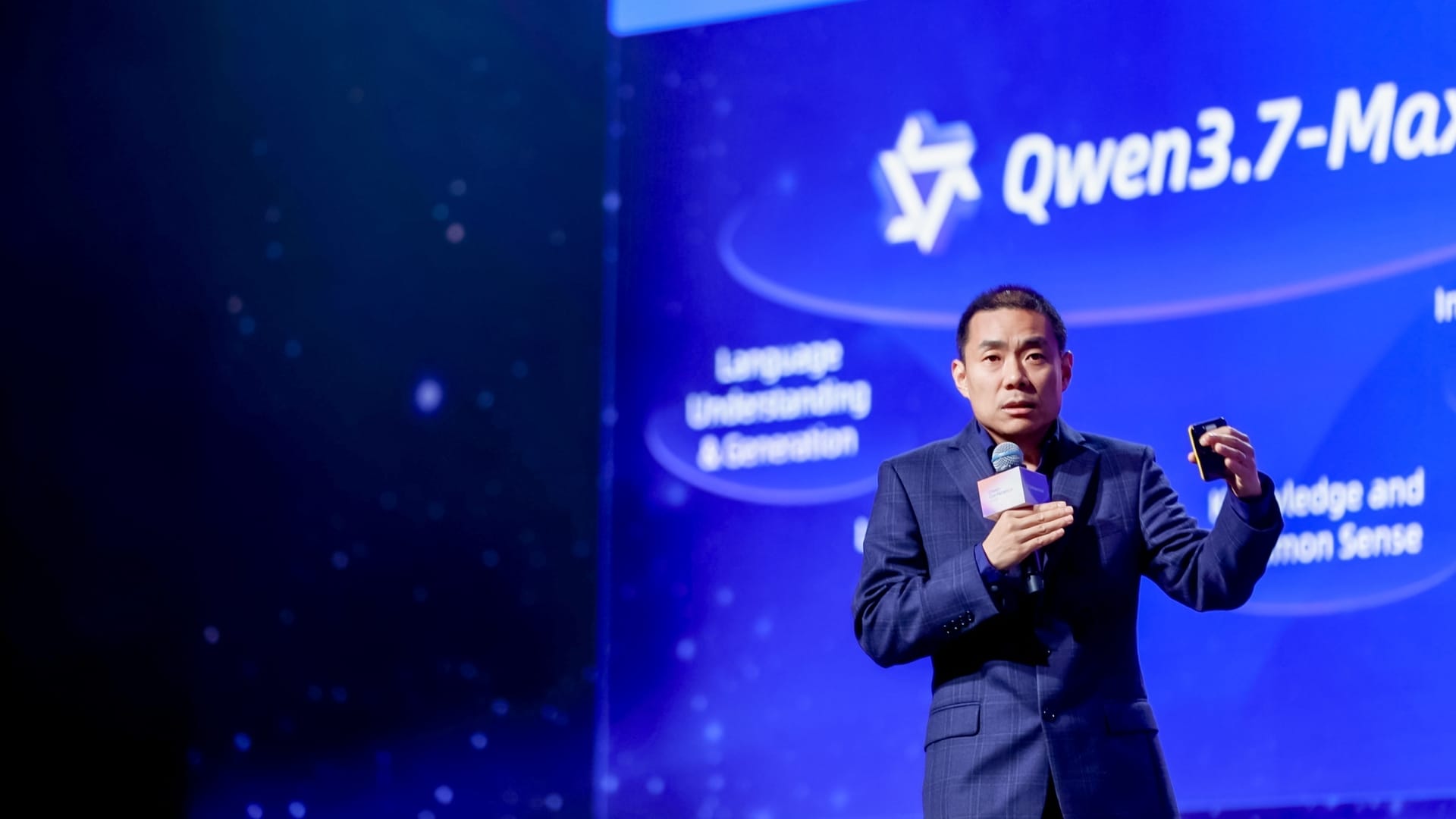
The announcements were made at Alibaba Cloud’s first international Qwen Conference in Singapore. They mark a fuller push beyond model access, with the company tying its latest large language model to cloud operations, developer workflows, mobile automation, and workforce upskilling.
Qwen moves from model access to agent deployment
Alibaba Cloud’s latest large language model, Qwen3.7-Max, is now available on Model Studio, its AI development platform, in the Singapore region. According to Artificial Analysis’s latest global large language model Intelligence Index, Qwen3.7-Max ranked fifth globally and first among Chinese models.
The model scored 56.6 points, placing it ahead of Kimi-K2.6, DeepSeek-v4-Pro-Max and GLM5.1. Alibaba Cloud said it also showed performance competitive with international models such as GPT, Claude and Gemini.
For enterprise users, the more important part of the announcement is how Alibaba Cloud is building around the model. The company introduced Qwen Cloud, an AI-native cloud platform designed to help developers, enterprises and prosumers build AI applications and agents.
Qwen Cloud uses three entry points. Skills is designed for agents, a Command Line Interface supports workflow integration, and a website serves human users. The platform brings together Alibaba’s proprietary Qwen models, open-source models and third-party offerings across text, vision, audio, image, video and embedding tasks.
“The agentic era represents a paradigm shift in how we interact with technology,” said Dr. Feifei Li, Chief Technology Officer and President of International Business of Alibaba Cloud. “Our commitment to developing a comprehensive, full-stack AI ecosystem means we are not just offering powerful models, but also the AI-native tools and agentic cloud infrastructure that enable our international customers to seamlessly integrate AI into every facet of their operations.”
Cloud operations become part of the agent stack
A central part of Alibaba Cloud’s update is the new Skills portal, which converts common cloud capabilities across more than 60 cloud products into Skill-based and MCP-compatible formats. This is designed to let AI agents call cloud resources in a way that is closer to invoking functions.
Alibaba Cloud said its core products, including databases, big data, operations and maintenance, and security, have developed product-level agents to help manage complex cloud environments. The company is also upgrading its AI infrastructure for agent runtime environments, including lightweight execution sandboxes, cross-task memory, data circulation, and intelligent operations and maintenance across the technology stack.
The enterprise deployment layer is being extended through the JVS Agent Suite, a set of agent toolkits for enterprises, developers and individuals. JVS Claw Teams is built on the OpenClaw framework with cloud-native security. It supports 7×24 cloud operation, centralised distribution of an organisation’s proprietary Skills, and integrated security management.
Alibaba Cloud also introduced JVS Mobile, an enterprise-grade mobile intelligent automation platform powered by the Qwen model and native OpenClaw. It is designed to create AI agents that can support autonomous thinking, multi-agent collaboration and complex task execution across applications.
The company also said it has joined the PyTorch Foundation as a Platinum member. The foundation is a community-driven hub for open-source AI under the Linux Foundation.
Singapore initiative targets practical AI skills
Alibaba Cloud is linking the platform rollout with a one-year Singapore upskilling initiative for more than 1,000 local SMEs and students. The initiative is run with Tech Talent Assembly, an affiliated association under the National Trade Union Congress, and ST Telemedia Global Data Centres.
The programme expands on a memorandum of understanding signed by Alibaba Cloud and NTUC’s Tech Talent Assembly on 26 November 2025. It will support AI adoption and digital upskilling through workshops, technical bootcamps and curated learning pathways, while also providing coordinated support for employers applying for NTUC’s Company Training Committee schemes.
Starting in June 2026, up to 200 employees from NTUC Union Companies will be eligible to register for tokens to access Alibaba Cloud’s GenAI tools, including Qwen and Wan. The tools can be used for content creation, multimodal reasoning and data analysis. Participants may also choose a one-month subscription to Qoder, Alibaba’s agentic AI-powered coding platform, alongside access to QoderWork, a desktop-based AI agent for multi-step workflows on a user’s computer.
The initiative will later expand to participants under IMDA’s Digital Enterprise Blueprint-Alibaba Cloud Digital Accelerator Programme, as well as ecosystem partners such as SGTech, Singapore Computer Society, Digital Defenders Alliance Singapore and Institutes of Higher Learning.
“This reflects a growing effort by partners to work with the Labour Movement to better support workers, including youths and PMEs, with the skills, guidance and confidence to take on opportunities in the AI economy. Through NTUC’s AI-Ready SG initiative, we will continue working closely with our partners to pool resources and strengthen impact on the ground, so that workers receive tailored guidance and support every step of the way,” said Desmond Tan Kok Ming, Senior Minister of State in the Prime Minister’s Office of Singapore and the Deputy Secretary-General of the National Trades Union Congress.
Alibaba Cloud and STT GDC, together with ecosystem partners, will also organise hands-on workshops to help participants apply the tools to business and learning scenarios. The company also launched a global hackathon for developers and startups to build production-grade AI agents with Alibaba’s models on Qwen Cloud, and a short film competition with Picsart for AI-generated films using HappyHorse.