


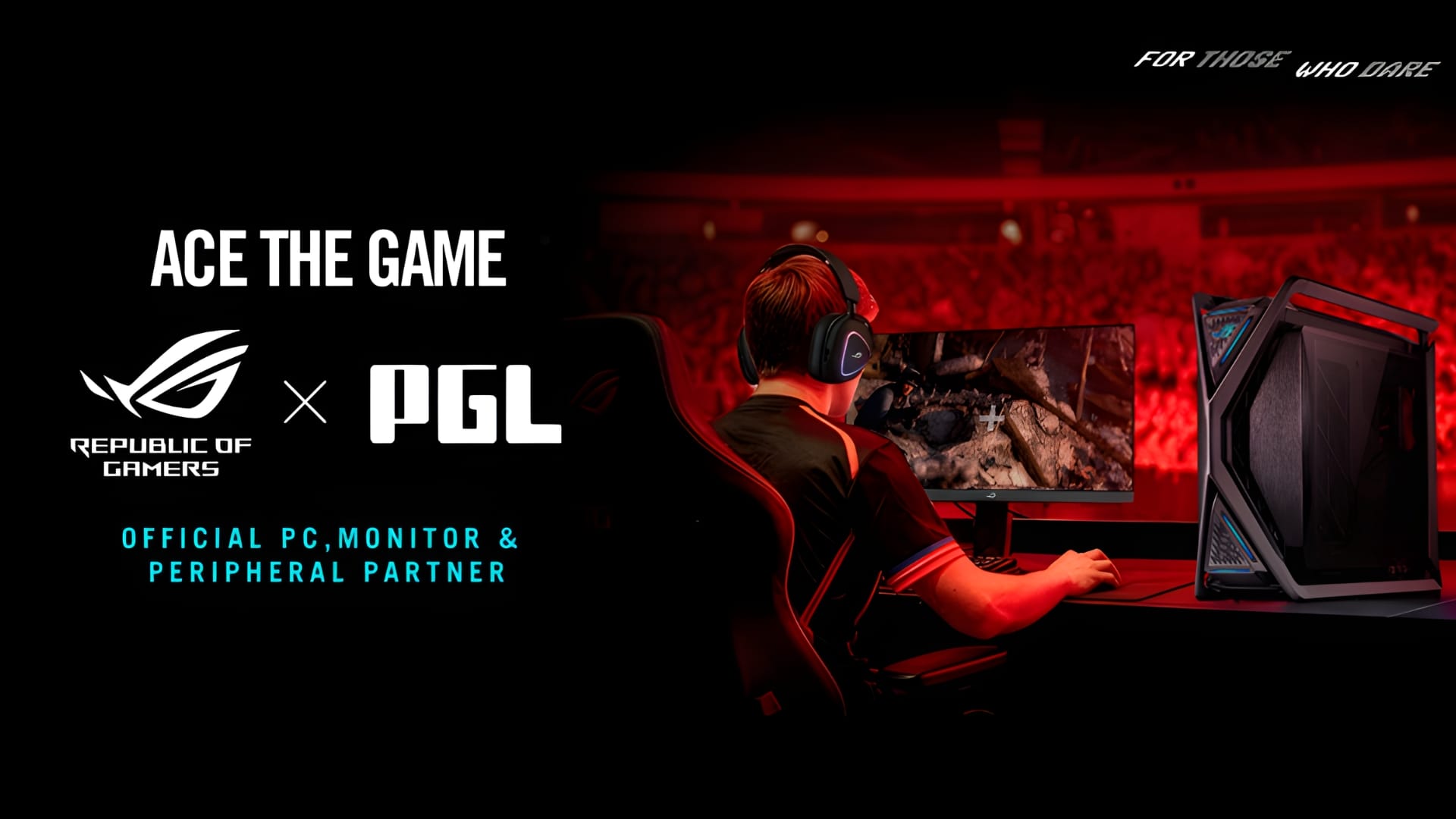
ASUS Republic of Gamers has entered into a season-long partnership with PGL, securing the role of official monitor, PC, and peripheral partner for the entire 2026 PGL global circuit. The agreement spans all competitive stages, from early group matches to the Grand Finals in Romania, with every player station standardised around ROG hardware.
The partnership places ROG equipment at the centre of PGL’s competitive infrastructure, reflecting the organiser’s emphasis on consistency, reliability, and ultra-low latency across its international tournament footprint. PGL events take place across arenas and studio environments, including Cluj-Napoca and Bucharest, with a production model that relies on identical hardware configurations to ensure fairness between competitors.
For players, the agreement means competing on a fixed tournament setup designed to remove performance variability. PGL has positioned this as a critical requirement for modern esports, where marginal gains in responsiveness and visual clarity can influence outcomes at the highest level of play.
Standardised tournament hardware across the 2026 circuit
At the core of the partnership is the ROG Strix XG248QSG Ace, which has been designated as the official monitor for all PGL 2026 matches. Each competition station will use the same display model, ensuring consistent visual performance from group stages through to finals. The monitor features a 24.1-inch Full HD Super-TN panel with an overclocked refresh rate of up to 610Hz, paired with Extreme Low Motion Blur 2 technology.
This configuration is designed to prioritise motion clarity and responsiveness over resolution, aligning with preferences commonly expressed by professional esports players. The use of a Super-TN panel reflects a focus on speed and minimal latency rather than colour accuracy, which remains secondary in competitive settings.
Alongside the monitors, all matches will run on a standardised Powered by ASUS PC configuration referred to as the PGL Esports Station. These systems are built around ASUS Prime GeForce RTX 5080 graphics cards, TUF Gaming X870E-Plus WiFi 7 motherboards, and AMD Ryzen 7 9800X3D processors. Power delivery is handled by ASUS TUF Gaming 1000W Gold power supplies, using components positioned for long-term reliability under sustained load.
PGL has framed this hardware standardisation as essential for maintaining performance parity across venues and broadcast environments. By deploying identical systems worldwide, the organiser reduces the risk of hardware-related inconsistencies affecting match integrity or production schedules.
ROG Ace peripherals built for professional competition
In addition to monitors and PCs, the partnership extends to peripherals from the ROG Ace esports collection, which will be available to players throughout the season. These devices have been developed with input from professional players, with an emphasis on precision, low-latency input, and durability under tournament conditions.
The ROG Harpe II Ace gaming mouse is part of the standard offering, weighing 48 grams and shaped with feedback from competitive players. It uses a 42,000-dpi ROG AimPoint Pro optical sensor and optical micro switches, combined with an 8,000Hz wireless polling rate enabled by SpeedNova 8K wireless technology. The design prioritises fast tracking and consistent responsiveness, particularly in high-sensitivity competitive scenarios.
Keyboard support comes from the ROG Falchion Ace 75 HE, which uses a 75% layout to balance desk space with functionality. It incorporates upgraded HFX V2 and V2X magnetic switches, a new ROG Hall sensor, and an 8,000Hz polling rate. Onboard controls include an adjustment wheel, multifunction button, touch panel, and a Rapid Trigger toggle, allowing players to fine-tune actuation behaviour without software intervention.
Audio is handled by the ROG Delta II gaming headset, offering tri-mode wireless connectivity using ROG SpeedNova technology. The headset features 50mm titanium-plated diaphragm drivers, a 10mm super-wideband boom microphone, and DualFlow Audio support. Weighing 318 grams, it is designed for extended use and offers up to 110 hours of battery life, addressing the long match days typical of major tournaments.
Broadcast integration and fan-facing activations
Beyond competition hardware, the partnership includes broadcast and event integration throughout the 2026 season. ROG will work with PGL on player-focused content that highlights professional setups and player perspectives on tournament equipment, extending the partnership beyond the stage and into broadcast storytelling.
ROG-branded booths will also be present at all arena events, allowing fans to experience the same monitors, PCs, and peripherals used by professional players. This hands-on approach positions the partnership as both a competitive infrastructure agreement and a marketing platform aimed at bridging professional and consumer gaming experiences.
Brand visibility will extend across live events and broadcasts, with ROG logos integrated into venue branding and on-screen graphics. For PGL, the arrangement reinforces its positioning as a premium esports organiser with tightly controlled production standards. For ROG, the season-long presence offers sustained exposure across multiple titles, regions, and audiences, rather than a single-event sponsorship model.