


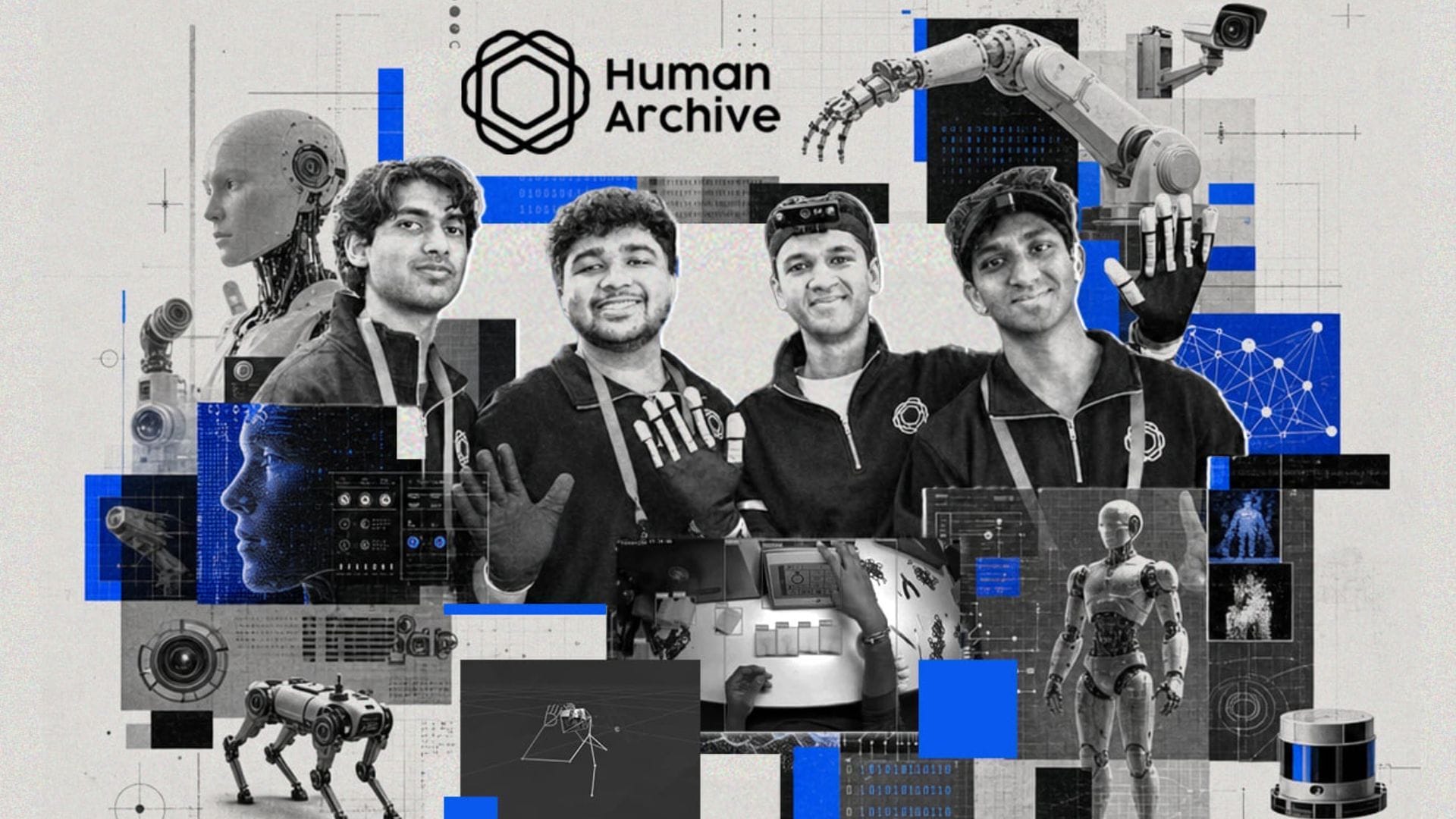
Silicon Valley startup Human Archive is turning to India’s growing gig economy to build large-scale datasets for training robots and physical artificial intelligence systems. The company is working with businesses in the home services, hospitality, and restaurant sectors to collect first-person video footage of workers performing everyday tasks.
The startup equips workers with camera-enabled caps and other wearable devices that record activities from the worker’s perspective. The footage is then used to create datasets that can train robots to perform physical tasks in real-world environments.
Human Archive said it currently has more than 1,000 active headsets operating across several locations. Although the company did not identify its commercial partners, it confirmed that it has secured collaborations with smaller firms after facing resistance from some of India’s better-known home services platforms.
The company announced on 27 May that it had raised US$8.2 million in funding from investors including Wing Venture Capital, NVP Capital, and Y Combinator, as well as angel investors connected to OpenAI, Nvidia, Google, and Meta.
Human Archive was founded by UC Berkeley students Samay Maini, Rushil Agarwal and Shloke Patel, together with Stanford student Raj Patel, who serves as chief executive. The founders have backgrounds in robotics, hardware systems and tactile data research.
Push to build physical AI increases demand for data
The startup’s business model is built around a growing challenge facing robotics companies and AI laboratories worldwide. While major technology firms are racing to develop robots capable of handling household and workplace tasks, many lack access to large volumes of high-quality training data showing humans performing those activities in real environments.
Human Archive believes India’s rapidly expanding gig economy offers an opportunity to fill that gap. The country has seen strong growth in food delivery services, cloud kitchens and app-based home services in recent years, creating a large workforce engaged in repeatable physical tasks.
However, the company’s approach has also generated criticism and public disputes. Reports from Indian media outlets revealed that several established home services companies declined to partner with Human Archive.
The issue gained wider attention after reports emerged that Pronto had explored potential data partnerships for robotics training and that discussions with Human Archive had eventually collapsed. Urban Company chief executive Abhiraj Singh Bhal later stated on X that his company would not take part in such arrangements.
In response, Raj Patel suggested that businesses that reject robotics-related data collection risk becoming less competitive in the future. Co-founder Rushil Agarwal also claimed that Pronto founder Anjali Sardana had dismissed the proposal and called him “stupid” during discussions. Pronto confirmed that talks had taken place but denied making any remarks.
Despite the setbacks, Human Archive said it has continued expanding its data collection network through smaller partners. The company has also begun collecting information from factory environments and other industrial workplaces.
To improve the value of its datasets, Human Archive is developing additional hardware beyond wearable cameras. The company now uses tactile gloves, wrist-mounted cameras and full-body motion capture suits capable of collecting movement and force data alongside RGB-D imagery, which combines colour visuals with depth information.
Patel said the startup initially relied on off-the-shelf equipment before moving towards custom-built systems.
“To capture data, we started with iPhones; then we built our own custom rigs and caps. Now we have more than seven different hardware products that we use interchangeably across different modalities. After data collection from different devices, we worked on synchronising data from all these different sources,” Patel said.
Privacy concerns emerge as the company expands internationally
Human Archive said its technology enables AI developers to train and test robotics systems more effectively by combining multiple forms of sensor data rather than relying solely on video recordings. The company is also developing tools to fine-tune AI models using its own datasets before evaluating them on robotic systems.
Wing Venture Capital partner Zach DeWitt said the startup’s ability to synchronise multiple forms of sensor input could give it a competitive advantage.
“No one else in the world has been able to synchronise and collect headset RGB-D, force feedback, full-body motion capture, and synchronised chest and wrist camera data at scale. They’ve been doing internal model training on this data, and every major lab and university is interested in running experiments on it due to the novelty of the sensors and the scale of the new dataset they are releasing soon,” he told TechCrunch.
To encourage participation, Human Archive works with service providers to offer customers discounted rates in exchange for agreeing to video-record their appointments. Customers who do not wish to participate can instead choose a standard service without recording.
Patel said many customers have accepted the arrangement because recorded footage can help resolve disputes over service quality. Workers participating in the programme receive a base payment of US$1 per hour, although reports suggest some rival firms operating in the same sector pay higher rates.
The company’s expansion has also raised questions about privacy and data protection. Critics have questioned whether workers and customers fully understand how their recorded footage may be used in the future.
Human Archive said its contracts comply with India’s Digital Personal Data Protection Act and that workers and customers are shown consent notices explaining how information is collected and processed. The startup added that all recordings are anonymised and faces are blurred before the data is used.
The issue has attracted attention from Indian regulators. Reports published last week stated that the Ministry of Electronics and Information Technology is examining how startups collecting egocentric data obtain consent and manage personal information.
While India remains Human Archive’s primary market, the company has started expanding into Southeast Asia and the United States. It is also developing a platform that would allow individuals to participate directly in data collection programmes in exchange for payment.
The startup is also testing pilot programmes in the US that would offer household services, such as cleaning and cooking, while collecting data from participating workers. Human Archive said these initiatives remain at an early stage.
As competition intensifies among companies developing physical AI systems, access to large-scale human activity data is becoming increasingly valuable. Human Archive is betting that its combination of wearable technology, sensor integration, and gig-economy partnerships can help meet that demand.