



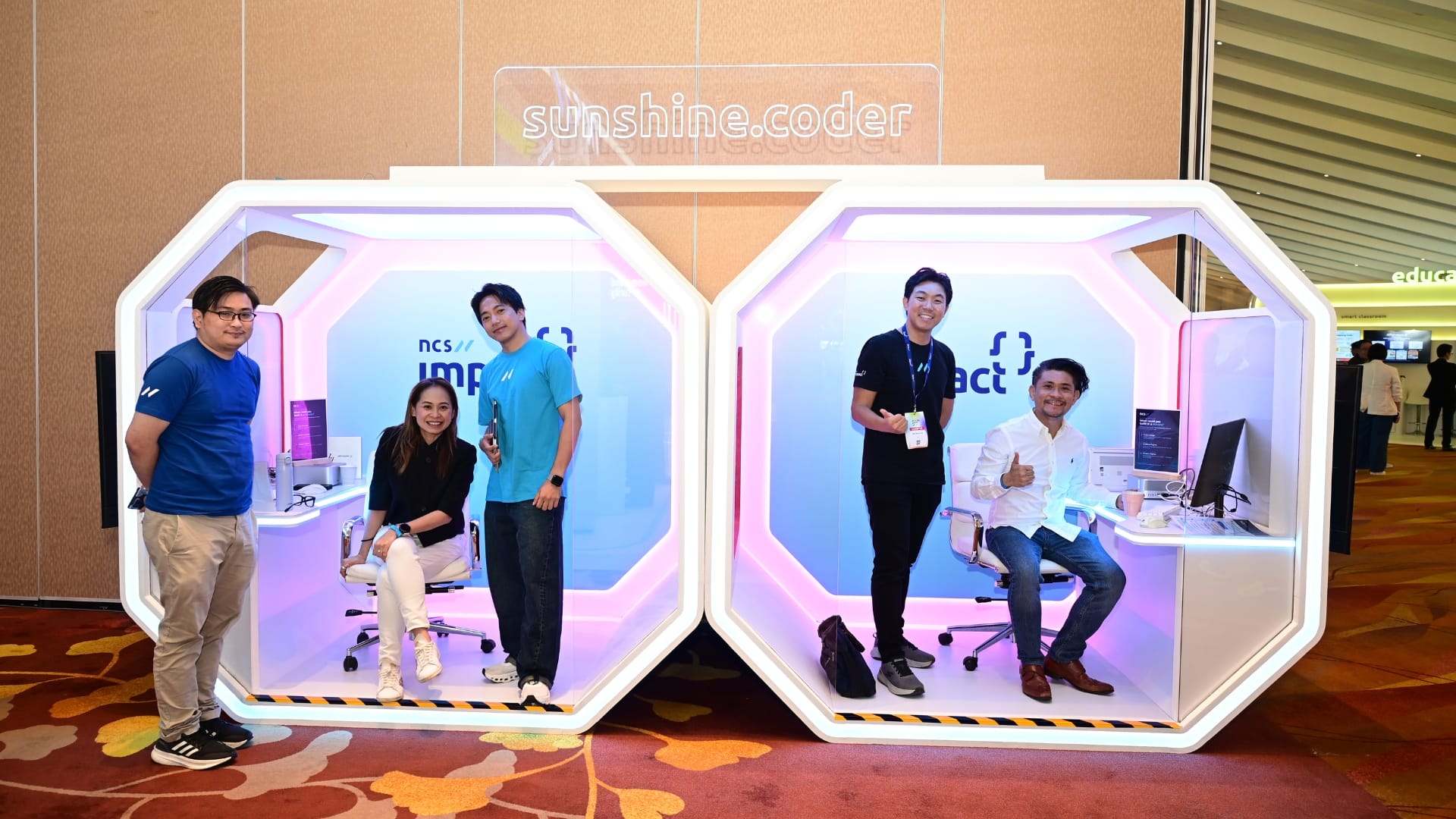
NCS has expanded its Sunshine.AI suite with new tools for building AI agents, managing robot fleets, embedding AI assistants into workplace systems and testing AI applications before they are deployed.
The updates, introduced at NCS AI Impact 2026, are part of a broader push by the Singapore technology services firm to turn AI deployment into a more repeatable enterprise model. Alongside the platform expansion, NCS announced sector partnerships in healthcare, education, transport and enterprise AI, as well as an AI Playbook based on more than 100 projects.
The expansion ties NCS’ AI platforms to the parts of enterprise deployment that often create friction, including data control, governance, cost management, safety checks, workflow redesign and skills.
Sunshine.AI moves deeper into enterprise deployment
The expanded Sunshine.AI suite is aimed at organisations that want to deploy AI within their own environments while retaining control over data, compliance and governance.
At the core of the suite is Sunshine.core, a foundational platform for building and operating production-grade AI agents. NCS said it includes reusable components so teams do not have to rebuild common infrastructure across projects.
That same idea carries through Sunshine.builder, which allows business analysts to create software applications without writing code. The tool translates business requirements into working systems, allowing users to define what they need, assess how it will work, validate requirements and deploy applications.
NCS is also extending AI into the software employees already use. Sunshine.chilliclaw is an enterprise assistant designed to work across productivity suites and business systems such as ERP platforms, while Sunshine.guardian provides safety and assurance for AI agents in production. According to NCS, Sunshine.guardian monitors agents, tests them through simulated attacks, fixes issues automatically and produces audit-ready records.
The suite also moves into Physical AI through Sunshine.commanderAI, a platform for managing multi-vendor robot fleets from a single command centre. To support this area, NCS has launched RAMP, or the Robot and AI in-Motion Programme, a by-invitation sandbox with AWS Generative AI Innovation Centre, Dell Technologies and NVIDIA. The programme will focus on client solutions for public safety, smart buildings and physical operations.
Sector work gives the platform strategy a test bed
NCS is linking the product expansion to partnerships in sectors where AI deployment has to meet operational, safety or regulatory requirements.
In healthcare, it has signed a Memorandum of Understanding with IHH Healthcare to establish a Joint AI Centre of Excellence. The centre will co-develop and deploy AI solutions across IHH’s multinational network, with a focus on clinical excellence, operational efficiency and cost management.
NCS is also working with NHG Health on AI pilots covering biometric identification, digital pathology and HR transformation. In education, it is deploying an AI Tutor with Ngee Ann Polytechnic and embedding Sunshine.coder into the institution’s ICT curriculum.
Transport and robotics form another part of the rollout. NCS is working with South Korea’s Autonomous A2Z to build an autonomous shuttle service for its employees, integrating the ROii vehicle with NCS’ RobotManager platform. The project is intended to create an operational model for future client deployments.
The company is also working with Alibaba Cloud to support enterprise AI adoption across sectors in the region. The partnership combines Alibaba Cloud and Qwen’s AI platforms and foundation models with NCS’ work in governance, security, systems integration and implementation.
In Physical AI and health technology, NCS has named partnerships with Fourier Rehab, Hypershell, iMedWay and LinkDoc. The work spans medical exoskeletons, all-terrain exoskeletons, healthcare IT systems and AI-driven clinical trials.
The playbook focuses on where AI projects stall
The NCS AI Playbook gives the announcement a more operational frame. Based on more than 100 AI projects, it is organised around two questions for enterprises: “Are we doing the right things, and are we doing things right?” The guide identifies three types of return: Return on Customer, Return on Employee and Return on Future. It also lists five causes of failed AI programmes, covering unclear cost, unchanged business processes, unready data, ungoverned agent development, and unknown security and safety risks.
Cost control is one of the areas where NCS is putting numbers behind the guidance. The company said better model selection and token management can cut AI costs by up to 82% and speed up responses by three to ten times.
NCS also said its existing AI tools have produced measurable internal gains. Sunshine.coder has lifted developer productivity and quality by 15%, Sunshine.operations has cut IT incident escalations by 40%, and Sunshine.productivity saves employees more than two hours a week.
The company is backing the platform and playbook strategy with an organisational shift. It has reorganised into 10 industry-specific Operating Groups, supported by two Service Organisations: Applications and Communications Engineering for AI-agent-led delivery, and Digital Resilience for secure and resilient operations. A newly created AI Central team anchors the structure.
NCS has also partnered with Digital Industry Singapore to hire more than 130 AI practitioners over three years. For senior leaders, it is working with Singapore University of Technology and Design, NUS School of Continuing and Lifelong Education, Shanghai Jiao Tong University, represented by SJTU Asia-Pacific Graduate Institute, and AI Singapore to develop Applied AI masterclasses.


