

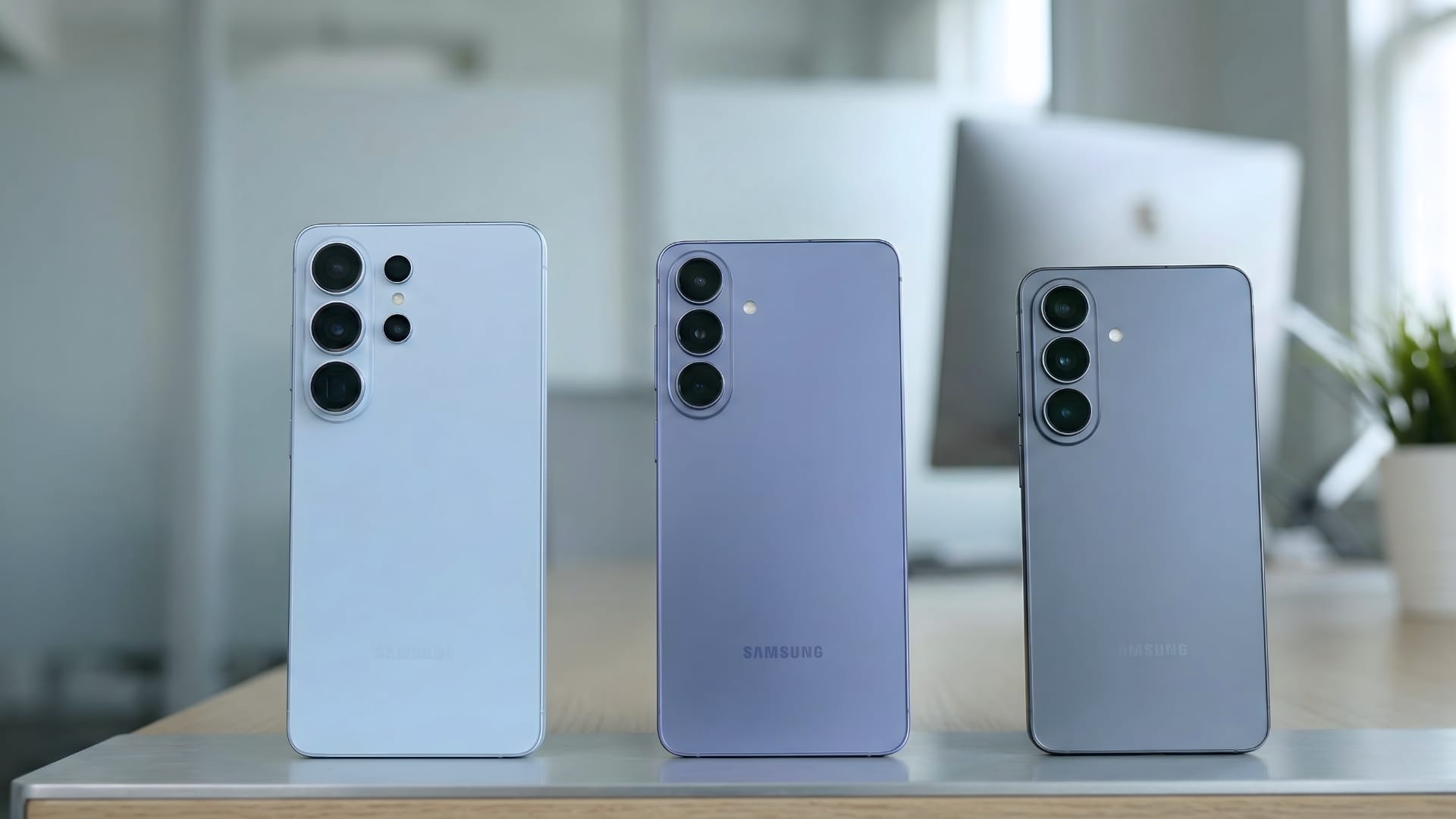
Each year, Samsung faces a more difficult challenge with its Ultra line. The company must persuade existing flagship users that progress has been made, while operating in a category where raw performance is already more than sufficient, and software support spans multiple years. With the Samsung Galaxy S26 Ultra, the narrative centres on intelligence and refinement rather than spec-driven upgrades. Samsung emphasises a more intuitive AI layer, faster charging, a redesigned chassis, and a new display feature aimed at privacy-conscious users.
Placed beside the S25 Ultra, the S26 Ultra clearly represents forward motion. It feels more polished. It behaves with greater confidence in certain scenarios. Yet for those already using the S25 Ultra, the more important question is not whether it is better, but whether it changes daily life enough to justify replacing a device that remains highly capable.
A smarter narrative, not a dramatic reinvention
Samsung’s positioning this year leans heavily into intelligence. The S26 Ultra is presented as the most intuitive Galaxy AI phone yet, with features designed to anticipate user needs, streamline search, and automate minor tasks. The emphasis reflects a broader industry shift, in which incremental specification increases alone rarely define a new flagship generation. Differentiation increasingly depends on how seamlessly the device integrates into everyday routines.
In practice, many AI enhancements are genuinely useful. Screenshot categorisation reduces digital clutter with little friction. On-device search is faster and more context-aware, making it easier to retrieve past content without manually digging through apps. AI-assisted image editing responds convincingly to natural-language prompts and preserves image integrity more reliably than earlier iterations.
The more ambitious elements, headlined by the new Now Nudge engine, aim to transform Galaxy AI from a reactive tool into a proactive assistant. Whether it’s surfacing a specific photo from a trip to New York the moment a friend asks for it in a chat, or automatically checking your calendar for conflicts when a meeting is mentioned, the system’s value is dictated entirely by its hit rate. When these contextual prompts land, they feel like the future of mobile interaction; when they miss or trigger a second too late, they become digital noise. At this stage, they represent a sophisticated “Agentic” signal—a hint at a post-app future—rather than a total structural change in how we use our phones.
What strengthens Samsung’s case this year is not just software, but the underlying chipset that supports it. The Snapdragon 8 Elite Gen 5 Mobile Platform for Galaxy marks one of the first near-2nm-class mobile architectures deployed at scale. While the S25 Ultra remains more than fast enough for conventional tasks, the efficiency gains delivered by this new architecture are strategically significant. Improved power efficiency allows the S26 Ultra to sustain increasingly complex on-device AI workloads without noticeable thermal buildup.
This matters because Samsung’s AI ambitions rely on continuous background processing rather than short bursts of peak performance. Contextual indexing, real-time inference, and more autonomous, context-aware behaviours require sustained efficiency. The S26 Ultra handles these processes without becoming uncomfortably warm under moderate use, which reflects architectural progress rather than headline speed alone.
Even so, the practical difference for S25 Ultra owners today remains narrow. App launches, scrolling fluidity, multitasking, and gaming performance are smooth on both devices. The chipset upgrade improves long-term resilience as AI workloads expand over the next few years, but it does not immediately alter daily behaviour for someone already using last year’s model.
AI reinforces the sense that the S26 Ultra is advancing, and the upgraded processor architecture provides the headroom to support that ambition. For S25 Ultra owners, however, those gains feel more future-facing than immediately necessary.
Privacy Display is innovative, but narrowly relevant
Privacy Display is the most distinctive hardware feature on the S26 Ultra, reducing off-axis visibility at the panel level. It can be activated automatically for specific apps or sensitive interactions, offering a level of contextual control that physical privacy filters cannot match.
In high-density urban settings, this addresses a legitimate behavioural concern. Commuters, consultants, financial professionals, and executives who frequently handle confidential information on the move will recognise the value immediately. Within the flagship segment, it is one of the few additions this cycle that feels genuinely differentiated.
However, innovation at the panel level introduces measurable trade-offs. In side-by-side use, the S26 Ultra exhibits earlier colour shift and more pronounced brightness drop at angles than the S25 Ultra, even with privacy mode disabled. Head-on, the panel is vibrant, with strong colour depth and refined scaling. Tilt the device, and the difference becomes noticeable.
More significantly, early hands-on reports following the 2026 launch suggest that integrating the new Privacy Layer has reduced the effectiveness of the Gorilla Armor anti-reflective coating compared to the S25 Ultra. For users who spend significant time outdoors, particularly in bright Southeast Asian sunlight, this is not trivial. The S25 Ultra’s anti-reflective coating was widely regarded as one of its standout display features. If the S26 Ultra sacrifices some of that glare resistance to accommodate directional light control, outdoor readability may feel marginally compromised.
For users who prioritise discretion in public environments, Privacy Display remains compelling. For users who spend extended time outdoors, particularly those who value the S25 Ultra’s glare resistance, the change may feel like a step sideways rather than forward.
Charging and ergonomics offer practical gains
Where the S26 Ultra delivers more tangible day-to-day improvement is in charging and physical refinement. Faster wired and wireless charging reduces idle time and improves flexibility during busy schedules. For professionals who rely on short charging breaks between meetings or travel segments, this improvement can have a measurable impact.
The device is also thinner and marginally lighter, with softened corners that improve comfort during extended handling. Samsung’s shift from titanium to aluminium reframes last year’s material narrative, yet in practical terms, the device remains robust and thermally stable. The weight reduction and ergonomic adjustments contribute to a more comfortable overall feel, particularly during prolonged usage.
These adjustments make the phone easier to live with, though they do not materially change how it is used. For S25 Ultra owners already comfortable with last year’s form factor and charging performance, the difference will feel incremental rather than pressing.
Camera refinements strengthen consistency, not hierarchy
The camera system reflects a similar philosophy of refinement. Sensor resolutions remain largely unchanged, but wider apertures allow more light into the system. In low-light environments, the S26 Ultra produces brighter results with improved noise handling and more balanced highlights. Video stabilisation benefits from enhanced rotational correction, leading to steadier handheld footage.
These differences are visible in a controlled comparison. They do not reposition Samsung within the broader smartphone camera hierarchy, nor do they render the S25 Ultra inadequate. For most users, the imaging experience remains familiar, albeit marginally more reliable in challenging conditions.
Samsung has improved consistency, especially in challenging lighting, but the upgrade does not meaningfully shift the overall photography experience for existing S25 Ultra users.
The economics of upgrading in a mature cycle
The S25 Ultra remains a fast, capable device with years of software support ahead. In a flagship market where annual gains have narrowed, the case for upgrading increasingly comes down to individual needs rather than habit.
In markets such as Singapore, trade-in values and promotional incentives can significantly influence purchasing decisions. Yet, when evaluating purely on functional grounds, the S26 Ultra does not create a compelling case for S25 Ultra owners to move immediately.
It improves charging speed. It refines ergonomics. It enhances low-light performance. It introduces a distinctive privacy feature. These gains are credible and cumulative, rather than disruptive.
A measured verdict
The Galaxy S26 Ultra is the stronger device. It reflects Samsung’s steady optimisation of its Ultra formula and demonstrates careful attention to polish. For buyers upgrading from older models, it represents a balanced and well-rounded flagship.
For those already using the S25 Ultra, however, the experience remains fundamentally similar. The refinements enhance comfort and consistency, but they do not materially alter daily behaviour.
In a mature flagship market, that distinction matters. The S26 Ultra advances the series. It does not make the S25 Ultra obsolete. For most S25 Ultra owners, patience remains the more rational strategy.