


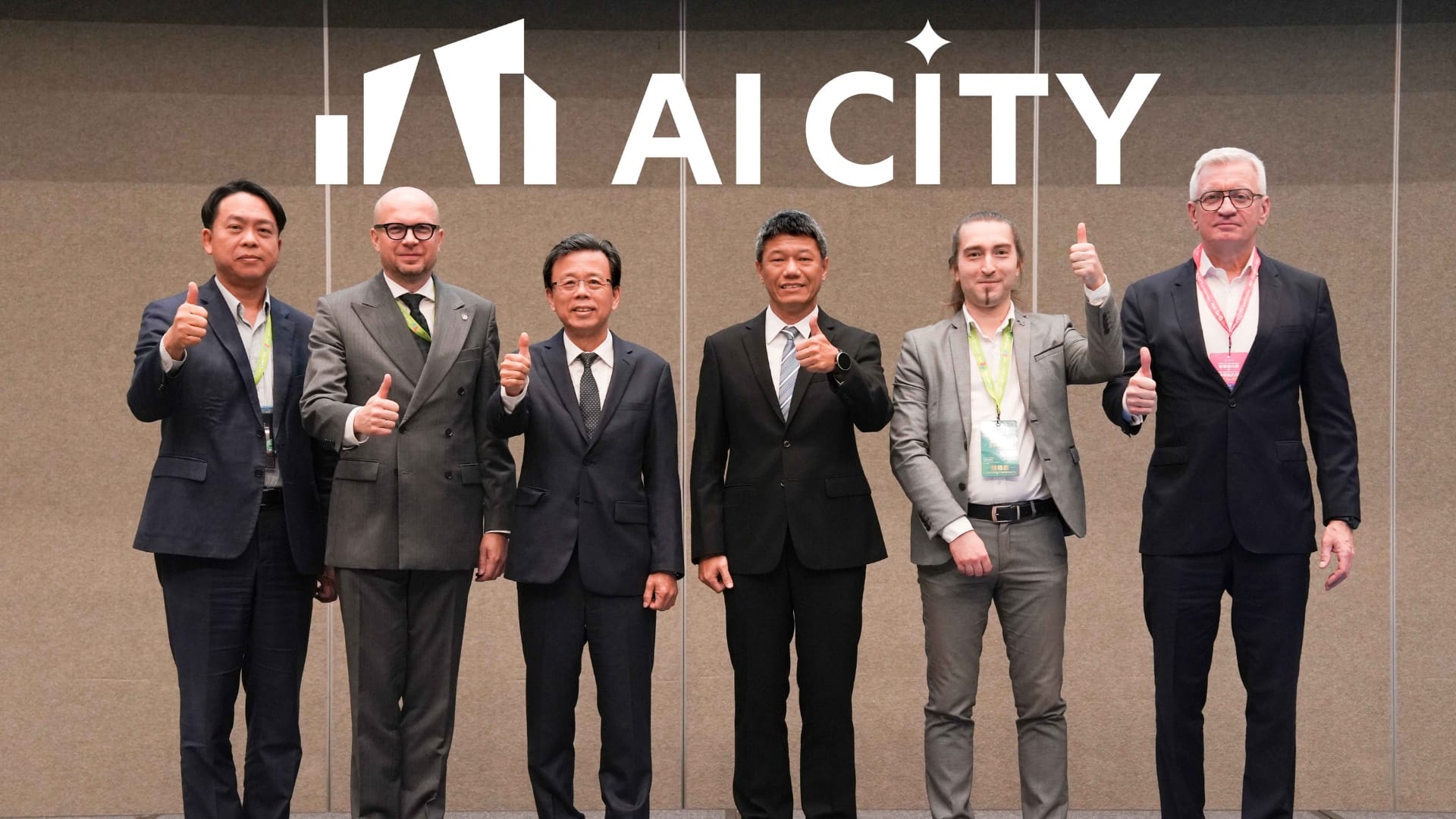
ASUS has introduced an “AI City” strategy alongside a five-layer architecture designed to support large-scale urban deployments, presented during the Smart City Summit & Expo and Net-Zero City Expo 2026. The approach brings together infrastructure, models, platforms, and applications into a single framework aimed at city-level implementation.
The company also outlined a “whole city” export model developed with Foxconn and partners from the Taiwan Smart City Solutions Alliance. According to ASUS, the model is intended to provide governments with a standardised blueprint for deploying AI across urban environments.
Five-layer architecture sets structure for deployment
At the centre of the announcement is a five-layer architecture spanning Sovereign Computing, Sovereign Models, Platforms, Applications, and Innovation. ASUS positioned this structure as a way to organise AI systems from infrastructure through to real-world use cases.
The Sovereign Computing layer covers data centres, edge computing, and core infrastructure required to operate AI systems at a national level. The Sovereign Model layer focuses on locally optimised large language models and AI systems designed to align with regional requirements.
Above this, the Platform layer integrates data services and system capabilities to support different urban functions. While, the Application layer zooms into four areas, transportation, healthcare, security, and daily public services, alongside net-zero initiatives. The Innovation layer connects computing resources, industrial ecosystems, and new applications to support long-term development.
ASUS presented deployments within the Application layer to demonstrate how systems move from proof-of-concept into operational use across city environments.
Taiwan AI Cloud provides infrastructure and model capabilities
Taiwan AI Cloud forms a key part of the stack, providing computing infrastructure, model development, and platform services. The company has participated in building and operating AI supercomputing centres and has worked with the Tainan City Government on an AI City demonstration project.
At the infrastructure level, Taiwan AI Cloud integrates high-performance servers, supercomputing resources, and scheduling platforms to support localised AI environments. These systems are designed to keep data and computation within local jurisdictions.
On the model side, ASUS presented the Formosa Foundation Model, a locally trained large language model built with regional data and domain knowledge. The model is designed for governance use cases, with private deployment to maintain data control.
Platform capabilities include AI inference systems, development tools, and a digital twin platform that supports simulation and deployment across transportation, public safety, energy, and citizen services.
Application layer focuses on healthcare, transport, and security
ASUS AIoT acts as the integrator for application-level deployments, combining hardware and software systems across multiple sectors.
In healthcare, solutions include the ASUS xHIS Next-Gen Healthcare Information Platform, ASUS VivoWatch, handheld ultrasound devices, and ASUS HealthHub. These systems aim to address fragmented data and operational challenges in healthcare delivery.
Security applications include the EHS Management Service, which uses image recognition to detect high-risk behaviour and unauthorised access in industrial or hazardous environments.
In transport, ASUS and its partners presented systems for fleet management, logistics, curbside monitoring, and infrastructure management. Askey contributes additional components such as smart bus stops, smart poles, and private 5G networks, while ASUS MAAS focuses on AI-based parking systems with dynamic pricing and EV charging integration.
The company also highlighted deployments in Europe, including projects in France, Greece, and the Czech Republic, alongside an autonomous driving solution built with international partners.
Maestro platform connects systems across domains
ASUS also introduced the Maestro Intelligent Orchestration Platform, designed to connect devices, platforms, and services across different systems using a standardised API framework.
The platform addresses fragmented deployments by enabling coordination between devices from different vendors. ASUS demonstrated capabilities such as multi-modal sensing, automated task handover, and continuous service execution across functions including visitor management, reporting, and logistics.
According to the company, the platform allows systems to move from isolated deployments to coordinated operations across domains, supporting more integrated service delivery.