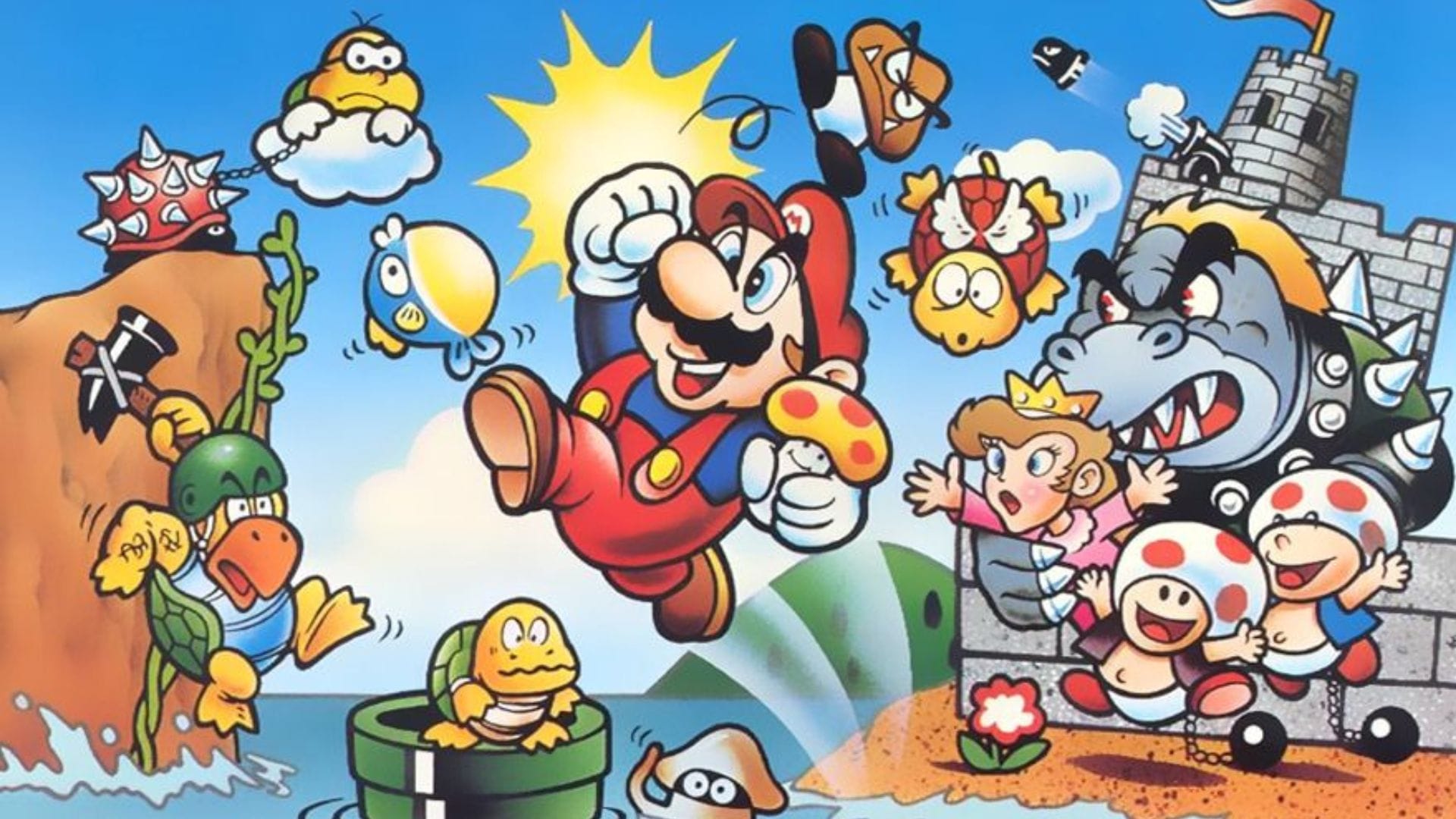
Hideo Kojima, the celebrated creator behind Metal Gear Solid and Death Stranding, has revealed that his decision to enter the video game industry was shaped by an unlikely influence: Nintendo’s Super Mario Bros. Speaking in a recent interview, Kojima said that without the classic platform game, he “probably” would never have become a game developer at all.
Kojima is widely known for cinematic storytelling, complex themes and games that often blur the line between interactive entertainment and film. His work is frequently compared to Hollywood blockbusters, filled with lengthy cutscenes, dramatic performances and ambitious narratives. Against that backdrop, it may seem surprising that a simple, four-decade-old side-scrolling game played such a central role in guiding his career.
Yet Kojima explained that Super Mario Bros arrived at a critical moment in his life and reshaped his view of video games’ creative potential. At the time, he was a university student with no clear plan to work in the games industry. Playing Mario changed that direction entirely, convincing him that games could become a powerful storytelling medium in their own right.
A student captivated by a simple game
In an interview with Wired Japan, Kojima recalled the intense impact Super Mario Bros had on him during his college years. The game, released by Nintendo in the mid-1980s, was already gaining global attention for its tight controls, imaginative level design and broad appeal. For Kojima, however, it became something more personal.
“[I] played it for a year. I was a college student. I skipped school to play at home,” Kojima told Wired Japan. “Without Super Mario, I probably wouldn’t have been in this industry. Yeah. I can’t really play it now, though. It’s a side-scrolling action game. Mario goes left to right. Basically just jumping.”
The comment highlights both his youthful obsession with the game and the distance he now feels from its straightforward mechanics. While Super Mario Bros may seem simple by modern standards, its design was revolutionary at the time. For Kojima, repeatedly playing it opened his eyes to what games could achieve beyond basic entertainment.
Although he admits he can no longer enjoy the game in the same way, the lasting influence remains clear. Super Mario Bros did not directly shape his design style, but it gave him the confidence that games could grow into something larger and more expressive.
Seeing the future of games beyond story
Kojima also reflected on how little traditional storytelling there was in Super Mario Bros. The premise was minimal, focusing on rescuing Princess Peach from an evil monster, with no complex plot or character development. Despite this, the game still delivered a strong sense of adventure.
The lack of narrative depth did not bother him. Instead, it helped him recognise a different kind of storytelling, one driven by player movement, challenge and discovery rather than dialogue or exposition.
The auteur game creator noted that the first Super Mario “had almost no story” aside from saving a damsel-in-distress princess from an evil monster, but it didn’t matter much. “It felt like you were on an adventure,” Kojima continued. “When I saw that, although it was pixel art with no story, I felt this medium would one day surpass movies. That conviction brought me to the game industry.”
This belief would later become a defining feature of Kojima’s career. While he is known for drawing heavily on cinema, his games consistently push interactive elements further than films can. Player choice, control and immersion are central to his work, often challenging conventional ideas of what a game should be.
His conviction that games could surpass movies was formed early, long before advanced graphics or realistic performances became possible. For Kojima, Super Mario Bros proved that emotional engagement did not depend on realism or complex plots, but on the experience of playing itself.
Films that influenced his creative vision
While Super Mario Bros sparked Kojima’s interest in games, cinema has remained a constant influence throughout his career. In the same interview, he spoke about several renowned filmmakers who shaped his creative outlook and storytelling instincts.
Kojima cited Martin Scorsese, Stanley Kubrick, Alfred Hitchcock and Akira Kurosawa as major inspirations. These directors are known for their strong visual styles, careful pacing and willingness to explore challenging themes. Their influence can be seen in Kojima’s attention to framing, atmosphere and dramatic tension.
Among them, one filmmaker stands out as particularly important to him. “He defied genre,” Kojima said of The Thing and Halloween director John Carpenter.
Carpenter’s work is often praised for blending science fiction, horror and action while maintaining a clear, personal style. That ability to cross genres without being confined by expectations mirrors Kojima’s own approach to game development. His projects frequently mix stealth, action, science fiction and philosophical ideas in ways that resist easy classification.
Over the years, Kojima has continued to reference his love of film, even casting well-known actors and directors in his games. Death Stranding, for example, features performances from film stars and uses cinematic techniques that would not feel out of place in a major movie production. Yet, despite these influences, Kojima’s journey into games began not with cinema, but with a plumber jumping across pixelated platforms.
The contrast between Super Mario Bros and Kojima’s later work underscores how inspiration can come from unexpected places. A simple game with minimal story helped convince one of the industry’s most ambitious creators that video games could become a dominant form of artistic expression.
As Kojima continues to work on new projects, his reflections serve as a reminder of how foundational experiences can shape creative paths. What began as a student skipping classes to play at home eventually led to a career that has influenced generations of players and developers alike.