


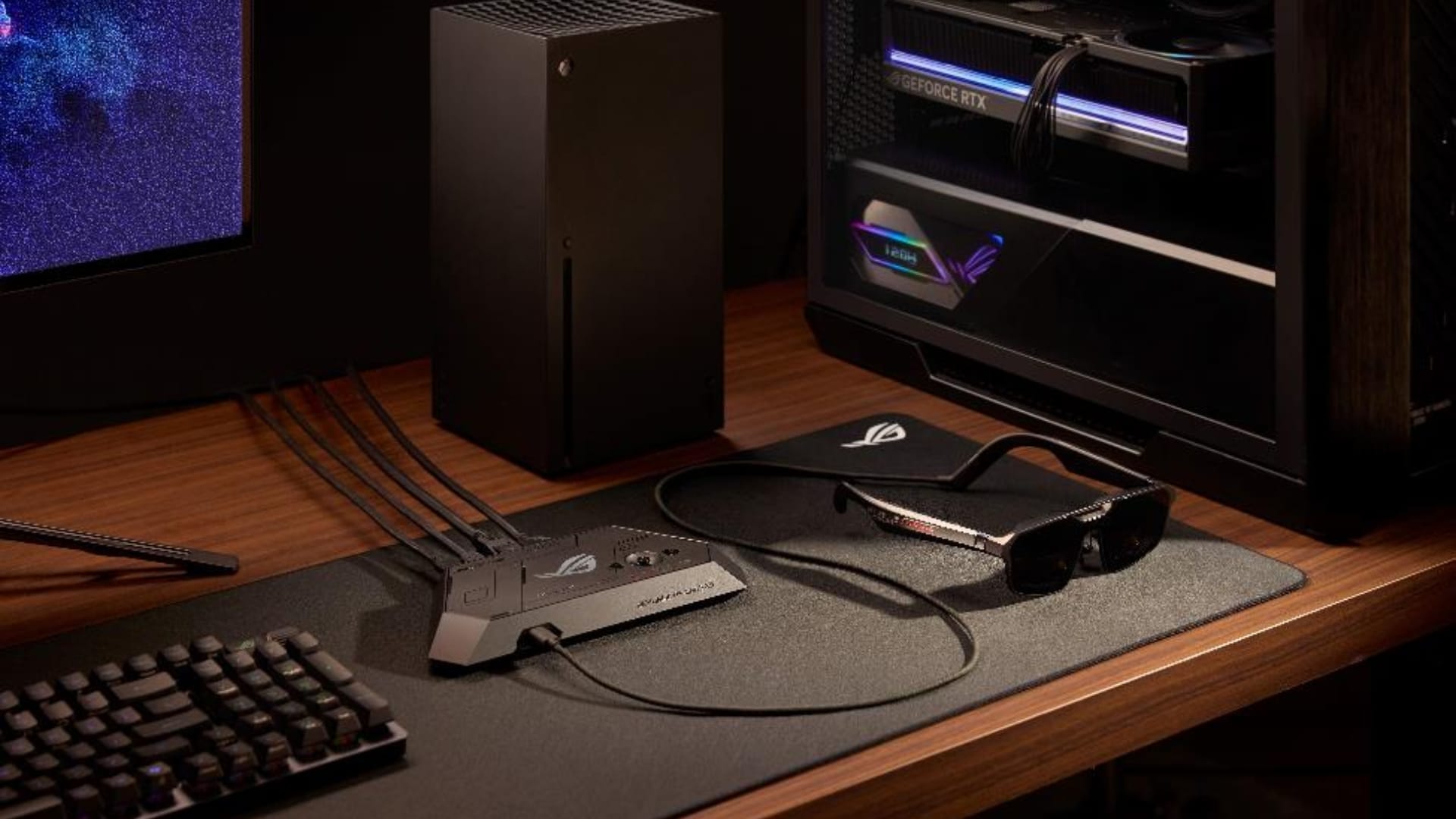
ASUS Republic of Gamers has announced the ROG XREAL R1, describing it as the world’s first AR gaming glasses to feature a 240Hz micro-OLED Full HD spatial display. Revealed ahead of CES 2026, the wearable device is designed to deliver large-screen gaming experiences in a compact and lightweight form, while supporting a wide range of gaming platforms including PCs, consoles, and handheld devices.
Developed in partnership with XREAL, a global player in consumer AR glasses, the ROG XREAL R1 marks ROG’s first entry into wearable spatial displays. The launch builds on the brand’s long-standing focus on gaming displays, which has traditionally ranged from portable monitors to large-format desktop screens. With the ROG XREAL R1, that display experience is translated into a wearable format intended for gaming both at home and on the move.
At the heart of the device is a Sony 0.55-inch micro-OLED display with a resolution of 1920 x 1080. Combined with a 240Hz refresh rate, the display is designed to deliver smooth visuals suited to fast-paced gaming. Rather than presenting content as a headset-style view, the glasses project a large virtual screen, aiming to replicate the feel of a traditional monitor at a much larger scale.
Designed for seamless use across gaming platforms
The ROG XREAL R1 is designed to integrate closely with the wider ROG ecosystem, with particular emphasis on compatibility with the ROG Ally handheld gaming console. When connected via a single USB-C cable, the glasses offer a plug-and-play experience that requires no additional setup. Users retain full access to the Ally’s touchscreen controls while viewing gameplay on a virtual display that can reach the equivalent of 171 inches at a viewing distance of four metres.
For PC and console users, ASUS includes the ROG Control Dock, which expands connectivity options and simplifies device switching. The dock supports DisplayPort 1.4 alongside two HDMI 2.0 inputs, allowing users to connect multiple devices and switch between them with minimal effort. Video output from the dock supports resolutions of up to 4K at 60Hz, ensuring compatibility with modern gaming systems.
The glasses themselves weigh 91 grams, reflecting a strong focus on comfort and portability. ASUS positions the device for extended use, whether at a desk or while travelling, without the bulk commonly associated with head-mounted displays. A built-in X1 spatial co-processing chip allows users to adjust the size and distance of the virtual screen with a button press, providing flexibility in how the display is positioned within the user’s physical environment.
Visual performance, adaptive lenses, and spatial audio
Visually, the ROG XREAL R1 offers a 57-degree field of view, covering 95 percent of the focused viewing area. The virtual display can be placed using native three degrees of freedom tracking, enabling the screen to remain anchored in a fixed position in the real world rather than moving with the wearer’s head. This Anchor mode is designed to recreate the experience of a stationary large display, while an alternative Follow mode keeps the screen centred on the wearer.
High refresh rates are paired with low motion-to-photon latency to minimise motion blur and jitter during gameplay. ASUS states that latency can be as low as 3ms, helping ensure that on-screen action closely matches player input. Peak brightness is rated at 700 nits, with colour coverage reaching 107 percent of the sRGB colour space, positioning the display for both gaming and media consumption.
The glasses also incorporate electrochromic lens technology that adapts to changing lighting conditions. The lenses automatically become more transparent when the user looks away from the virtual screen and tint again when attention returns to it. Users can also manually select from three levels of dimming to suit different environments, ranging from bright outdoor settings to darker indoor spaces.
Audio is delivered through Sound by Bose technology, which is designed to provide immersive and spatially accurate sound without the need for separate headphones. According to ASUS, the system enhances in-game awareness by clearly reproducing positional audio cues such as footsteps and environmental effects, contributing to a more immersive gaming experience.
Availability and outlook
ASUS has confirmed that the ROG XREAL R1 is expected to ship globally in the first half of 2026. The device will be showcased at CES 2026 in Las Vegas, with demonstrations planned at the ASUS ROG booth at The Venetian as well as at XREAL exhibition locations during the event.
Pricing details have not been announced. By combining high-refresh-rate micro-OLED displays, broad device compatibility, and adaptive AR features, ASUS is positioning the ROG XREAL R1 as a practical step towards spatial gaming displays that fit into existing gaming setups rather than replacing them.