

Meta has started rolling out new software features for its Ray-Ban Display smart glasses, marking one of the most significant updates since the device launched late last year. The additions aim to make the glasses easier to use and more discreet, particularly when sending messages or reading prepared text.
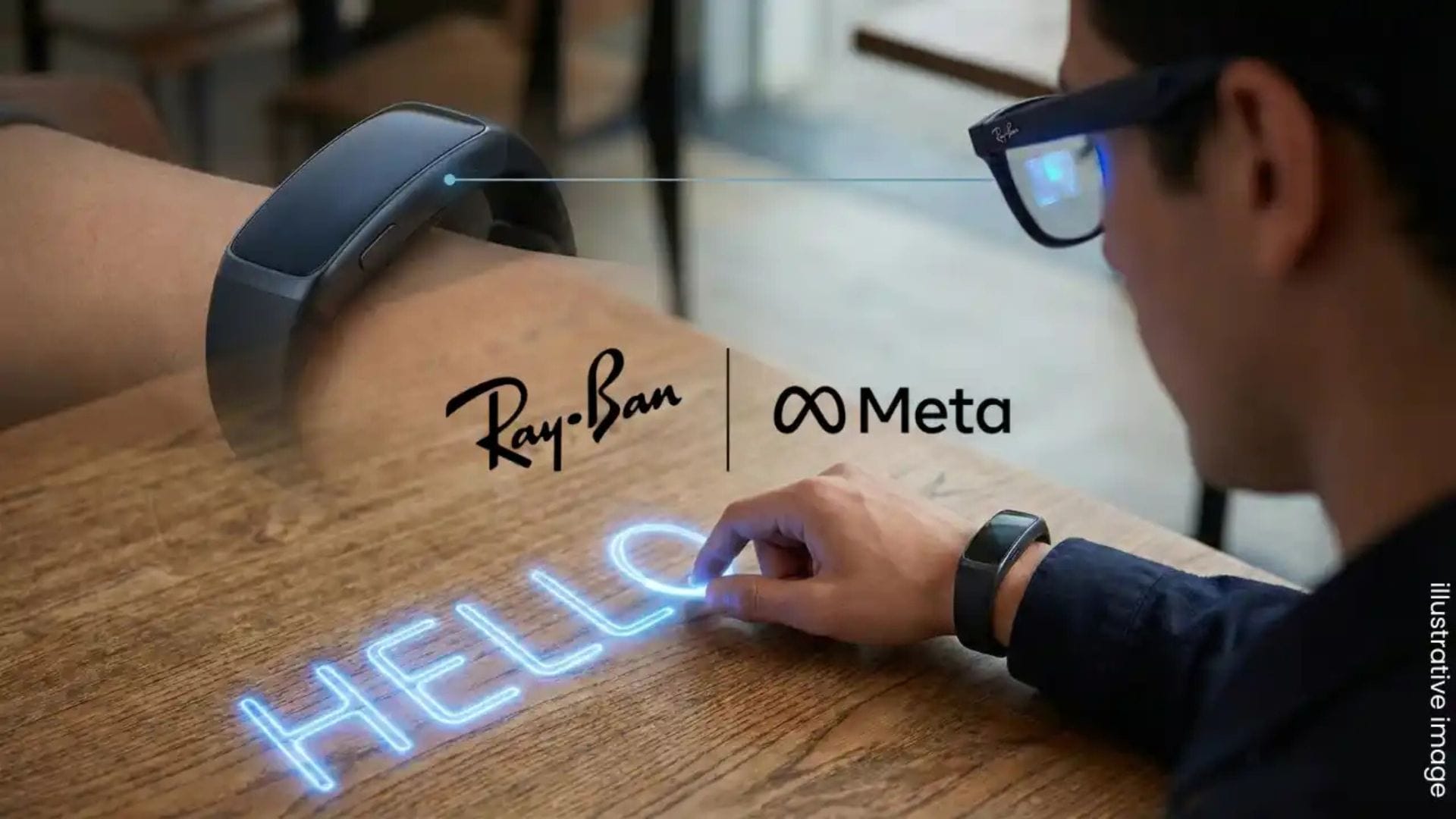
The most notable change is the introduction of a handwriting input feature, which allows users to write messages by tracing letters with their hand on a surface. The feature was first teased when Meta announced the display-enabled glasses last year and is now becoming available to people enrolled in the company’s early access programme.
Early impressions from hands-on testing suggest the update could change how users interact with the glasses in everyday settings, especially for those who prefer not to rely on voice commands in public.
Handwriting offers a quieter way to send messages
Until now, replying to messages on the Meta Ray-Ban Display glasses has depended mainly on voice dictation or a small set of preset replies. While these options work, they have limited appeal for users who feel uncomfortable speaking to their glasses in shared spaces such as cafés or public transport.
The new handwriting feature is designed to solve that problem by allowing users to compose custom messages more discreetly. By wearing the glasses and the accompanying neural band, users can trace letters with their hand on a nearby surface, such as a table, to form words and sentences. The glasses then interpret these movements and convert them into text on the display.
Early tests show that the system is not flawless, but it is intuitive enough to be practical. In one example, the software misread a capital “I” as an “H”, highlighting that recognition accuracy still has room to improve. Even so, users could quickly write short sentences and make corrections with simple gestures. A swipe from left to right adds a space, while a swipe from right to left deletes the last character, making basic editing possible without touching a phone.
For Meta, the feature represents another step towards reducing dependence on voice input. The company has previously positioned the neural band to make interactions with smart glasses feel more natural, and handwriting fits neatly into that vision by offering an alternative that feels both personal and low-key.
Teleprompter feature targets creators and speakers
Alongside handwriting, Meta has announced a teleprompter feature for the Ray-Ban Display glasses. This tool allows users to copy and paste text into the system and display it in the glasses, making it easier to deliver speeches, presentations, or scripted content while maintaining eye contact.
The teleprompter supports up to 16,000 characters, which Meta says is equivalent to half an hour of spoken material. This capacity suggests the feature is aimed not just at casual users but also at creators, professionals and public speakers who may rely on longer scripts.
Unlike traditional teleprompters, Meta’s version does not automatically scroll as the user speaks. Instead, text is displayed on individual cards that the wearer swipes through manually. According to the company, an auto-scrolling version was tested during development, but early feedback showed that users preferred to control when new text appeared. This approach reduces the risk of losing one’s place and allows the speaker to pause naturally without feeling rushed by moving text.
The teleprompter feature is now rolling out, though Meta has cautioned that it may take some time to become available to all users. As with handwriting, access will initially be limited, reflecting a gradual release strategy.
A sign of Meta’s long-term plans for smart glasses
These updates are among the first major software additions to the Meta Ray-Ban Display glasses since their release and point to a broader strategy of keeping the device relevant through ongoing improvements. Rather than relying solely on hardware updates, Meta appears focused on adding new capabilities that expand how the glasses can be used day to day.
The company has taken a similar approach with its other smart glasses, regularly introducing features after launch to maintain interest and respond to user feedback. The handwriting and teleprompter tools suggest Meta is paying close attention to how people actually use the glasses, particularly in social settings where discretion matters.
Elsewhere at CES, Meta also shared updates on its neural band, which pairs with the glasses, hinting at future enhancements that could further reduce reliance on voice or physical controls. At the same time, the company confirmed it is delaying a previously planned international rollout of the device, indicating that it is prioritising refinement over rapid expansion.
Taken together, the new features underline Meta’s ambition to make smart glasses more practical and socially acceptable. While the technology is still evolving, handwriting and teleprompter support show how small interaction changes could have a big impact on whether people choose to wear these devices more often.