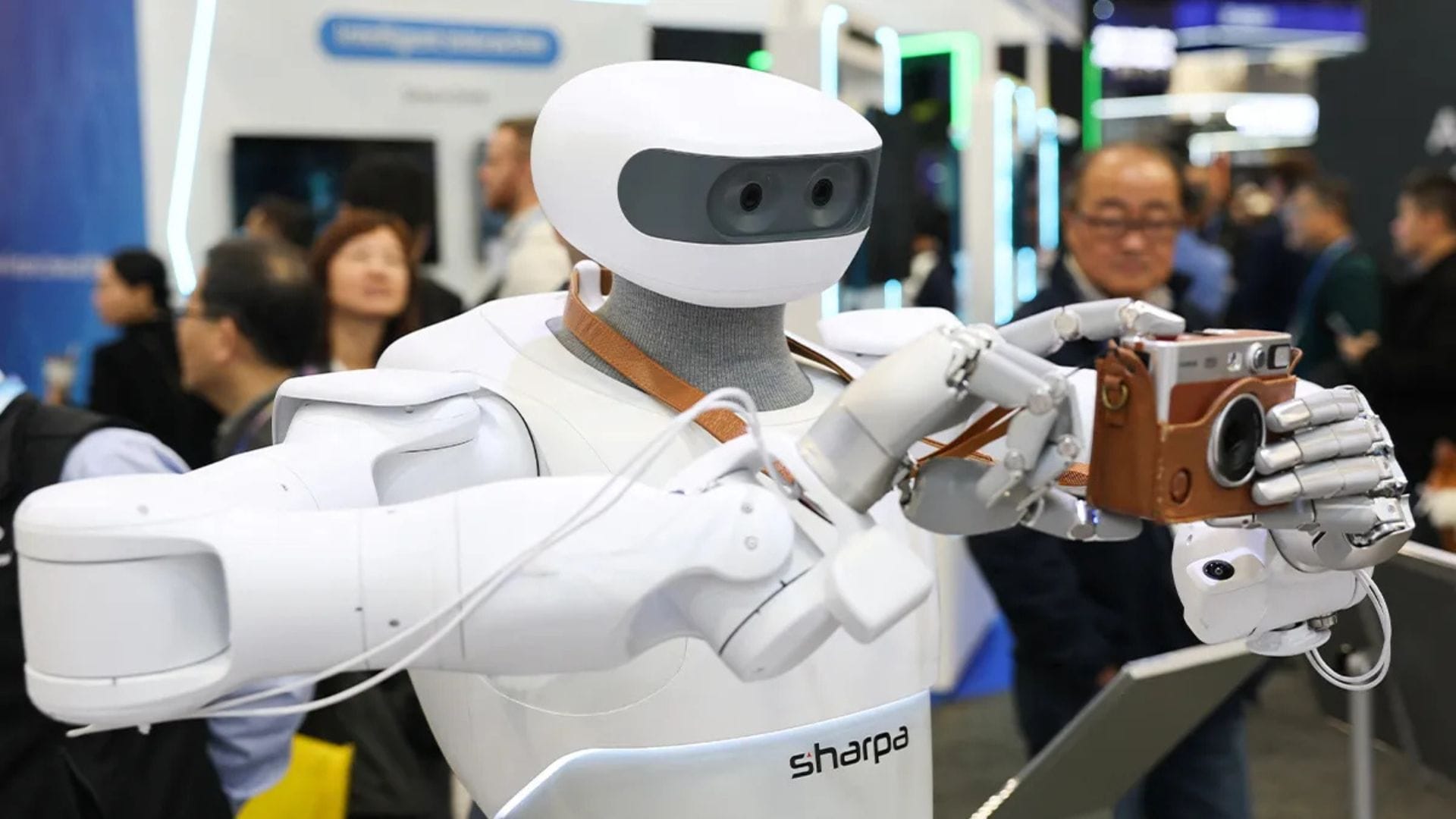
Sharpa drew steady crowds at CES 2026 with a humanoid robot that appeared to be constantly at work. Rather than standing still for demonstrations, the machine moved between tasks with ease, playing ping-pong, dealing blackjack cards and posing for selfies with visitors. The display highlighted the company’s ambition to build robots capable of handling a wide range of real-world tasks without human control.
The humanoid was presented as a general-purpose system rather than a single-task machine. By combining vision, touch, and precise movement, Sharpa aimed to demonstrate how its technology could move beyond research labs into practical environments. The booth focused as much on the robot’s hands and sensing systems as on its humanoid body, underscoring the importance of dexterity in everyday tasks.
A humanoid designed for constant activity
Throughout the event, Sharpa’s humanoid remained in near-continuous motion. It rallied with human players at a ping-pong table, adjusting its posture and timing to return shots, before switching roles to deal cards at a blackjack table. The same robot then turned its attention to visitors, lifting an arm to take selfies with people passing by the stand.
@engadget Sharpa's jack-of-all-trades robot puts its super dexterous hands to work
♬ original sound – Engadget
This variety of tasks was central to Sharpa’s message. Many robots shown at trade shows are built to perform a single action repeatedly, often in controlled settings. Sharpa’s humanoid, by contrast, was designed to adapt to different situations. Its upper-body humanoid form enabled it to use tools and interact with objects in ways familiar to people, allowing it to move between games, demonstrations, and social interactions without physical reconfiguration.
The company positioned the robot as evidence of progress towards machines that can operate in human spaces. By demonstrating leisure activities alongside service-style interactions, Sharpa suggested its technology could one day be used in public venues, entertainment settings or hospitality environments. The emphasis was not on speed or strength, but on coordination, balance and smooth movement over long periods of operation.
SharpaWave hand highlights advances in dexterity
Alongside the humanoid robot, Sharpa showcased SharpaWave, a full-scale robotic hand built to match the size of a human hand. The hand features 22 active degrees of freedom, enabling complex finger movements and fine motor control. This level of articulation allows the hand to perform actions that are difficult for traditional robotic grippers, such as subtle pinching or gentle placement of objects.
SharpaWave uses a combination of vision and touch to guide its movements. Each fingertip contains a miniature camera and more than 1,000 tactile pixels. These sensors allow the hand to judge pressure and texture, helping it adjust its grip accordingly. In demonstrations, the hand picked up delicate items, such as individual playing cards, without bending or damaging them.
The hand is designed to mirror human gestures in real time. When a person moves their hand in front of the system’s camera, SharpaWave accurately copies those motions. This approach supports training and learning, as the robot can observe and replicate human actions. Sharpa presented the hand as a key building block for future humanoid robots, where precise manipulation is essential for tasks in homes, workplaces and public spaces.
Moving beyond single-purpose robots
Ping-pong robots have appeared at technology shows before, but they are often limited to mechanical arms mounted beside a table. Sharpa’s approach was different. By giving its robot a humanoid upper body, the company aimed to show how form and function can work together. The robot’s ability to shift its stance, track the ball and return shots added to the impression of a more natural interaction.
Sharpa’s broader goal is to develop robots that can handle many jobs rather than one fixed role. The CES demonstrations were chosen to highlight this flexibility. Playing games, handling cards and interacting socially all require different combinations of vision, movement and decision-making. By performing these tasks in sequence, the humanoid reinforced the idea of a single platform capable of adapting to varied demands.
The company suggested that this general-purpose approach could open the door to wider deployment of humanoid robots. Instead of designing separate machines for each task, Sharpa envisions systems that can be trained and updated to take on new responsibilities as needed. The CES appearance served as a public test of that vision, using familiar activities to make advanced robotics easier to understand.