

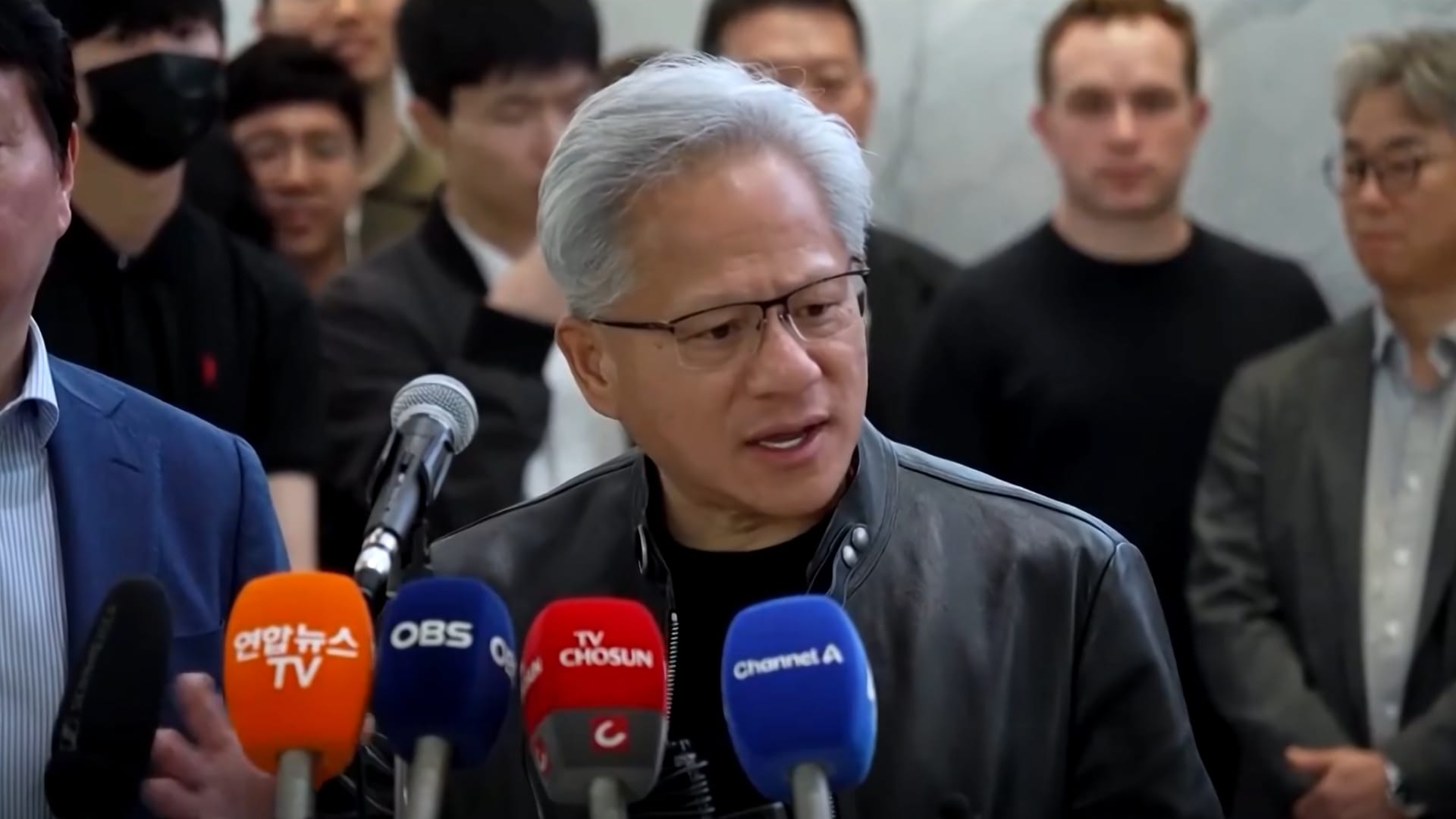
NVIDIA has announced a series of Korea-focused collaborations as Jensen Huang visited South Korea, linking SK Group, NAVER and Doosan Group more closely to its AI factory roadmap.
The partnerships connect NVIDIA’s infrastructure plans to Korea’s semiconductor, cloud and industrial base. SK hynix will co-develop next-generation memory for AI factories, SK Telecom and NAVER plan to expand AI cloud capacity using NVIDIA DSX, and Doosan Group will explore robotics, power systems and materials used in AI data centre equipment.
Memory remains the foundation of the AI factory stack
SK hynix sits at the memory layer of NVIDIA’s AI factory roadmap, under a multiyear partnership to co-develop next-generation memory for AI factories.
The agreement is aimed at aligning SK hynix’s memory development with NVIDIA’s AI infrastructure roadmap. NVIDIA said the collaboration will support advanced memory supply, as advanced memory requires long development cycles, advanced fabrication and substantial capital investment.
SK hynix will co-develop memory for several NVIDIA platforms, including Vera Rubin AI supercomputers, Vera CPUs, RTX Spark-powered PCs and Jetson Thor robotic computing platforms. That gives the partnership a wider scope than data centre accelerators alone, extending it into personal AI and physical AI systems.
“AI factories are the engines of the next industrial revolution, and advanced memory is essential to their performance,” said Jensen Huang, founder and CEO of NVIDIA. “SK hynix has been an extraordinary partner to NVIDIA, playing a central role in delivering advanced memory technologies for NVIDIA AI computing platforms. Together, we will codevelop the next generation of memory for AI factories and support the accelerating global expansion of AI infrastructure — from frontier model training to agentic and physical AI.”
The partnership also extends into how semiconductors are designed and manufactured. SK hynix is using NVIDIA CUDA-X libraries and AI to accelerate semiconductor simulation, including technology computer-aided design and computational lithography workflows. It is also using CUDA-X and NVIDIA PhysicsNeMo to support in-house simulation codes and AI physics workflows.
NVIDIA said this work could lead to three-way collaborations between chipmakers, NVIDIA and electronic design automation software vendors, as semiconductor companies look for faster ways to simulate, validate and optimise advanced chip processes.
SK Telecom and NAVER add the cloud capacity layer
If SK hynix anchors the memory side of the roadmap, SK Telecom and NAVER represent the next infrastructure layer: AI cloud capacity built on NVIDIA DSX.
SK Telecom plans to build a gigawatt-scale AI Cloud in Korea using NVIDIA DSX, with the first AI factory planned to come online in 2027. The cloud is intended to support sovereign, physical and agentic AI services for enterprises and industries across Korea, with a stated vision to expand to wider Asia regions.
NVIDIA describes AI Clouds as large-scale infrastructure made up of AI factories that support training, inference and agentic AI workloads. The NVIDIA DSX platform provides the architecture for building and operating these systems, combining accelerated computing, systems, software and partner technologies.
The focus on token performance per megawatt also shows how AI infrastructure is being framed around operating efficiency, rather than GPU capacity alone. NVIDIA said DSX MaxLPS software is designed to maximise token performance per megawatt, while DSX OS provides an operating layer for lifecycle management, runtime consistency, health automation, resiliency and multi-tenant operations.
SK Telecom will also become an NVIDIA Cloud Partner, joining a programme for providers using NVIDIA infrastructure, software and developer tools to deliver AI cloud services.
“Through our close partnership with NVIDIA, we have now secured full-stack AI infrastructure capabilities, from chips to data centre operations,” said Chey Tae-won, Chairman of SK Group. “We will work with NVIDIA to tackle GPU, memory and energy challenges and become a leading AI factory player shaping Asia’s AI ecosystem.”
NAVER’s announcement also links AI infrastructure expansion to sovereign AI and model development. The company is expanding its AI infrastructure using NVIDIA DSX, starting with 55 megawatts at GAK Sejong, NAVER’s hyperscale data centre in Sejong, South Korea, with plans to move to gigawatt scale.
NAVER plans to use NVIDIA full-stack AI platforms, models and software to support sovereign AI models, agentic AI services and its AI data centre business. The infrastructure is intended to serve enterprises, industries, government organisations and AI cloud customers.
The company is also advancing HyperCLOVA X models by fine-tuning NVIDIA Nemotron 3 Ultra with its proprietary data and training expertise. NAVER is the first Korean company to participate in the NVIDIA Nemotron Coalition and plans to launch an AI Agent Platform in Korea in the second half of the year, powered by NVIDIA NemoClaw blueprints.
NAVER is also developing a Seoul World Model using proprietary urban street-view data and spatial modelling technology, building on NVIDIA Cosmos world foundation models.
Digital twins and robotics move the roadmap into industry
The Korea announcements also connect NVIDIA’s AI factory strategy to manufacturing and physical AI, where AI systems are applied to factories, robots and industrial equipment.
SK hynix is developing fab digital twins as a foundation for autonomous semiconductor manufacturing operations. The work combines NVIDIA Omniverse libraries, OpenUSD pipelines and scene optimisation technologies to build 3D factory scenes for visualising, simulating and improving complex fab environments.
These digital twins can support operational optimisation, including the movement of autonomous mobile robots and other fab assets, using NVIDIA cuOpt and the NVIDIA Metropolis platform. NVIDIA and SK hynix are also exploring ways to connect digital twins with legacy software and agentic AI workflows, allowing AI systems to reason over fab data, automate tasks and support manufacturing decisions.
Doosan Group brings the physical AI thread into robotics, construction equipment and industrial systems. Doosan Robotics is integrating NVIDIA Isaac Sim, NVIDIA Isaac Lab, NVIDIA Cosmos, the Newton physics engine and NVIDIA Jetson Thor into its Agentic Robot OS.
The platform is designed to connect perception, reasoning, simulation, learning and on-device inference. NVIDIA and Doosan Robotics are exploring reference use cases for industrial tasks such as depalletising and sanding, as well as new robot form factors including dual-arm and humanoid platforms.
Doosan Bobcat plans to explore NVIDIA physical AI technologies for equipment used in construction, landscaping, agriculture and material handling. The work is intended to support specialised world models that help machines perceive operating environments, reason about changing conditions and perform tasks with greater autonomy.
Power and materials round out the infrastructure picture
The Doosan collaboration also reaches into two less visible parts of AI infrastructure: power supply and advanced materials.
Doosan Enerbility is exploring opportunities to support NVIDIA AI factories and the NVIDIA DSX platform through large-scale power infrastructure. Its portfolio includes gas turbines, steam turbines and small modular reactors, while Doosan Fuel Cell’s hydrogen fuel-cell systems are also part of the collaboration area.
Future work could include power supply design for AI factory deployments, optimisation of generation equipment and evaluation of low-carbon power sources such as small modular reactors. These areas are relevant to AI data centres because accelerated computing requires reliable, high-efficiency and continuously available power.
Doosan Corporation Electro-Materials BG is supporting AI data centre infrastructure through copper clad laminate, a foundational material used in printed circuit boards. High-performance copper clad laminates are used in PCBs for networking equipment, AI accelerators and AI server motherboards, where low signal loss and reliability are important.
NVIDIA MGX provides a modular reference architecture for accelerated systems, helping manufacturers and ecosystem partners build servers and rack-scale AI factory infrastructure. As AI servers and networking systems require higher performance and bandwidth, materials such as copper clad laminate become part of the data centre equipment stack.
The Korea announcements give NVIDIA a single infrastructure narrative across memory, AI cloud, industrial systems, power and materials. For SK Group, NAVER and Doosan Group, the collaborations connect their existing industrial roles to NVIDIA’s AI factory roadmap, with Korea serving as a deployment market for AI cloud infrastructure and a partner base for memory, industrial systems, power and materials.