

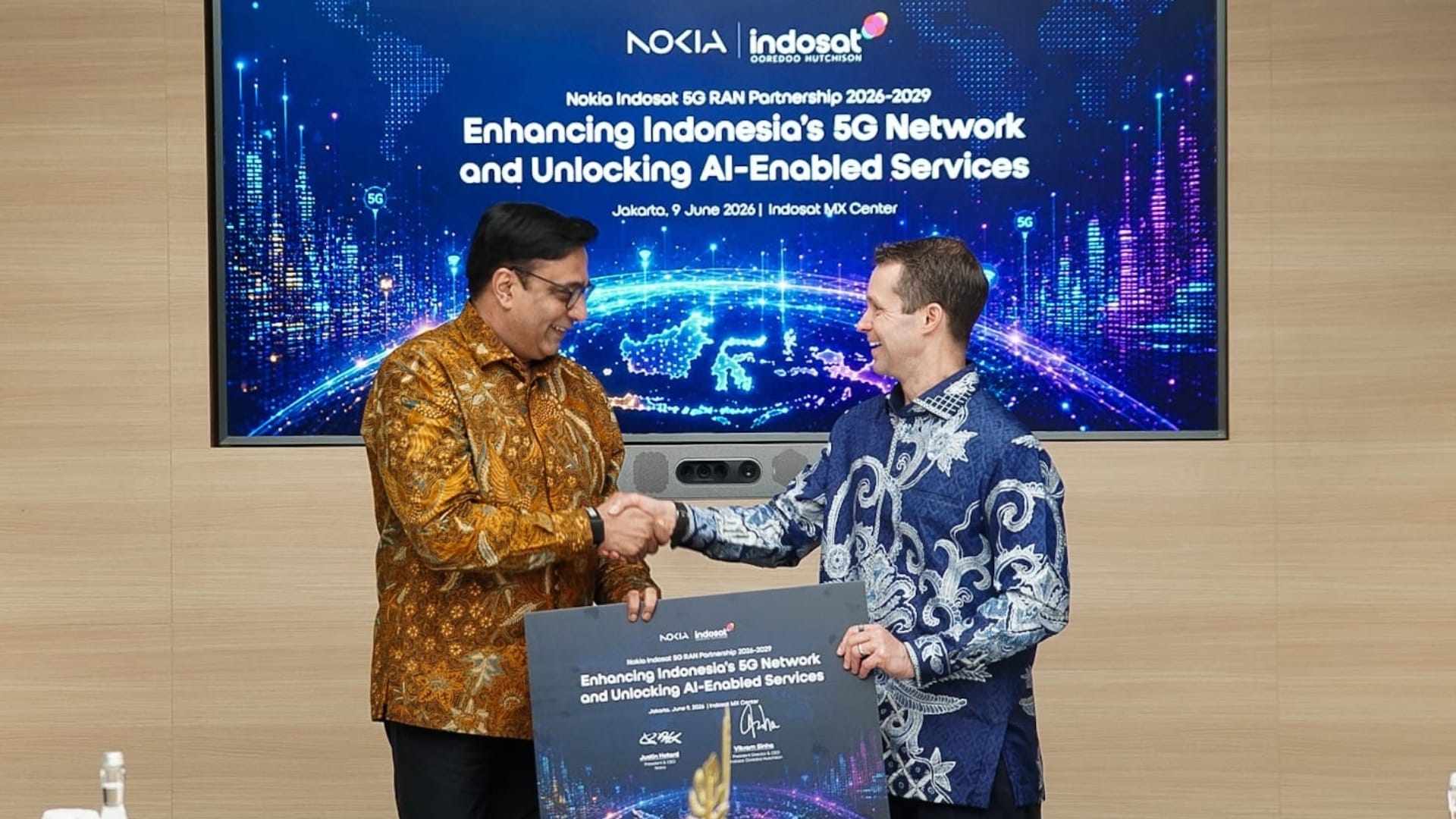
Nokia and Indosat Ooredoo Hutchison are working together to modernise Indosat’s mobile network in Indonesia, with Nokia supporting the rollout of low-band and mid-band 5G across the operator’s network.
The agreement covers 5G Radio Access Network technologies, network management tools and automation platforms. It also links Indosat’s 5G expansion with its work on AI-RAN and AI Grid deployment involving Nokia and NVIDIA, with field trials in Indonesia expected by the end of 2026.
Indosat plans wider 5G coverage across Indonesia
Nokia will support the deployment of low-band 5G across Indosat’s full network footprint. Mid-band 5G is expected to cover about 80% of the network over the next three and a half years.
The companies said the deployment is intended to improve network capacity, performance and coverage across Indonesia. For consumers, the upgraded network is expected to support everyday digital use such as entertainment, gaming, work, learning and communication. For enterprises and public-sector users, the network is expected to support use cases across public services, industry and digital services.
The rollout gives Indosat a broader 5G foundation for both coverage and capacity. The use of both low-band and mid-band 5G points to a rollout that addresses coverage and capacity, although the companies did not disclose band-specific deployment details.
Nokia’s role covers radio, baseband and automation
As part of the agreement, Nokia will deploy its Habrok and Pandion radio families, Levante basebands, Centralized RAN, and advanced network management and automation platforms.
The equipment mix points to a network upgrade that covers both radio hardware and the operational layer needed to manage larger 5G deployments. Nokia said the platforms would support intelligent operations, improved energy efficiency and faster service innovation.
AI-driven automation is also part of the deployment. In practical terms, this gives Indosat a way to manage network performance and energy use as 5G coverage expands. The companies said the upgrade would support a more sustainable approach to digital infrastructure, although the release did not provide projected energy savings, cost reductions or operational benchmarks.
AI-RAN trials are planned for Indonesia by end-2026
The agreement also extends into AI-RAN, an architecture that combines radio access network functions with AI computing infrastructure. Nokia, Indosat and NVIDIA are already working together on AI-RAN, with the next step expected to be field trials in Indonesia by the end of 2026.
According to the companies, this follows the first AI-RAN call completed at Mobile World Congress 2026. Nokia is also working on AI algorithms designed to improve spectral efficiency on NVIDIA AI-RAN platforms, with those capabilities expected to be included in the upcoming field trials.
Indosat is combining centralised AI factories with distributed AI-RAN infrastructure as part of what it calls an AI Grid. The company said the model is intended to distribute AI and connectivity to millions of Indonesians, with applications already being accelerated in government services, healthcare, education and agriculture. The work is supported by the AI-RAN Innovation Center in Surabaya and the NVIDIA AI Technology Center ecosystem.
“Indosat and Nokia are showing what it looks like when a 5G network becomes the platform for intelligence. By building on our AI-RAN work together and moving toward field trials in Indonesia, we are helping create an architecture where AI and connectivity can work side by side to improve efficiency, enable new applications and support digital transformation at scale,” said Ronnie Vasishta, Senior Vice President of Telecommunications at NVIDIA.
The field trials will be the more important test of how the partnership translates from network planning into deployment. The current agreement sets out the infrastructure direction, but the companies have not disclosed trial locations, participating enterprise users, service models, performance targets or commercial timelines for AI-enabled services.