


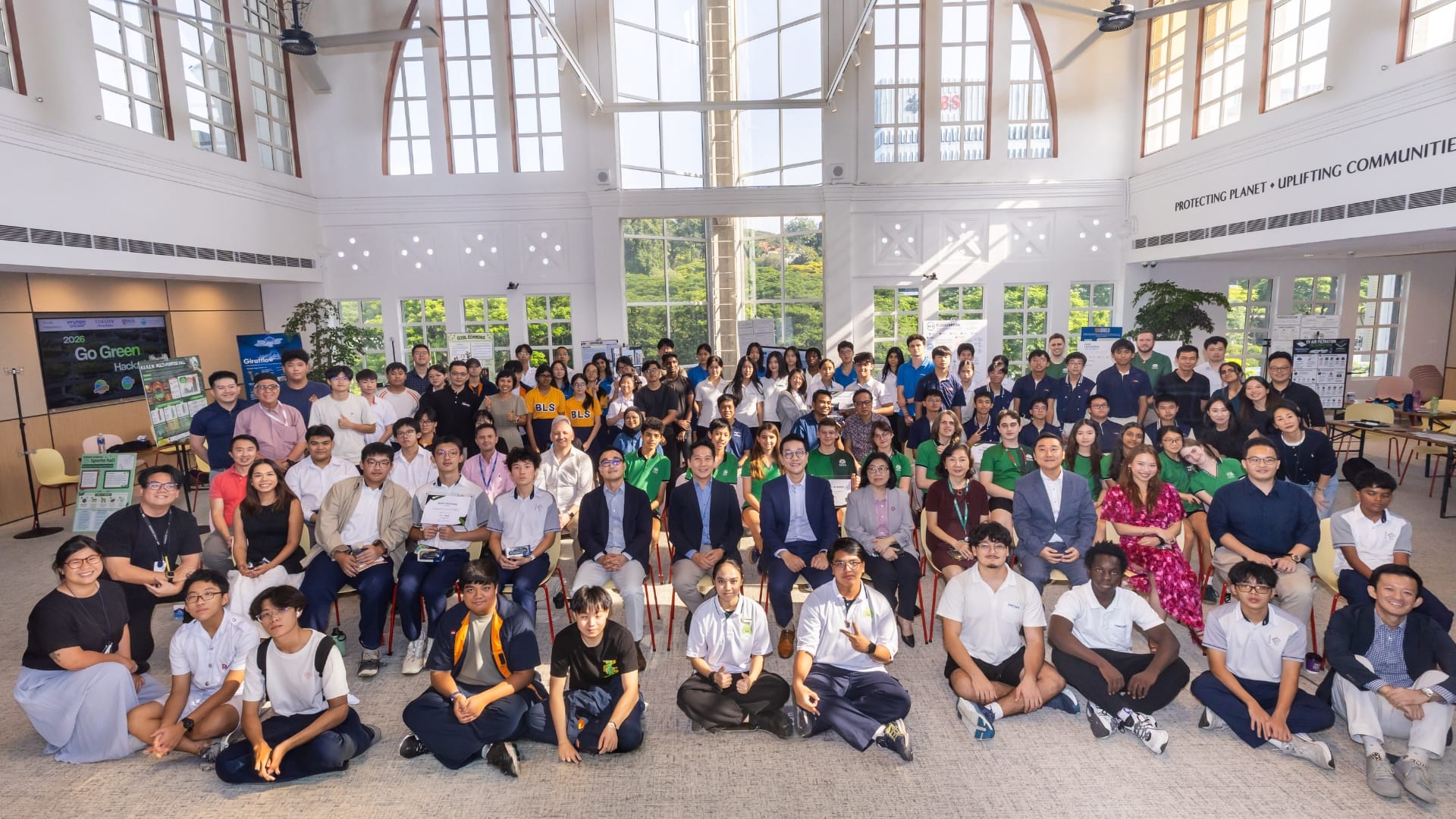
Singapore student teams explored vehicle safety systems, passive cooling structures and climate-adaptive public spaces at the fifth Hyundai Go Green Hackathon, with projects aimed at heat, flooding and air quality risks in urban environments.
The 2026 edition brought together 91 students across 25 teams from nine local and international schools. Hosted by Hyundai Motor Group Innovation Center Singapore (HMGICS) and Hyundai CRADLE Singapore, the hackathon was held in conjunction with the Ministry of Sustainability and the Environment’s Go Green SG 2026, in partnership with Temasek Foundation, with support from the National University of Singapore.
The theme, “Go Green: Climate Adaptation”, gave students two practical design briefs. One asked teams to reimagine multi-purpose community spaces so they could continue serving daily community needs while helping residents cope with heat. The other focused on smart car-based systems that could turn vehicles into mobile safe spaces during climate hazards such as extreme heat, flooding and poor air quality.
The strongest concepts treated climate adaptation as a sensing, materials and design challenge. Students worked with ideas such as water-depth detection, vehicle-speed alerts, smart tinting, cabin air monitoring, terracotta cooling structures, misting systems and flood-resilient transport.
Vehicles become part of the climate response
The mobility projects focused on how vehicles could protect passengers when roads flood, cabin temperatures rise, or air quality becomes unsafe.
German European School Singapore’s Team License to Chill won first place for the mobility problem statement with a smart window concept for parked vehicles. The project uses SPD film that adjusts tint levels based on UV index through voltage control and a mobile app, with the aim of reducing heat build-up inside the cabin before passengers enter.
School of Science and Technology’s Team WD-40 placed second with an emergency underwater escape system for vehicles trapped in floods. The concept is designed as a last-resort mechanism that automatically shatters the moonroof once water reaches a dangerous level, creating an escape route when water pressure prevents doors from opening.
Other teams focused on flood sensing and route safety. SST’s H4rdcov3r project monitors water depth and vehicle speed in real time when a car is moving through shallow floodwater. It alerts drivers if they exceed a safe threshold of about 7 to 8 km/h, helping them maintain a protective bow wave and reduce the risk of water entering the engine.
Boon Lay Secondary School’s Team BLSparkler, which won the Most Feasible award, developed a vehicle-based Smart Puddle Detection System. The concept uses sensors and artificial intelligence to detect flooded roads, estimate water depth, alert drivers and suggest safer routes through GPS integration. It also includes a collaborative data-sharing network so vehicles can improve system accuracy over time.
The transport-focused projects also looked beyond private cars. United World Colleges East’s SafeNest concept reimagines a 20-seat electric public transport vehicle for flood conditions in Singapore. It includes an upgraded hydropneumatic suspension system that can raise the chassis through sensor- and ECU-controlled adjustments, along with mmWave radar, thermal cameras, software assistance, and waterproofing for critical components such as batteries.
Cabin systems focus on heat and air quality
Several teams treated cabin comfort as a safety and health issue, especially in hot or polluted conditions.
GESS’s Fast and Curious project monitors PM2.5 particles, carbon monoxide, heart rate and breathing patterns inside the vehicle. The system adjusts airflow using adaptive intake controls, multi-stage filtration and thermoelectric cooling. Its design responds to the most at-risk occupant in real time, rather than applying one setting across the cabin.
UWC East’s Team EcoLink, which received the Most Innovative award, focused on keeping vehicle cabins safe during extreme heat, including during power failures. Its three-layer cooling system combines a reflective outer coating, bio-inspired microchannel “veins” that dissipate thermal energy, and phase-change material seat mats that absorb and regulate heat around passengers.
Other concepts explored self-sustaining or low-energy cabin cooling. UWC Dover’s The Green project harvests moisture from the air to generate water, which is then circulated through the cabin structure for cooling. River Valley High School’s Team CHEM worked on a multilayer smart film for vehicle windows and surfaces that blocks UV and infrared radiation while harvesting solar energy to support cooling and ventilation.
Public spaces are treated as cooling infrastructure
The community-space projects approached heat adaptation through everyday places such as shelters, void decks, classrooms, sports areas, parks and walking routes.
Across the public-space concepts, teams returned to a common constraint: cooling has to be practical, low-energy and usable in places people already gather. Hot air passes through a porous structure where moisture lowers the temperature, while integrated fans improve airflow. Kinetic play elements help circulate water through the system, keeping the material moist and sustaining the cooling effect.
River Valley High School’s Team Ephemeral placed second with a climate-adaptive redesign for Singapore’s void decks. The project uses water management, biochemical waste and architectural enhancements to make communal spaces cooler, safer and more usable as temperatures rise.
UWC East’s Team Coolth, which won Best User Experience, designed climate-adaptive smart garden lounges for elderly residents. Intended for Active Ageing Centres, the concept combines an edible plant canopy for shade and natural cooling, a porous terracotta wall for evaporative cooling, and environmental sensors that trigger fans or misting when needed.
Boon Lay Secondary School’s Squid project took a similar approach to sports spaces. Its Smart Flexible Sports Hall uses weather data and a microcontroller to adjust its roof and side curtains, protecting users from heat, intense sun and sudden rain while allowing natural ventilation where possible. The system is powered by solar energy and supported by a rainwater recycling system.
ITE College West’s Coolmunity Spaces project, MistDeck, focused on HDB estates. It channels water from rooftop level to ground level, using the resulting pressure to generate fine cooling mist with minimal electricity use. Temperature sensors would reduce or stop misting on cooler or rainy days to conserve water and energy.
Feasibility shaped the strongest ideas
The judging criteria placed the strongest weight on whether teams understood the problem and whether their ideas could be implemented. Relevance and alignment accounted for 30% of the assessment, while feasibility and practicality also accounted for 30%. Innovation and creativity made up 20%, with impact and benefit making up the remaining 20%.
That structure pushed teams to consider affected stakeholders, technical feasibility, required resources, cost estimates, regulatory constraints, potential partners, implementation steps, measurable benefits, scalability and adoption pathways.
ITE College East’s R.E.N.E.W. project reflected that broader retrofit lens. It explored how an existing multi-purpose hall could be redesigned into a cooler, low-energy community space using solar shade canopies, reflective coatings, cool paints, tree canopies, vertical greenery, passive airflow through stack and Venturi effects, rooftop solar panels, battery storage, motion-sensor controls and real-time energy monitoring.
UWC Dover’s Jianwei & Yana team drew from biomimicry with Girafflow, a giraffe-inspired passive cooling system for classrooms. The system uses specialised panels to improve natural ventilation, optimise lighting, reflect heat and support renewable energy generation.
Climate learning supported the project work
The hackathon included learning journeys at HMGICS, Gardens by the Bay, and the National Environment Agency’s Centre for Climate Research Singapore.
At HMGICS, students were introduced to advanced robotics, smart factory technologies, smart farms, data-driven manufacturing and sustainable operations. At the Centre for Climate Research Singapore, they attended a session on Climate 101, Singapore’s Third National Climate Change Study, climate impact, and weather and climate observation systems. They also toured the Upper Air Observatory and observed a live weather balloon release.
At Gardens by the Bay, students explored how renewable energy sources, horticultural waste, passive design and advanced technologies are used in a built environment setting. The hackathon is part of a broader partnership between HMGICS and Temasek Foundation, formalised through a Memorandum of Understanding signed in September 2025 to strengthen youth development.
A one-week public exhibition will be held at Temasek Shophouse’s Banyan Cove in October, giving the teams a platform to present their ideas to a wider audience. Since its launch in 2022, the annual hackathon has engaged more than 330 students.