


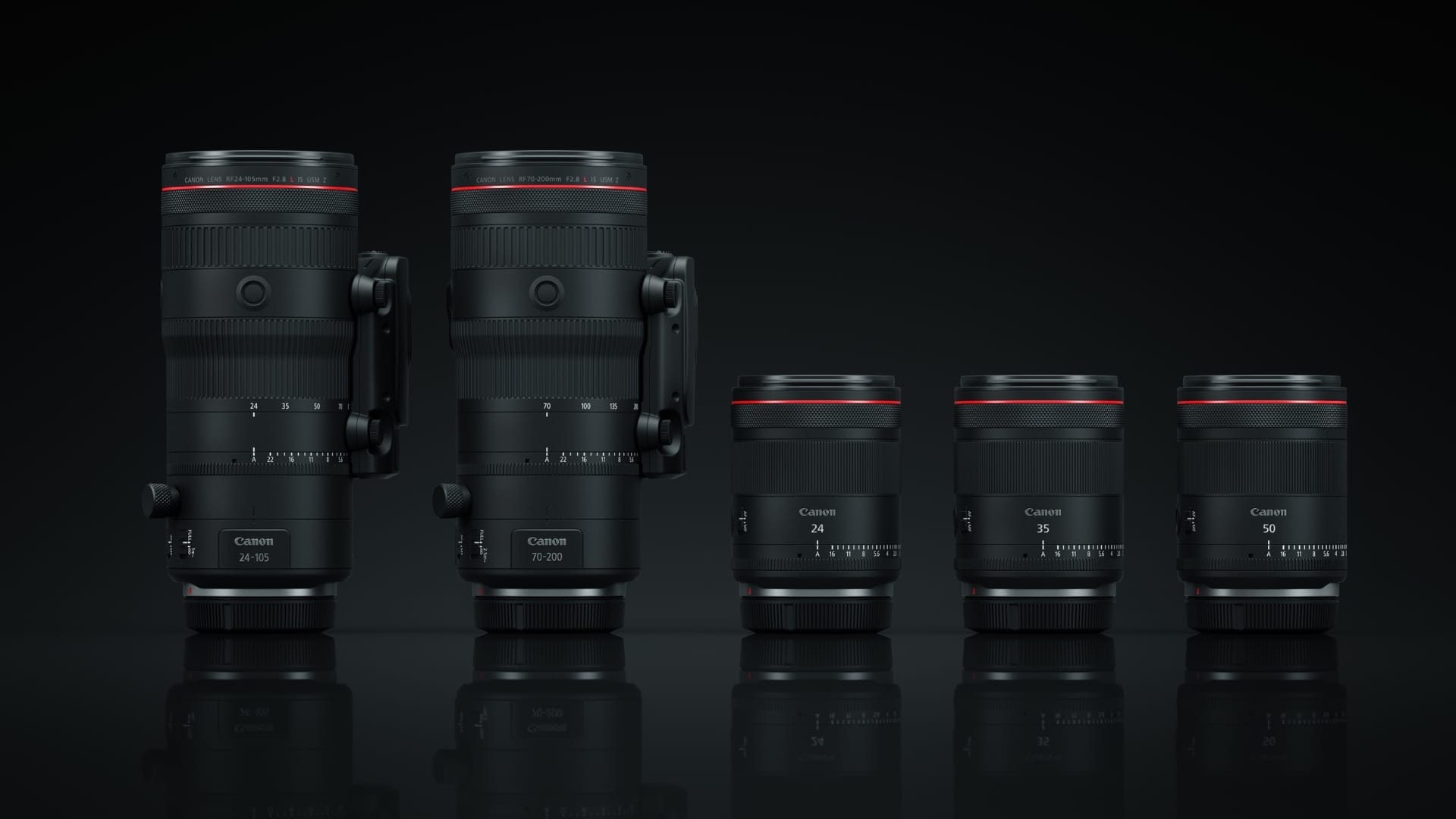
Canon has expanded its RF lens lineup with three new additions: the RF70-200mm f/2.8L IS USM Z, RF50mm f/1.4L VCM, and RF24mm f/1.4L VCM. These lenses combine popular focal lengths with video-centric features, designed for versatility and aimed at hybrid shooters and videographers. Canon’s new offerings demonstrate their commitment to supporting the evolving needs of the EOS R System.
“These new lenses demonstrate our commitment to continuously refine the EOS R System and RF Lens ecosystem. Built with the modern creative’s shooting requirements in mind, we are confident that these new hybrid lenses will stand up to the most challenging shooting needs,” said David Yeo, Senior Marketing Manager of Consumer Business at Canon Singapore.
Advanced features for seamless video and photography
The RF70-200mm f/2.8L IS USM Z is Canon’s second professional hybrid zoom lens, following the RF24-105mm f/2.8L IS USM Z. This lens is engineered for both photo and video use, with advanced motor-powered zoom control via the optional Power Zoom Adapter PZ-E2/PZ-E2B, allowing for smooth, controlled zoom operations. With its extensive 70-200mm range, the lens is ideal for capturing subjects from a distance, such as in sports, news, or event settings.
To further extend its reach, the RF70-200mm f/2.8L IS USM Z is compatible with extenders, achieving focal lengths of 98-280mm at f/4 with the Extender RF 1.4x, or 140-400mm at f/5.6 with the Extender RF 2x. The lens also excels at close-up work, with a minimum focusing distance of 0.68m at 200mm, delivering up to 0.3x magnification. Its Nano USM motors, part of an electronic floating focus system, ensure precise and smooth autofocusing from close to distant subjects.
For video usability, this lens is optimised for stability on gimbals and rigs thanks to its fixed-length barrel and internal focusing. These features maintain a stable centre of gravity, essential for handheld shooting and smooth video transitions. Weighing approximately 25% less than its EF-mount predecessor, the EF70-200mm f/2.8L IS III USM, it’s also more portable. The lens boasts advanced image stabilisation (IS), offering up to 7.5 stops with compatible cameras, enabling sharper images and steadier handheld video in low light. Users can switch seamlessly between three IS modes, making it versatile for various shooting conditions.
The RF70-200mm f/2.8L IS USM Z is available in two finishes: a heat-reflective white ideal for outdoor shoots, and a black option for studio setups where a discreet look is preferred.
Prime lenses offering cinematic quality for video and stills
Canon’s RF50mm f/1.4L VCM and RF24mm f/1.4L VCM lenses are designed as hybrid prime lenses, working seamlessly with the RF35mm f/1.4L VCM. These lenses feature large f/1.4 apertures, enabling photographers and videographers to achieve dramatic, cinematic bokeh that isolates subjects with beautiful shallow focus.
The RF24mm f/1.4L VCM, with its ultra-wide-angle perspective, offers an immersive, exaggerated field of view that brings scenes to life. On the other hand, the RF50mm f/1.4L VCM provides a more natural perspective, giving subjects a lifelike presence and depth. Together with the RF35mm, these three lenses offer varied angles to suit any creative vision.
These prime lenses are designed for convenient use with rigs or gimbals, with a consistent 99.3mm body length, 67mm front filter diameter, and similar weights across the three models. This consistency simplifies lens swapping during shoots. The RF24mm also comes with a rear filter holder, compatible with sheet filters, in addition to the standard screw-in filter. Autofocus is driven by Canon’s VCM (Voice Coil Motor) combined with Nano USM, delivering quiet, rapid, and accurate focusing essential for smooth subject tracking during video recording.
Pricing and availability
The RF70-200mm f/2.8L IS USM Z lens will be available in November 2024, with pricing to be announced soon. Both the RF50mm f/1.4L VCM and RF24mm f/1.4L VCM lenses are set for release in December 2024. Canon’s latest additions to the RF lineup are expected to attract hybrid photographers and videographers seeking versatile, high-quality lenses for both photography and video.