

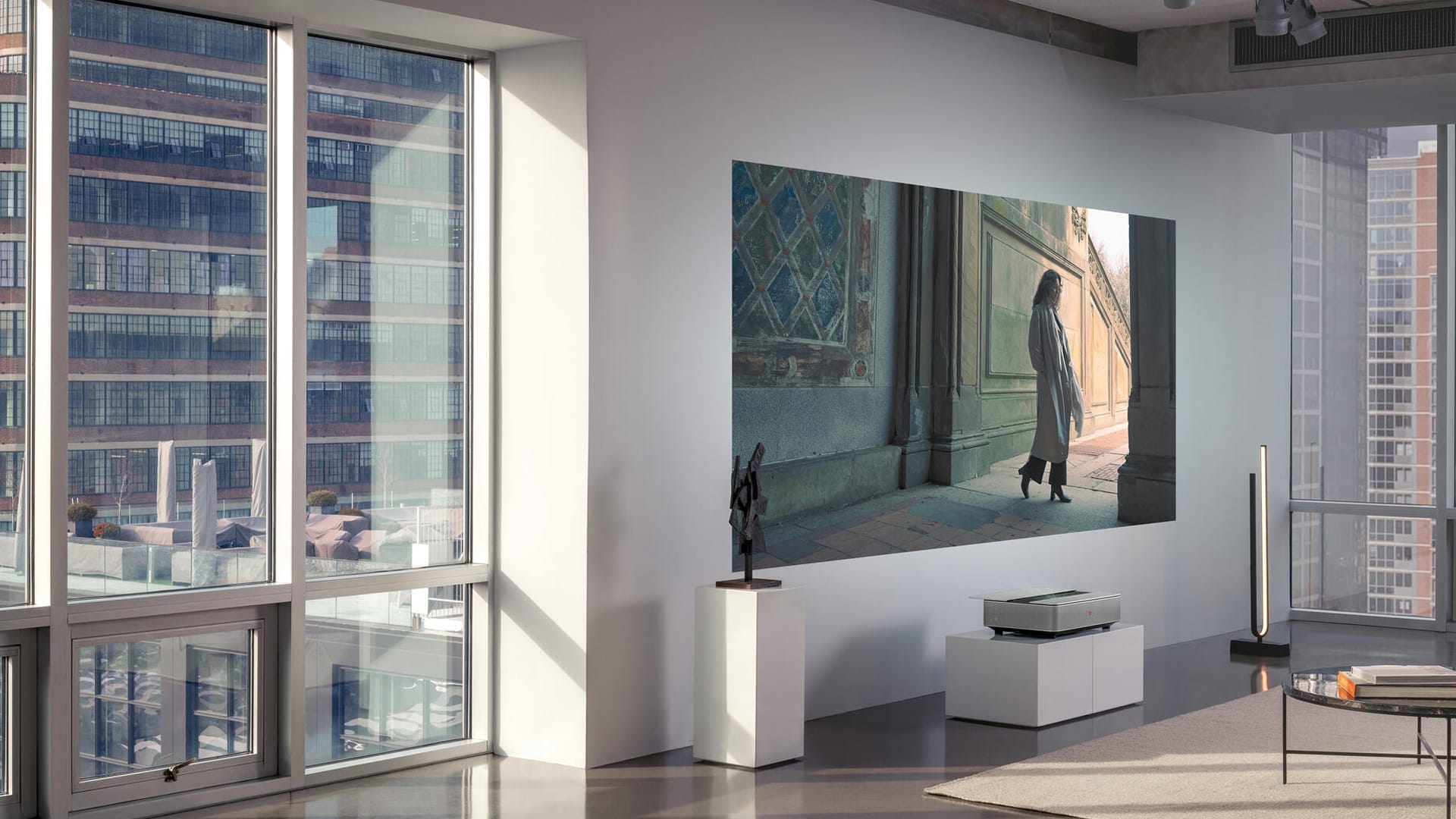
With a history spanning 169 years in the field of cameras and optics, Leica has now stepped into the home entertainment arena with the introduction of the Cine 1. This ultra-short throw projector represents Leica’s maiden foray into this sector.
A fusion of elegance and technology
The Cine 1 is a product of Leica’s collaboration with Hisense, announced in August 2022 and showcased at the IFA Conference in Berlin the following September. Designed as a luxury item, it fits well within Leica’s established reputation for superior quality in optics and imaging. The projector’s design is particularly noteworthy, featuring a robust aluminium body, a sliding dust cover, a front speaker grille, and the distinctive Leica red-dot logo.
State-of-the-art features and optics
The heart of the Cine 1 is its triple-laser RGB Hisense light engine, akin to those found in Hisense’s top-end ultra-short throw projectors. It includes a single-chip DLP system with Texas Instrument’s 0.47-inch micromirror device and XPR four-phase pixel-shifting technology, enabling it to deliver full UHD resolution (3840×2160 pixels). The projector boasts a brightness rating of 3,000 ANSI lumens and a lifespan of 25,000 hours. Its dynamic contrast ratio is a remarkable 2,000,000:1, exceeding the BT.2020 colour gamut, offering an exceptionally broad colour range.
The Cine 1 features Leica’s 0.25:1 Summicron lens, incorporating four aspherical elements for sharp imaging. Leica’s Image Optimisation (LIO) technology has also been applied to enhance natural colours, detailed gradations, and contrast. The Cine 1 supports HDR10, HLG, and Dolby Vision HDR processing for those keen on technology. It also includes a Google TV streaming platform, providing access to 4K content, a Next-Gen TV ATSC off-air tuner and a Dolby Atmos-compatible audio system with two 25-watt speakers.
Availability and pricing
Leica is offering two models of the Cine 1, which differ in the size of the image they project: 100-inch and 120-inch. The 100-inch model is priced at US$9,400 (S$12,790), and the 120-inch model is priced at US$9,950 (S$13,540). These projectors are currently available at the Leica Store at Raffles Hotel Arcade.