


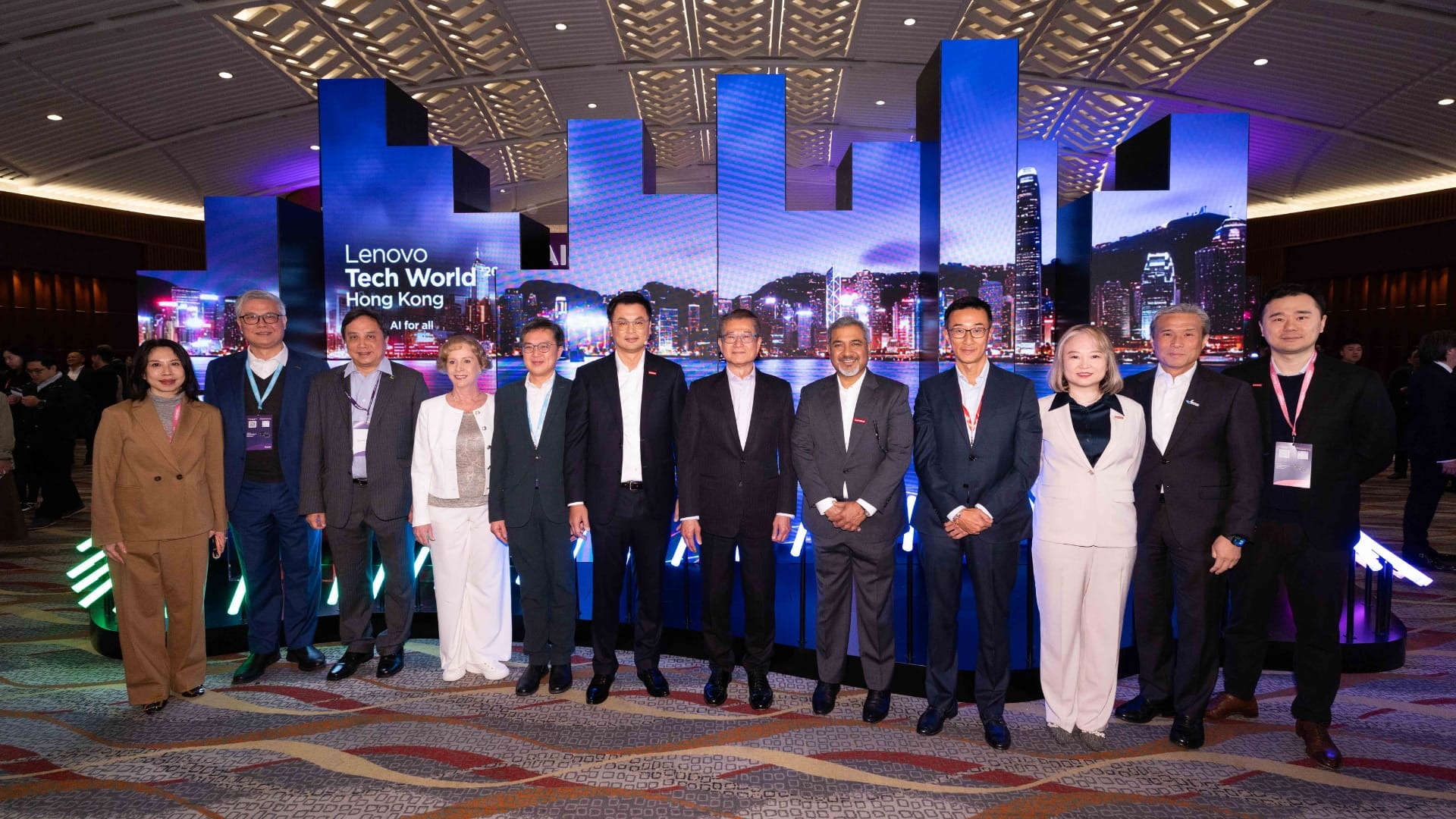
Enterprises are entering a new phase of artificial intelligence deployment where the focus shifts from experimentation to operational systems capable of supporting real business environments. At Tech World ’26 Hong Kong, Lenovo outlined how organisations are beginning to scale AI across industries while addressing governance, infrastructure, and integration challenges.
The event brought together industry leaders and policymakers to discuss the role of AI in economic development and enterprise transformation. Lenovo positioned its Hybrid AI framework as a way for organisations to deploy AI workloads across different environments while maintaining oversight and operational control.
Hong Kong positions AI as a strategic economic driver
Hong Kong is increasingly treating artificial intelligence as both an industry and an enabling technology across sectors. The discussion at Tech World ’26 Hong Kong reflected broader regional efforts to integrate AI into economic and industrial development strategies.
Mr. Paul Chan, Financial Secretary of the Hong Kong Special Administrative Region, said, “Every major economy now recognises the strategic importance of AI. Hong Kong is developing AI as a strategic industry in its own right, and is also harnessing AI as a powerful enabler across the economy. We call this ‘AI+’.”
He added, “Innovation thrives only in an ecosystem where government, academia and industry work closely together. Lenovo’s deep strengths in AI, and its experience in deploying AI solutions across industries, can provide valuable support to Hong Kong’s efforts.”
From pilot projects to operational AI systems
Many organisations have already experimented with artificial intelligence through proof-of-concept projects or small pilots. The next challenge lies in operationalising these systems so they can function reliably within production environments.
“AI is entering a new phase of execution and measurable impact,” said Ken Wong, Executive Vice President and President, Solutions & Services Group, Lenovo. “As Hong Kong accelerates AI adoption across sectors, success will depend on trusted infrastructure, strong governance and ecosystem collaboration. Lenovo’s Hybrid AI approach helps organizations scale AI securely, efficiently and responsibly.”
Lenovo’s showcase builds on AI initiatives previously highlighted at Tech World at CES 2026 in Las Vegas. The company described this transition as part of a broader industry shift from experimentation toward scaled deployment.
Governance and readiness gaps remain across Asia Pacific
Despite rising investment, many organisations are still developing the governance frameworks required to deploy AI at scale. Lenovo’s CIO Playbook 2026, developed with IDC, indicates that readiness and policy implementation remain key barriers.
In Hong Kong, 50% of surveyed organisations expect it will take more than 12 months to achieve AI readiness. Across Asia Pacific, 47% are still developing AI policies that have yet to be implemented, suggesting that governance and operational integration remain central challenges.
Lenovo describes its Hybrid AI framework as an approach to address these gaps. The framework combines personal AI designed to improve workforce productivity, enterprise AI to orchestrate and govern multi agent systems, and public AI designed to support ecosystem and city level collaboration.
Real world deployments across multiple industries
The demonstrations at Tech World ’26 Hong Kong focused on practical applications of AI in operational environments. Lenovo presented examples spanning sports, entertainment, robotics and intelligent mobility.
The company highlighted collaborations with FIFA, the 15th National Games (Hong Kong Region) and DreamWorks, alongside partnerships with robotics company Yunji Technology and autonomous driving company WeRide. These deployments were presented as examples of AI operating in complex, real time environments where multiple systems must interact.
Lenovo stated that applying global experience in partnership with local stakeholders can help organisations accelerate deployment while strengthening governance frameworks. The broader objective is to support enterprises as they move from experimentation toward sustained AI operations at scale.