


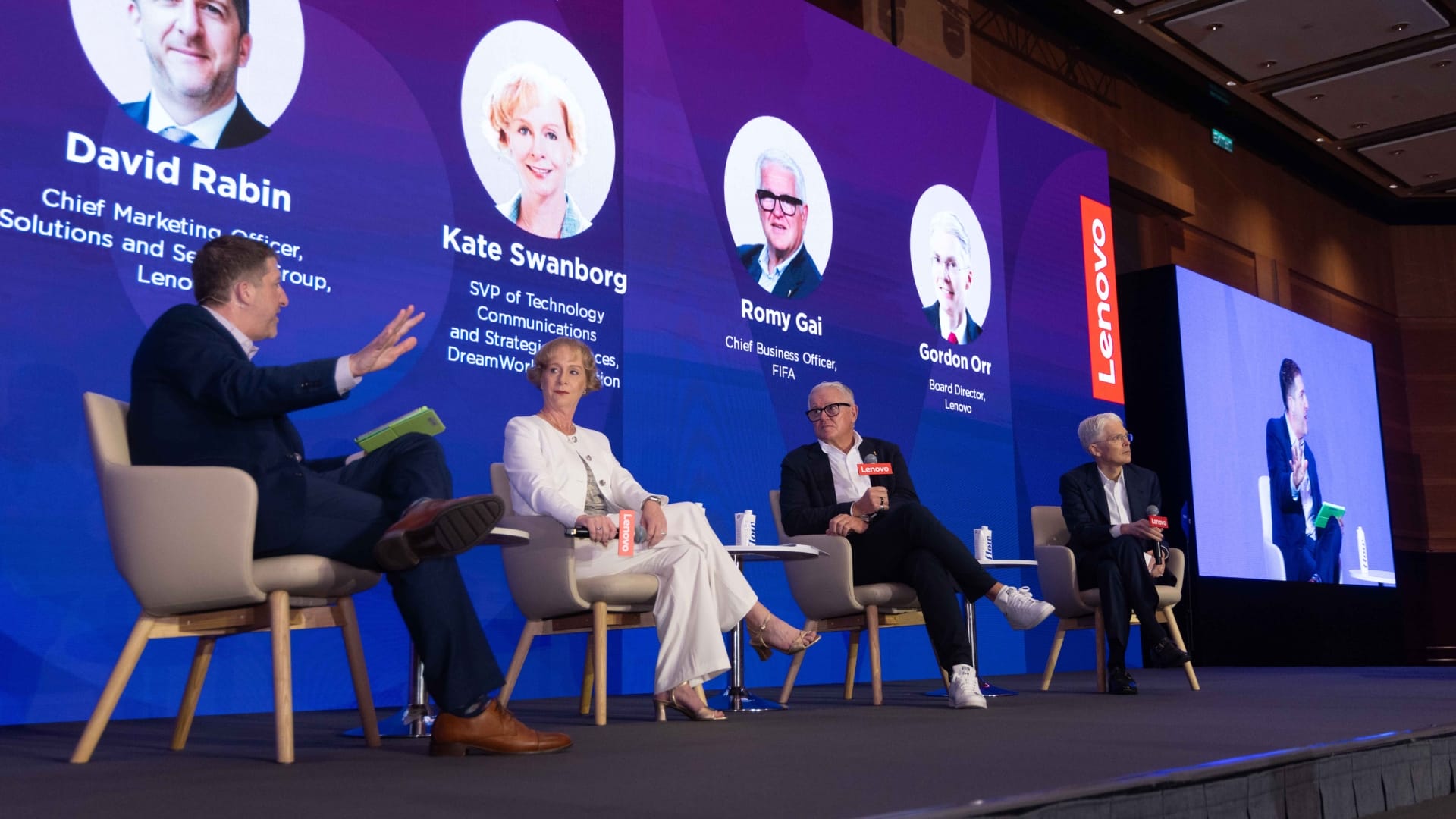
Lenovo’s keynote in Hong Kong framed AI less as a model contest and more as an operational system that has to work across devices, data centres, services and real-world environments. That shift matters because it reflects where the market is heading as enterprise buyers move beyond pilot projects and begin asking which architectures can deliver reliability, governance and measurable outcomes.
Across the technology sector, the early generative AI cycle was dominated by model performance and application demonstrations. Enterprise architecture teams are now confronting a different challenge, integrating AI into operational environments where data governance, infrastructure constraints and regulatory requirements determine how systems can actually be deployed.
The event also placed Hong Kong within that narrative, linking Lenovo’s strategy with the city’s ambitions to position itself as a regional hub for AI deployment. Taken together, the keynote suggested that the next phase of AI competition will be shaped by orchestration, infrastructure discipline and local execution rather than by model performance alone.
Hybrid AI is becoming the enterprise default
Hybrid architectures are increasingly emerging as the practical deployment model for enterprise AI. Large organisations rarely operate purely in public cloud environments, and most must balance regulatory constraints, legacy infrastructure and latency requirements when deciding where AI workloads should run.
Lenovo’s central argument was that hybrid AI should be the operational architecture for enterprise deployment. Enterprises want the flexibility to decide which models they use, where workloads run and how sensitive data is governed, rather than committing to a single cloud or model stack.
That argument also reflects the limits of the earlier generative AI cycle. Many organisations spent the past two years experimenting with copilots and chat interfaces, but those efforts often remained disconnected from operational systems and enterprise data governance frameworks. As a result, the next wave of enterprise spending is likely to favour vendors that can integrate inference, security, orchestration and lifecycle services into a deployable platform.
Ken Wong, Executive Vice President of Lenovo and President of the Lenovo Solutions and Services Group, summarised that shift during the keynote when he said, “the next era of AI leadership will not be defined by who builds the biggest model. It is actually by who makes AI operational, trusted, and scalable.”
His remark reflects a broader industry transition from fascination with frontier models to the more difficult task of enterprise implementation.
The new AI battleground is orchestration
A second signal emerging from the event was the growing importance of orchestration. Across the industry, enterprises are increasingly experimenting with multiple models, specialised agents and domain-specific tools that must work together within a governed architecture.
Lenovo repeatedly emphasised that enterprise AI will involve multiple models and agents collaborating across systems. That aligns with a wider industry shift away from monolithic AI applications toward layered architectures that route tasks and data across different services.
Most large organisations do not lack AI models. Their challenge lies in fragmented data estates, duplicated tools and governance gaps that make it difficult to move from experimentation to production.
In that environment, vendor advantage is likely to depend less on model capability and more on the ability to connect knowledge, workflows and infrastructure without introducing operational risk.
Lenovo describes these capabilities using terms such as Lenovo Hybrid AI Factory, Lenovo AI Library and “Super Agents”, which form part of its Hybrid AI Advantage architecture. The terminology reflects a broader enterprise need for reusable deployment frameworks and orchestration layers that allow multiple models and agents to operate within a governed AI system.
That shift also changes the role of enterprise technology leaders. As AI budgets spread across operations, marketing, manufacturing and customer functions, CIOs must coordinate governance, security and organisational change across multiple departments rather than treating AI purely as an IT deployment.
Real-time AI is pushing infrastructure back to the centre
The keynote also highlighted a broader shift across the AI industry. As generative AI moves closer to operational deployment, infrastructure considerations are returning to the centre of enterprise technology strategy.
Early public attention focused heavily on models and applications. In practice, organisations deploying AI in environments such as autonomous driving systems, industrial inspection, or large-scale event operations must contend with constraints such as data movement, latency requirements and energy consumption.
Those factors are increasingly shaping procurement decisions. Enterprises deploying real-time AI cannot rely solely on generic cloud infrastructure. They must align compute resources with where data is generated, how quickly decisions must be made and which regulatory frameworks govern that data.
Hybrid environments that combine cloud, private infrastructure and edge systems, therefore, become a practical necessity. Lenovo’s emphasis on liquid cooling, edge infrastructure and lifecycle services partly reflected product positioning, but it also signalled a wider shift in enterprise buying behaviour.
AI is gradually moving from a software-led conversation toward a systems conversation in which power efficiency, deployment speed and operational support become strategic considerations. This dynamic is particularly relevant in Asia, where manufacturers, logistics operators and public agencies often operate across fragmented infrastructure environments and regulatory regimes.
Physical AI is emerging as the next proving ground
Another clear message from the event was the growing emphasis on physical AI systems. The keynote linked Lenovo’s AI strategy to autonomous vehicles, robotic inspection and sensor-driven environments where AI interacts directly with the physical world.
These deployments introduce a much higher operational standard. A conversational AI system that produces an imperfect response may cause inconvenience. A robot inspecting electrical infrastructure or an autonomous vehicle navigating city streets introduces safety and reliability requirements that are far more demanding.
As a result, real-world deployments are becoming an important benchmark for enterprise AI maturity. Organisations will increasingly judge AI systems by their ability to support mission-critical workflows with consistent reliability and measurable efficiency gains.
The sectors highlighted during the event suggest where that validation is likely to occur first. Utilities, manufacturing, transport and urban infrastructure are emerging as early proving grounds for operational AI systems.
Asia may play a particularly significant role in that transition. Dense urban environments, large-scale manufacturing ecosystems and government-backed digital infrastructure programmes create conditions in which physical AI can move from pilot projects to scaled deployment relatively quickly.
Hong Kong is positioning AI as industrial policy
Beyond the product announcements, the keynote also highlighted a broader policy dimension through its framing of AI+. The stage became a platform for a wider message that AI is increasingly being treated as both a strategic industry and an enabling technology across the wider economy.
This reflects a broader shift across Asia. Governments are moving beyond startup rhetoric and investment announcements toward policies that focus on deployment capacity, governance frameworks and talent development.
Mr. Paul Chan, Financial Secretary of the Hong Kong Special Administrative Region Government, highlighted that approach when he said, “We are developing AI as a strategic industry in its own right, and we are also harnessing AI as a powerful enabler across the economy.”
The strategy positions AI both as a sector in its own right and as infrastructure supporting industries such as finance, logistics, healthcare and manufacturing. For Lenovo, that alignment is commercially significant because it connects its hybrid AI narrative with government priorities around healthcare technology, robotics and digital infrastructure. For Hong Kong, the strategy suggests that future competitiveness may depend less on producing headline AI champions and more on becoming a credible testbed for the governed deployment of AI.
Mega-events as enterprise AI showrooms
Lenovo’s references to Formula One, FIFA and the National Games illustrate how large-scale events are increasingly used to demonstrate the operational value of AI infrastructure.
Mega-events compress logistics coordination, broadcasting workflows, security monitoring, and edge computing into environments with extremely low failure tolerance. That makes them effective demonstration platforms for technologies designed to operate under pressure.
If a vendor can support such environments with minimal disruption, it strengthens the case for enterprise adoption in similarly complex operational settings. The broader message emerging from the Hong Kong keynote was that AI competition is gradually shifting away from research performance and toward operational credibility.
The next phase of the AI market may therefore be defined less by who builds the most powerful models and more by who can design, deploy, and sustain AI systems across infrastructure, operations, and real-world environments.